How can Jev, who can't write a single character, become the hottest model after ChatGPT?
 Core Viewpoint

 TypeSafe AI's Jev is a semantic decision model without text generation capabilities, specifically designed for high-frequency deterministic judgments, outputting strongly typed options and confidence probabilities, with a speed approximately 200 times faster and a cost approximately 400 times lower.
Recently, Jev has become incredibly popular. It is a brand new model that cannot chat or write code but can reduce the decision-making costs of many AI applications by 400 times.
However, many people are still confused about Jev.
I have researched it in detail and hope this article can help you fully understand Jev. Today, Jev is available for everyone to use, so you can try it out.
If you don't want to read the text version, I made a 5-minute explanatory video using GLM-5.3 flash, which is quite effective; you can just watch the video.
Without further ado, let's get started.
Jev has no text generation capabilities.
Since its release, the level of discussion it has sparked is almost the highest since ChatGPT.
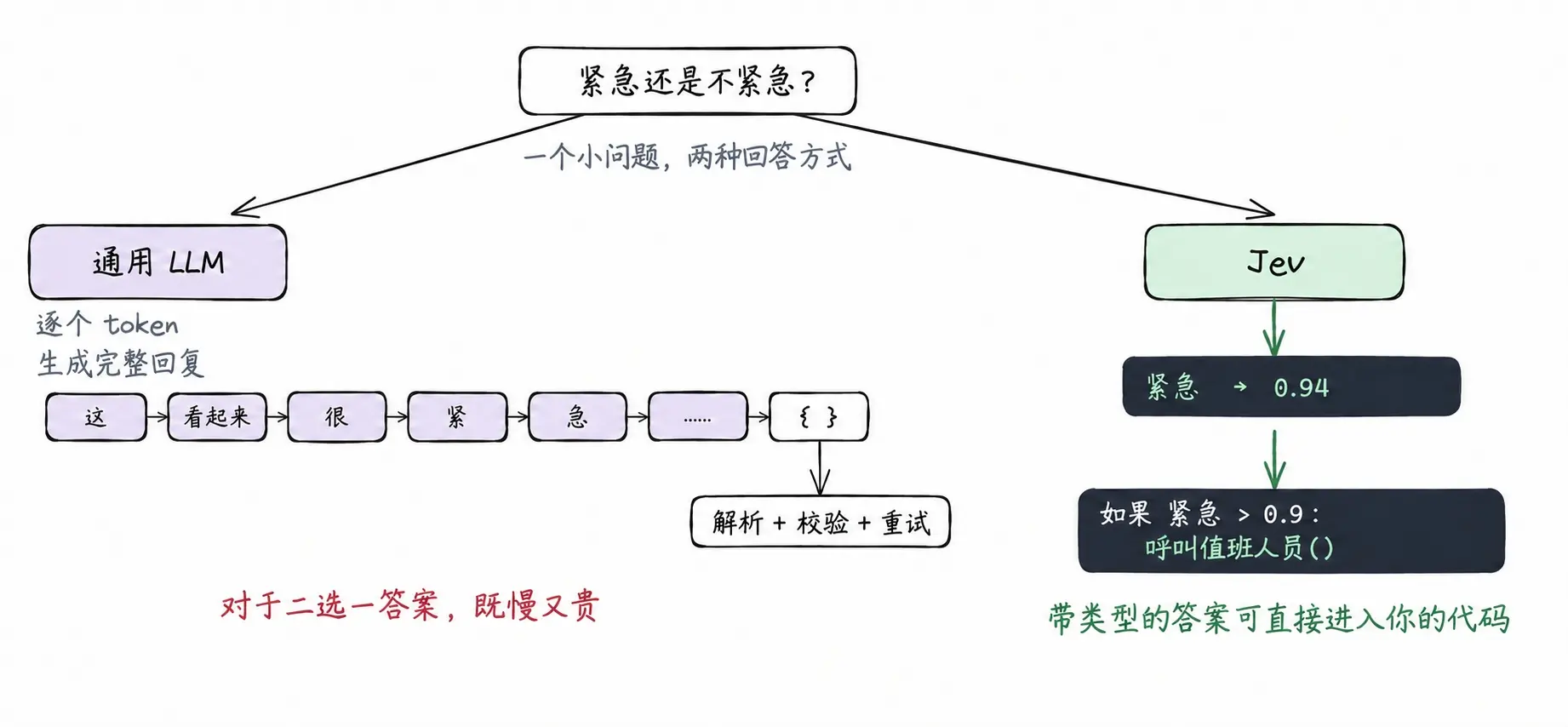
In the past two years, everyone has gotten used to throwing all requests at general large models.
But in real business, the software systems face a large number of requests every day that do not require writing lengthy articles.
What the system really needs is often just a series of very small deterministic judgments:
Is this work order urgent?
Which downstream model should this instruction be dispatched to?
Is there a risk of data deletion in the terminal command entered by the user?
Can this piece of knowledge just retrieved answer the user's question?
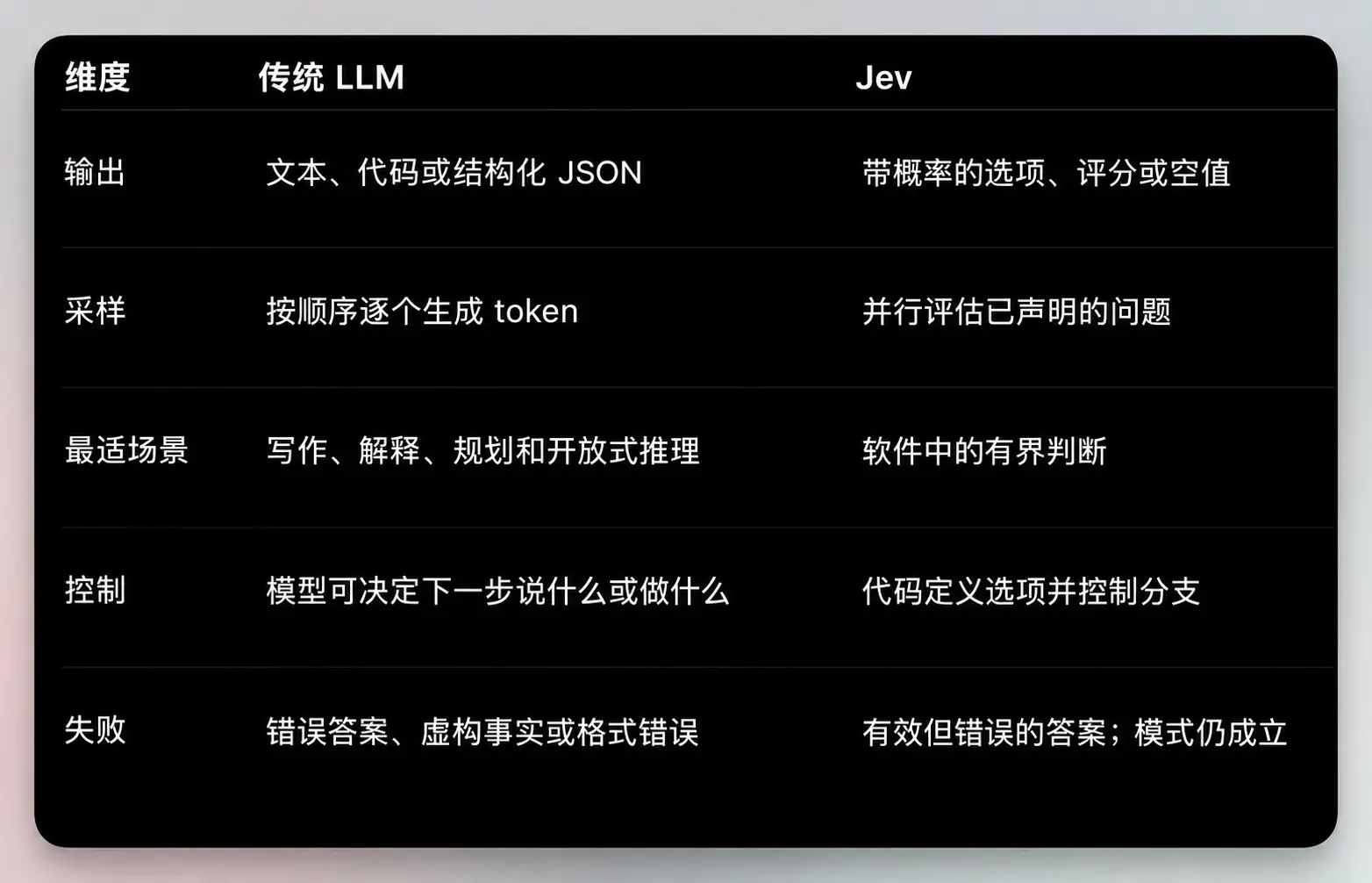
Previously, to make these judgments, developers had to make the large model generate answers word by word, then parse the JSON with code, and if there was a format error, they had to retry.
This was not only slow but also expensive.
TypeSafe AI's Jev is specifically designed to address these decision-making needs.
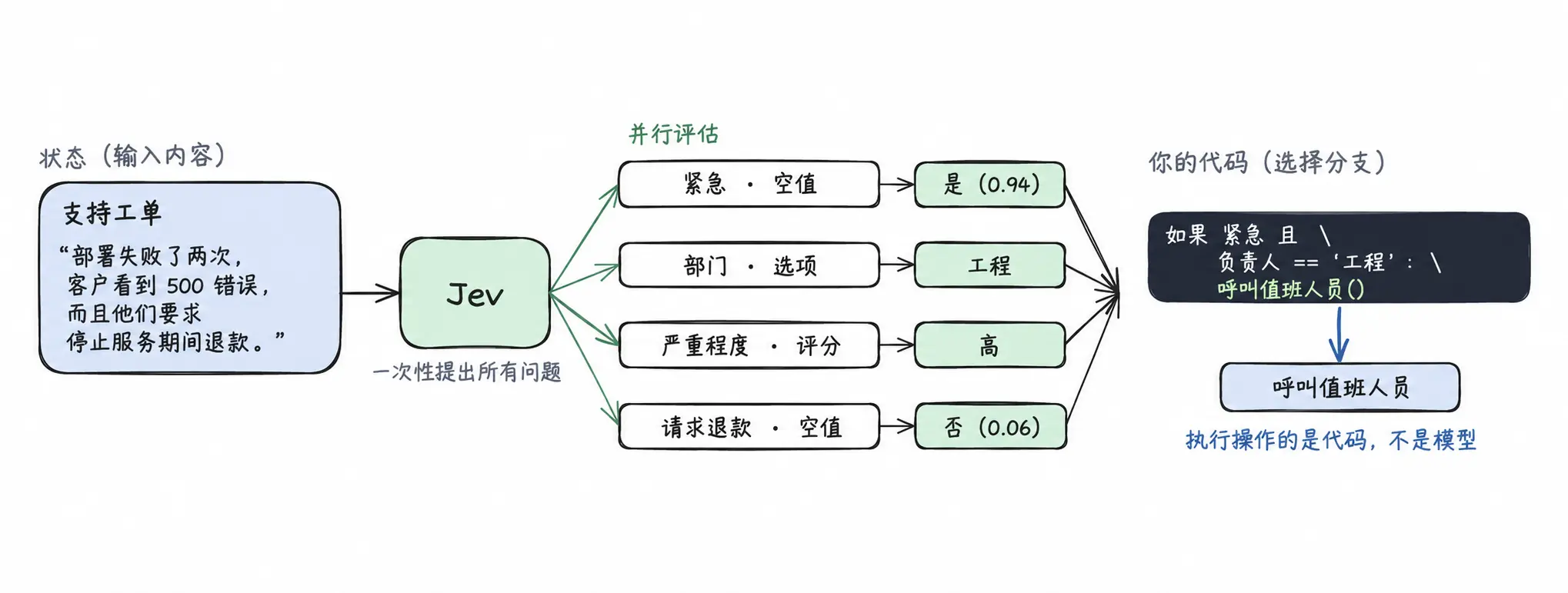
They refer to Jev as the "System One model": input a piece of unstructured data, and it directly outputs strongly typed options and precise confidence probabilities.
Why are traditional large models too heavy for making judgments?
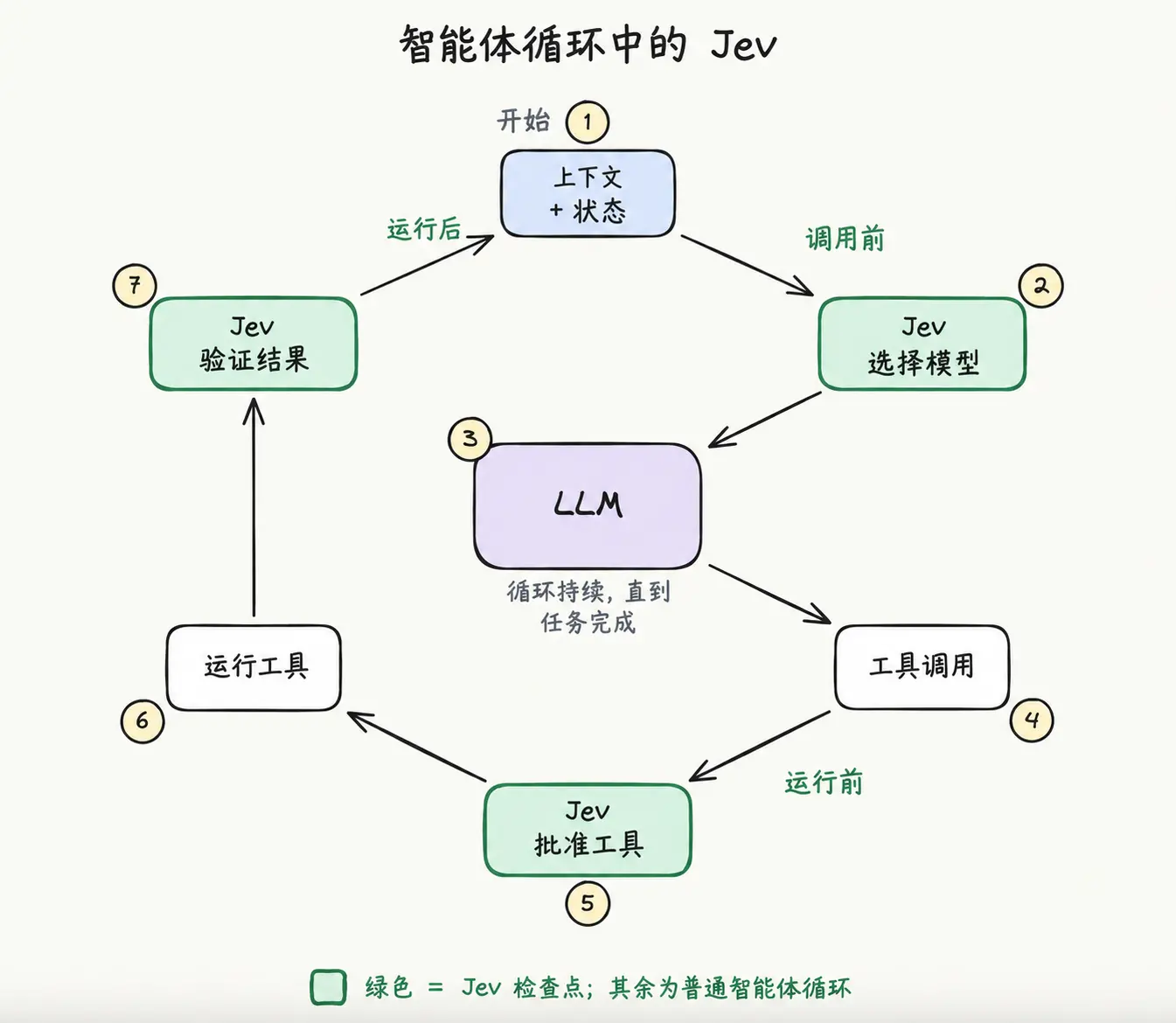
In a typical agent loop, the system must make decisions at every step:
python
while not done:
    action = llm(context)
    result = run_tool(action)
    context += result
In this loop, the model has to select tools, check execution results, assess risks, and determine if the task is complete.
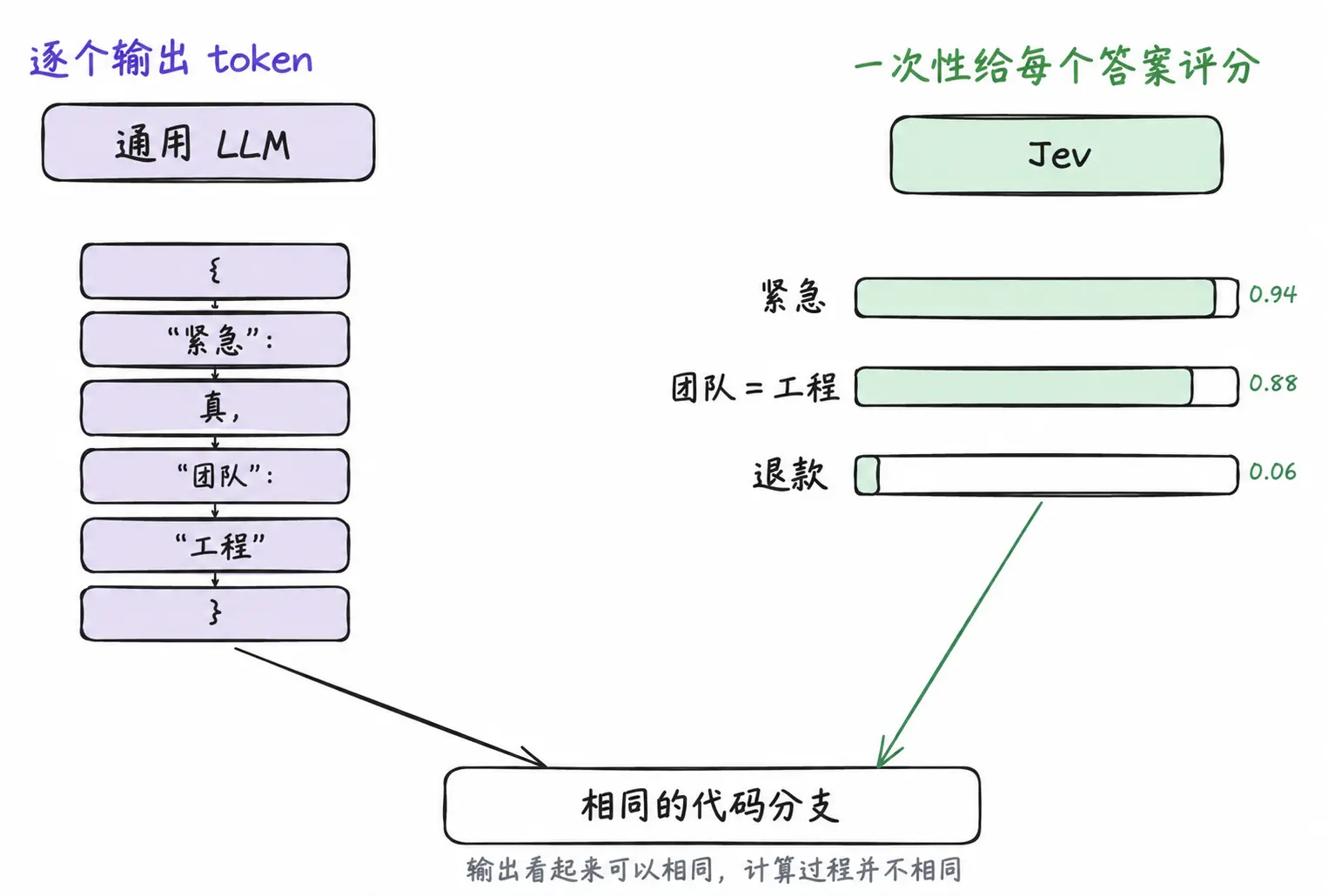
Even if the final decision is just a single word, like "finance," traditional generative models still output one token at a time.
You have to pay for the input and also for the generation wait time.
The core logic of Jev is very straightforward:
When the code already knows all possible answers, using word-by-word text generation is a huge waste of resources.
How does Jev actually work?
The essence of Jev is a semantic decision engine.
When calling Jev, you only need to provide it with two things:
State: Text or JSON describing the current situation.
Questions: The decisions you want it to make based on this state.
Each question must have a fixed output type before submission. Jev natively supports three basic data types:
Choice: Select one option from your defined list and return the probability distribution of all options.
Score: Map the input to your defined ordered levels, such as low, medium, high.
Noul: Boolean judgment, returning the probability value of the proposition being true (a decimal between 0 and 1).
A typical request looks like this:
json
{
  "model": "jev-latest",
  "state": "Deployment failed twice, and the user side is starting to see a large number of 500 errors.",
  "questions": {
    "urgent": {
      "type": "noul",
      "instructions": "Does this issue need to be addressed immediately?"
    },
    "owner": {
      "type": "choice",
      "instructions": "Which team should this issue be assigned to?",
      "criteria": {
        "engineering": "Product faults and service outages",
        "billing": "Billing, invoices, and refund issues",
        "sales": "Pricing inquiries and new customer onboarding"
      }
    }
  }
}
Jev does not return an explanation but a definite probability value and a team probability distribution.
There is no unnecessary chatter, and it will not fabricate a nonexistent fourth team.
Business logic directly takes over control:
python
if urgent > 0.9 and owner == "engineering":
    page_on_call()
elif confidence < 0.6:
    send_to_human_review()
else:
    add_to_queue(owner)
Many engineers describe it as a "switch statement with semantic understanding capabilities."
Business branches remain firmly in the hands of traditional code, while Jev is only responsible for providing semantic judgments that cannot be calculated by the code itself.
Core Metrics: 200 Times Faster, 400 Times Cheaper
Jev supports parallel evaluation of all questions in a single request.
This means you do not have to ask questions serially; you can send all independent judgments for the same content at once.
The official published test data:
End-to-end latency: 70 to 500 milliseconds.
Price: only $0.042 per million input tokens, with output tokens completely free.
In the multiple workflow comparisons provided by the official, its overall execution speed is about 200 times that of traditional large model workflows, and the overall cost is reduced by nearly 400 times.
Even in complex business environments, considering these data as theoretical limits, the efficiency improvements it brings are still on a magnitude scale.
Probability and Confidence, the Key Design
Providing only a classification label is often not safe enough.
Suppose Jev determines that a work order belongs to the "billing team," and the returned result is as follows:
json
{
  "choice": "billing",
  "probabilities": {
    "billing": 0.52,
    "technical": 0.46,
    "sales": 0.02
  },
  "confidence": 0.18
}
Billing received the highest votes, but technical support got a 46% probability, and the overall confidence is only 0.18.
If the system automatically assigns it, it is very likely to make mistakes.
With this layer of probability distribution, developers can clearly delineate in the code:
High confidence: Automatically execute low-risk logic.
Medium confidence: Call a stronger large model for verification or require user confirmation.
Low confidence: Directly move to the manual review queue.
Jev uses a "Reinforcement Learning with Calibrated Decisions (RLCD)" training method. When the model gives a 90% probability judgment, its actual accuracy can also converge highly around 90%.
Must Clarify Facts: Does Jev Really Not Hallucinate?
The official promotion mentions that "Jev does not produce hallucinations." This statement has very strict prerequisites.
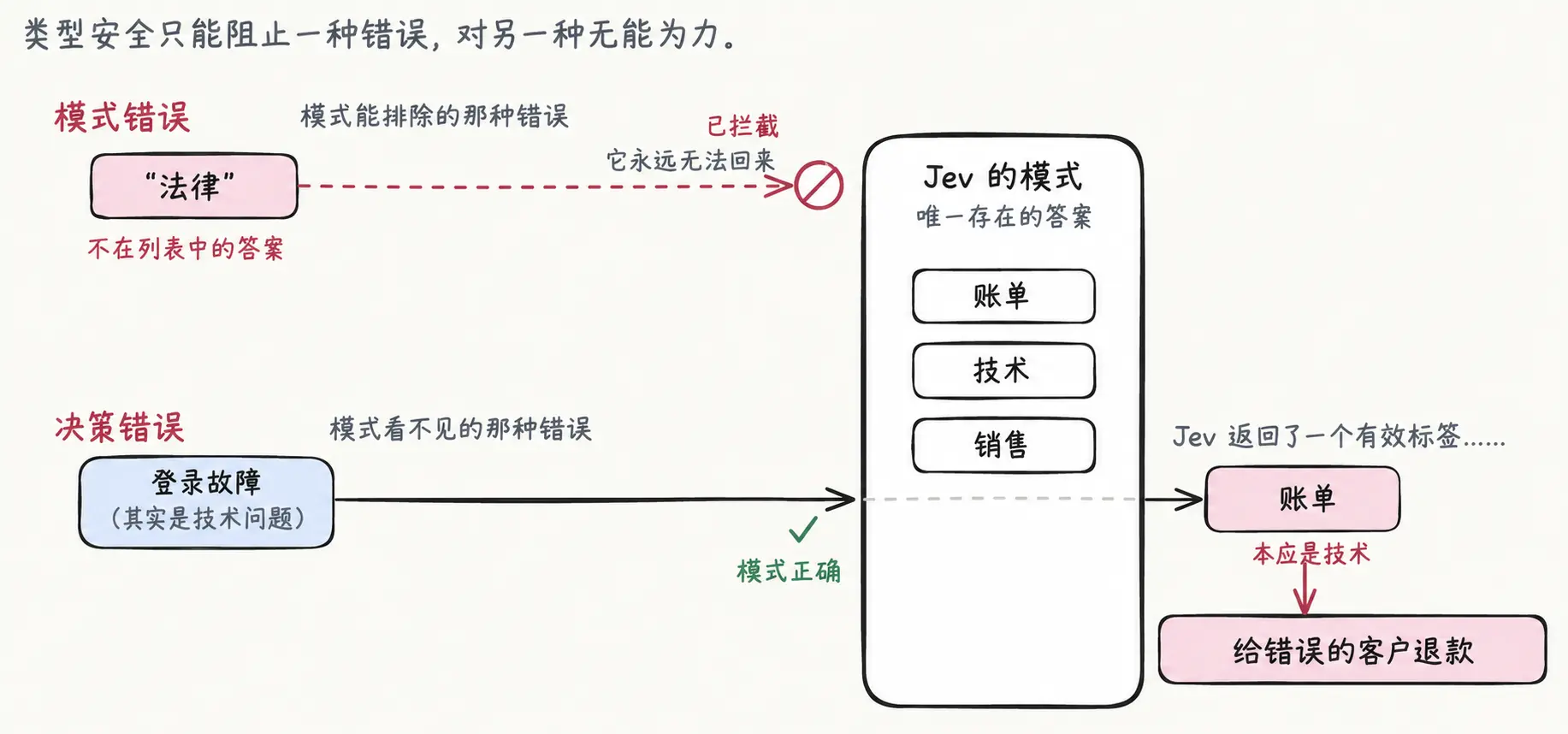
Jev will never return content outside the schema format you provide. If you define options A, B, and C, it will absolutely not return D, nor will it output garbled JSON.
But this does not mean its judgments are always correct.
Type safety guarantees that the output structure does not crash but does not guarantee that business judgments will not be wrong.
An incorrect judgment that conforms to the type definition can still mistakenly issue refunds or incorrectly distribute faulty work orders.
The accurate understanding should be: Jev guarantees that it will not break the code contract, but it still has a probability of choosing the wrong option.
What Position is Jev Best Suited for in a System?
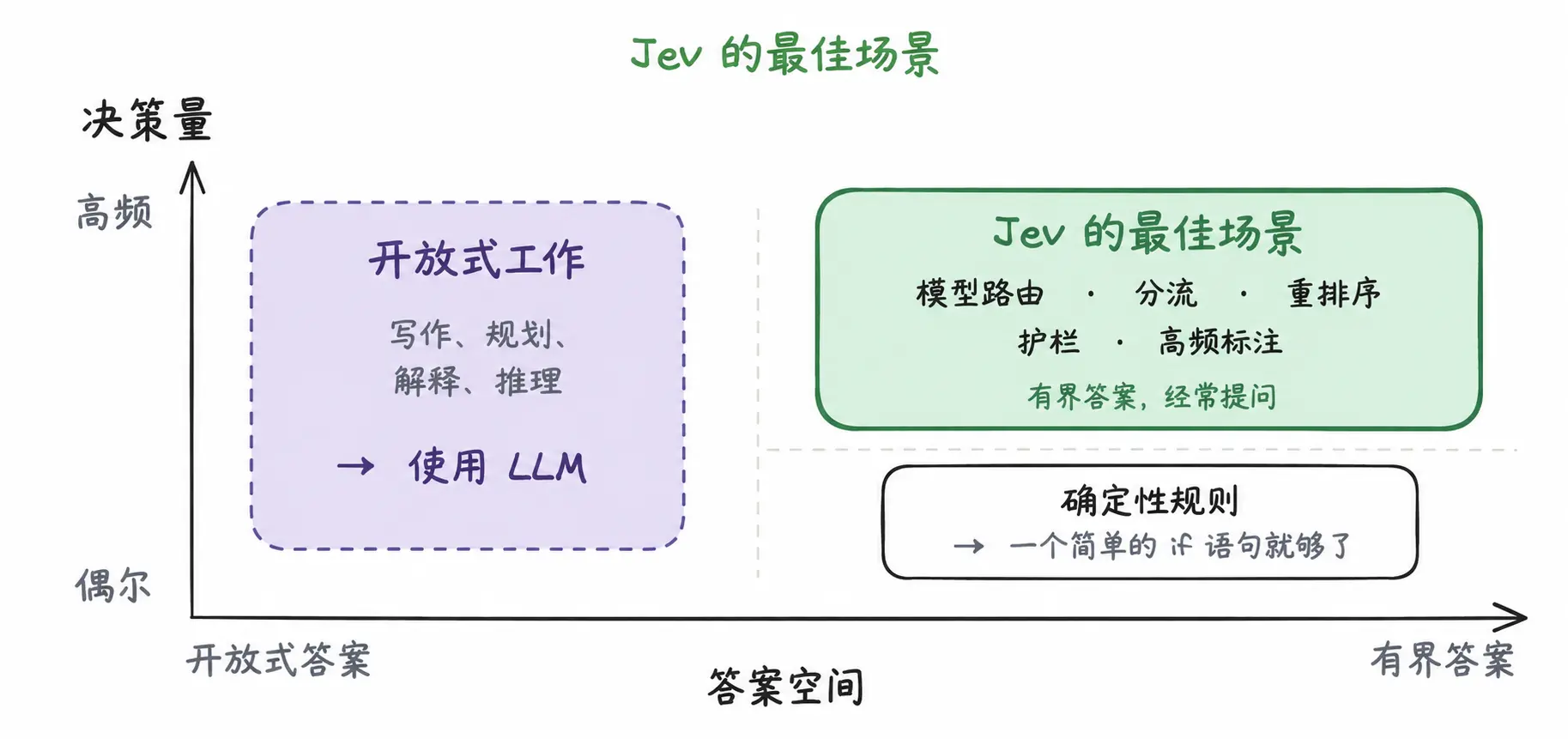
Jev's positioning is very clear: it is designed to work alongside large models, not to replace them.
Large models are responsible for writing code, creating plans, and performing long text reasoning and communication.
Jev is responsible for surrounding it, performing high-frequency, rapid boundary control.
Currently, there are three mature application scenarios:
Model Routing
When facing user requests, Jev first assesses the task difficulty. Simple retrieval and rewriting are directly assigned to inexpensive small models, while high-difficulty architectural designs are routed to expensive inference models.
Tool Execution Risk Control
Before the agent calls terminal commands, Jev assesses whether the command is read-only, reversible, or destructive. Destructive operations are automatically paused, awaiting manual authorization.
Result Verification and Supervision
Before the task ends, Jev quickly checks: Did the test cases pass? Did the agent get stuck in a loop of repeated calls? Does the output violate preset rules?
When Should You Absolutely Not Use Jev?
Do not force its introduction in any place where it is not needed:
When the answer space is uncertain: If you need to write articles, summarize, or generate code, you must use traditional large models.
Deterministic logical operations: For mathematical calculations, character counting, date comparisons, implement directly with pure code; pure code is always cheaper, faster, and more reliable than models.
When complex long-chain reasoning is required: Multi-step logical deductions should be handled by reasoning models with chain-of-thought capabilities, or break down large problems into multiple discrete smaller problems and then hand them over to Jev.
How to Get Started?
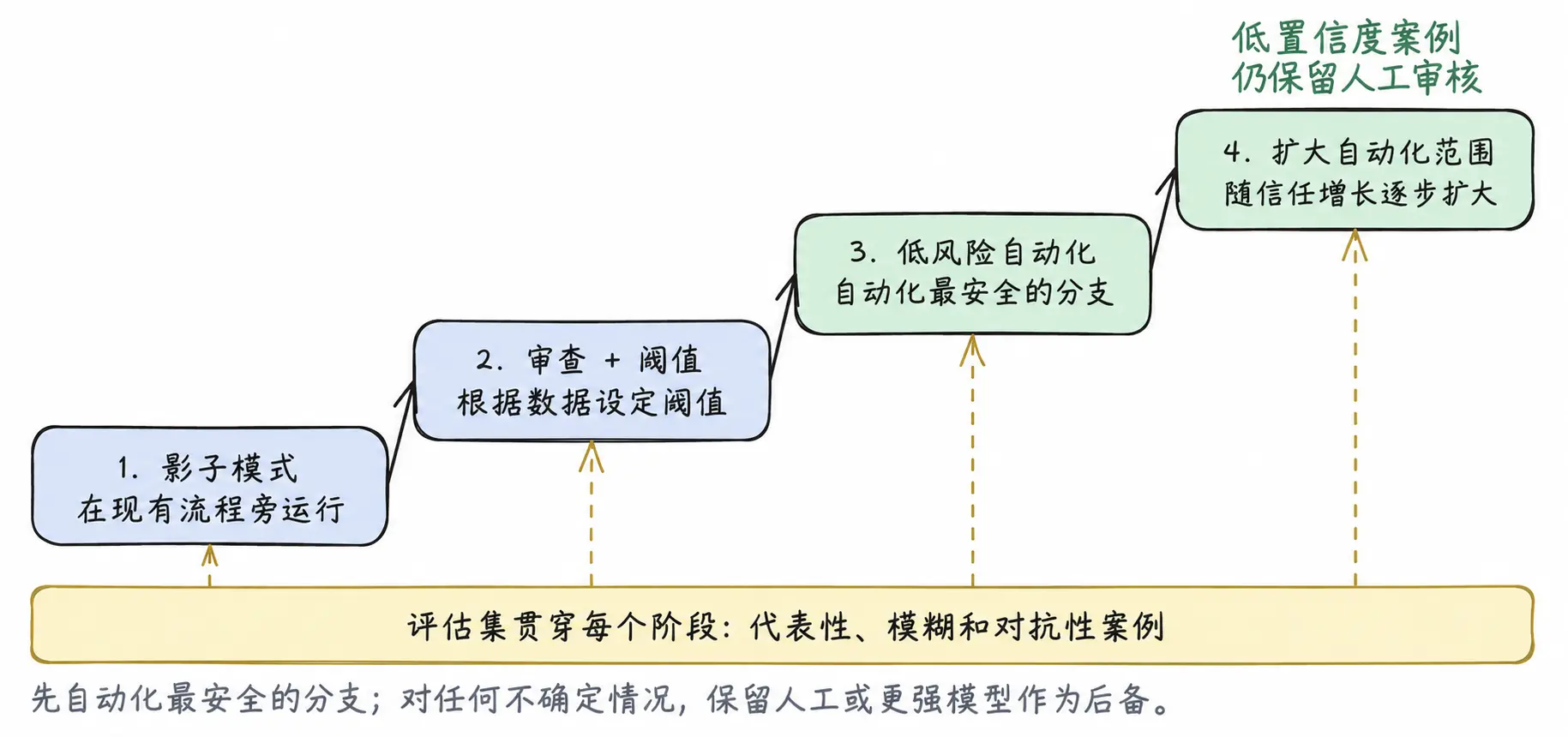
Do not start by restructuring core business processes.
The most reliable way to integrate is:
Choose a regular expression rule that currently has the highest maintenance cost and is prone to errors, or a node that calls a large model just to obtain a yes/no judgment.
Clearly define all possible option definitions for this node.
Enable Shadow mode, allowing Jev and existing logic to run in parallel, collect data, and calibrate confidence thresholds.
Once the accuracy rate meets the standards, formally switch the traffic.
Currently, TypeSafe has completely opened access, no waiting list required. Registration grants a $5 credit, equivalent to directly testing about 120 million tokens of input.
The entire industry has become accustomed to solving all problems with text generation over the past few years.
However, in many engineering systems, what code often needs is not more elegant text, but an accurate judgment with millisecond-level response, format preservation, and extremely low cost.
This is also the fundamental reason why Jev can quickly ignite the developer community.
 Risk warning




Popular articles