Moscow suffers the "largest-scale attack," Ukraine "hits important Russian oil industry facilities," and the global "refinery crisis" intensifies
 Core Viewpoint

 Ukrainian drones launched the largest airstrike on Moscow, causing one of Russia's largest oil refining companies to come to a standstill. The global diesel market responded urgently—U.S. crack spreads soared to a historic peak of $117 per barrel, with retail prices surpassing $6.45 per gallon. Meanwhile, the U.S. Congress is fiercely debating an export ban, and analysts warn that this move will not only fail to save domestic oil prices but will also trigger a rupture in the global energy chain.
The impact of geopolitical conflicts on global energy infrastructure is intensifying. Ukraine's significant drone strikes on Russia's Moscow refinery are pushing the already strained global refined oil market to the brink of a new crisis.
According to CCTV News, on September 20 local time, the General Staff of the Armed Forces of Ukraine reported that the Ukrainian military struck the Moscow refinery in the Moscow region early that morning. The Ukrainian side stated that a large-scale fire broke out in the refinery area, and the AVT-6 primary refining unit and integrated crude oil processing unit were hit. The Ukrainian military claimed that the Moscow refinery is one of Russia's largest refining enterprises, with an annual crude oil processing capacity of about 12 million tons, producing petroleum products such as gasoline, diesel, aviation fuel, and heavy oil. The Ukrainian side stated that the refinery is involved in supporting the needs of the Russian armed forces.
This incident quickly triggered deep concerns in the market about the supply of key fuels for global industry and transportation—diesel. As the wars in Eastern Europe and the Middle East simultaneously restrict the export capacity of key oil-producing regions globally, global diesel futures and refining margins have surged to historic highs, with U.S. diesel retail prices also breaking historical records.
Against the backdrop of a sharp decline in supply, the United States, currently the key "last supplier" globally, is facing immense domestic political pressure. Calls in Washington to restrict or even ban diesel exports are rising, with analysts warning that such moves could further disrupt the global energy supply chain and trigger broader economic shocks.
Record Airstrikes Devastate Russian Energy Hub
According to reports from CCTV News and other media, the attack on September 20 was the "largest-scale attack" Moscow has faced. Moscow Mayor Sobyanin stated that over 1,600 drones have been shot down since the 19th, with 450 of them intercepted as they approached Moscow. The Moscow refinery suffered severe damage in this attack.
Additionally, according to reports from Global Times and other media, Ukrainian President Zelensky posted on social media platform X later on the evening of the 20th, commenting on the related attack actions. Zelensky stated in the post that Ukraine's long-range strikes on the Moscow region "had a very significant impact" last night. He claimed that an important oil industrial facility and logistics facility in Russia were hit.
Reports indicate that the refinery is owned by Gazprom Neft and is located about 16 miles from the Kremlin, with a daily crude processing capacity of approximately 245,000 barrels (annual processing capacity of about 12 million tons). The General Staff of the Armed Forces of Ukraine reported that the AVT-6 primary refining unit and integrated crude oil processing unit at the plant were struck. This facility primarily produces gasoline, diesel, and aviation fuel, supplying not only the metropolitan area around Moscow but also directly supporting the needs of the Russian armed forces.
In response, Russia launched a new round of airstrikes on multiple locations in Ukraine. According to the Ukrainian State Emergency Service and Air Force, the Russian military launched 138 drones, attacking industrial and railway facilities in Kyiv Oblast, Vinnytsia Oblast, and Odesa Oblast, with the attacks in Kyiv Oblast currently resulting in 4 deaths.
Global Diesel Market in Crisis, Prices Reach Historic Highs
The attack on Moscow comes at a time when global diesel supply is extremely fragile. Bloomberg data shows that as supply from the Gulf region and Russia is severely disrupted, global diesel futures and refining margins surged to historic highs last week. The U.S. heating oil crack spread, which measures the difference between fuel and crude oil prices, soared to $117 per barrel, marking the highest level recorded by Bloomberg since it began tracking this data in 2009.
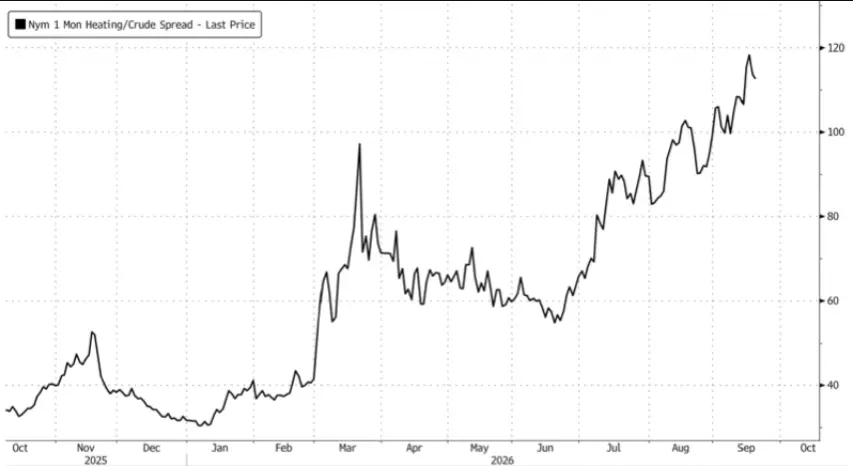
Wall Street Journal previously mentioned that U.S. diesel retail prices surpassed $6 per gallon for the first time last week and further climbed to $6.45 this Friday, setting a new historical high. Globally, fuel shortages have already appeared at gas stations in rural Brazil, Libya, and some African countries, putting critical fuels that global industry, transportation, and agriculture rely on under severe strain.
Bloomberg senior commodity strategist Mike McGlone warned that the current diesel price shock mirrors the surge in gasoline prices during the 2008 energy crisis. Meanwhile, reports indicate that Russia is considering extending its diesel export ban, exacerbating the already tense supply situation.
Geopolitical Conflicts Disrupt a Decade of Refining Patterns
The current predicament of the global refining system stems from the intense collision between the capacity expansion patterns of the past decade and the current geopolitical conflicts. Over the past decade, the Middle East and Russia have invested heavily in expanding refining capacity. Kuwait, the UAE, Iraq, and Saudi Arabia have built or expanded large refineries, causing the Middle East's diesel export volume to double between 2017 and 2025, surpassing North America to become the world's largest diesel exporter.
However, according to analysis from the International Energy Agency (IEA), these two wars have abruptly reversed this supply pattern. Since February of this year, disruptions in the Strait of Hormuz have forced Kuwait, the UAE, and Iraq to significantly cut exports; at the same time, attacks by Houthi forces have compressed Saudi Arabia's export capacity through the Red Sea. IEA senior oil market analyst David Martin stated, "We are witnessing possibly the most tense diesel market pattern in history."
Moreover, Western countries find it difficult to fill this gap during a crisis. Alan Gelder, senior vice president of refining at consulting firm Wood Mackenzie, pointed out that the massive investments by Middle Eastern countries have long depressed the profit margins of Western refiners, leading to a situation where major Western oil companies have not built new refineries in nearly thirty years, and over ten refineries have closed in Europe and the U.S. since 2015. Currently, while Western refineries are operating at full capacity and leaning towards diesel production, they still cannot effectively fill the supply gap.
U.S. Export Ban Debate Intensifies Market Uncertainty
In the face of soaring domestic oil prices, the debate over export bans within the United States is heating up dramatically. Congressman Tim Burchett introduced a bill for a diesel export ban this week, and Senate Majority Leader John Thune expressed an open attitude towards the proposal. Trump attributed the rise in oil prices to the Russia-Ukraine war rather than the situation in the Middle East. However, IEA data shows that the amount of diesel obstructed in the Gulf is about three times the shortfall from Russia.
Analysts and several think tanks strongly warn that the U.S. export ban will not only fail to resolve domestic issues but will also harm the global market. The American Petroleum Institute pointed out in a letter to then-Energy Secretary Jennifer Granholm in 2022 that restricting exports would drive up domestic oil prices.
Research from the Center for Strategic and International Studies (CSIS), the Dallas Federal Reserve, and Columbia University indicates that U.S. refining capacity is highly concentrated along the Gulf Coast, with its infrastructure designed entirely for export markets. Domestic oil pipelines are currently nearing full capacity, and global tanker capacity is tight. CSIS emphasized in its report that if a ban is implemented, refiners along the Gulf Coast will inevitably cut back significantly on refining activities due to lack of profitability. This will lead to a decrease in domestic gasoline and diesel supply, partially or completely offsetting the initial inventory buildup, ultimately exerting upward pressure on domestic oil prices that the ban intended to suppress, and inevitably triggering further price surges in other regions of the world.
 Risk warning



Popular articles