The first governance vote in Solana's history has ended: Why did SGP-003 spark huge controversy?
 Core Viewpoint
 When a public chain shifts from "pursuing performance" to "supporting the economy," governance is no longer an ancillary mechanism but becomes the very competitiveness itself. Solana's first round of governance may just be the beginning of this game.
Author: Gu Yu
Solana is undergoing a milestone governance experiment.
On August 23, for the first time in its history, Solana officially launched on-chain governance voting, with proposals SGP-0001, SGP-0002, and SGP-0003 entering the voting phase simultaneously. The contents involve the governance framework, SOL inflation mechanism, and transaction fee structure, respectively.
This not only means that Solana is beginning to delegate some major decisions to validators and stakers, but it also signifies that network upgrades, which were previously coordinated mainly by core developers and ecological institutions, are now entering a phase of public competition.
Around 11 PM tonight, the voting for these three governance proposals officially ended. Proposals SGP-0001 and SGP-0002 both reached the minimum voting rate of one-third (the proportion of all effective SOL staked users who voted) and the minimum support rate of two-thirds (the proportion of supportive votes among all votes), and will now officially enter the implementation phase.
However, the proposal SGP-0003, which involves restructuring network fees, did not pass, receiving a support rate of 54.3%, still short of the 66.6% minimum threshold. Notably, the list of opposing votes includes a series of well-known projects such as Jupiter, Forward Industries, Anagram Staking, and Solana Company.
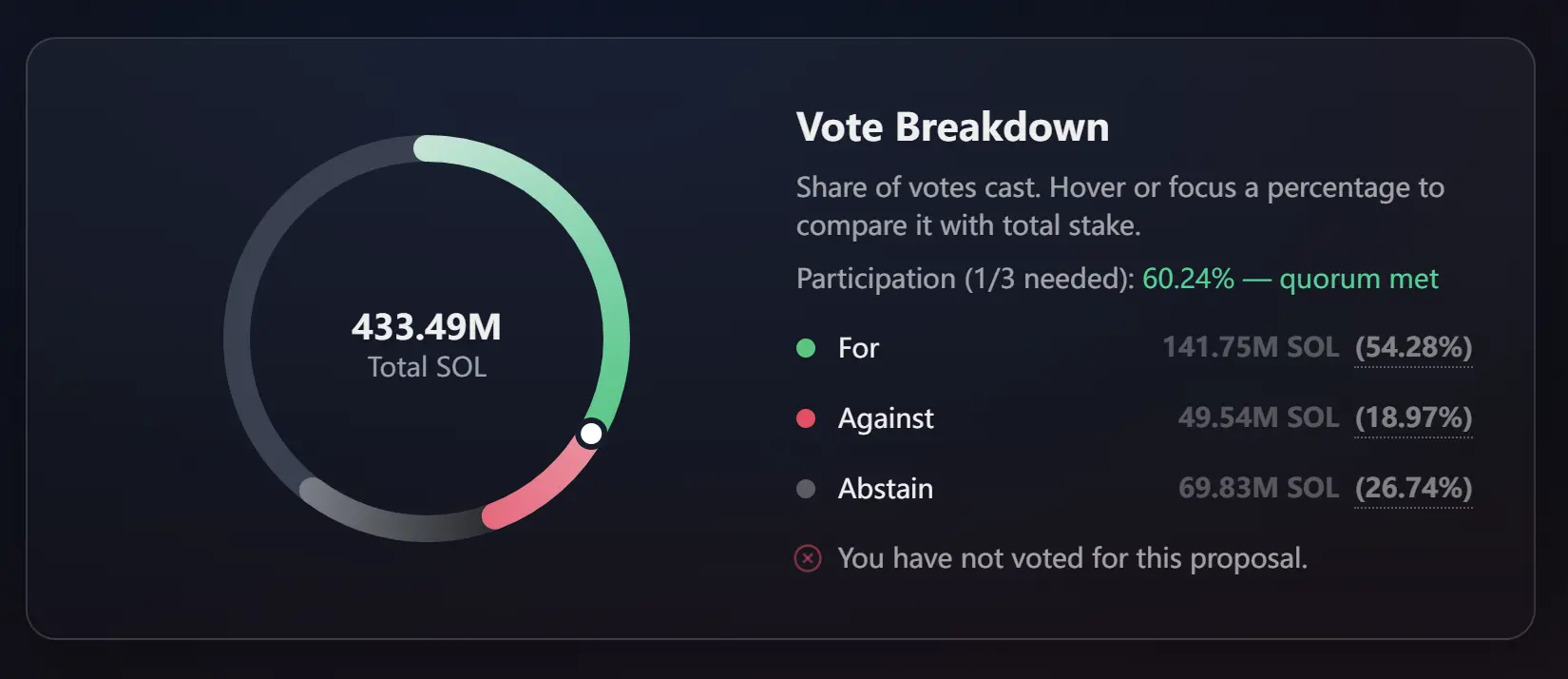
So, what do SGP-0001 and SGP-0002 mean for the Solana ecosystem? Why did SGP-0003 face significant controversy on social media and ultimately fail to pass?
SGP-0001: Establishing a Formal Governance Framework for the First Time
Previously, Solana did not have a clear and standardized on-chain governance process like Ethereum's governance system. Traditional SIMD primarily addressed "how to technically implement" changes, while the newly introduced SGP attempts to answer another question—should Solana move in this direction?
SGP-0001, titled "Solana Constitution," serves as the institutional foundation for this governance mechanism.
According to this framework, any proposal that receives at least 15% active staking support can enter formal on-chain voting; voting is weighted by the amount of staked SOL, and by default, validators express opinions on behalf of stakers, although stakers can override validator votes through their staking accounts. To pass a proposal, at least one-third of the network's staked participants must participate, and at least two-thirds of those participating must vote in favor.
Thus, the significance of SGP-0001 lies not in changing Solana's performance or token economics, but in providing a formal procedure for future controversies.
SGP-0002: Ending the Inflation Decline Cycle Three Years Early
If SGP-0001 is about institutional construction, then SGP-0002 and SGP-0003 directly touch upon the monetary economic model of SOL.
SGP-0002, titled "Double Disinflation," proposes to increase the current annual inflation decline rate of Solana from 15% to 30%, but it will not change the final inflation floor of 1.5%.
The difference lies in the time it takes to reach this endpoint.
According to the proposal's calculations, Solana originally needed about 5.7 years to gradually reach a terminal inflation rate of 1.5%. The new plan shortens this time to approximately 2.8 years, with an expected cumulative reduction of about 18.9 million SOL in new issuance over the next six years.
Supporters argue that this effectively allows SOL to transition more quickly from the "high inflation, high staking subsidy" early network model to a mature asset model. Forward Industries, a SOL treasury company, believes that reducing new issuance can lessen the selling pressure from staking rewards and decrease dilution for long-term holders; the company estimates that 18.9 million SOL, based on its price at the time, corresponds to a potential reduction in issuance of about $1.795 billion.
However, opposing voices are equally direct. For validators, inflation rewards are an important source of income. The new plan does not create new network revenue out of thin air but reduces future issuance, meaning that the SOL rewards available to validators and stakers will decrease.
This also continues the controversy surrounding Solana's SIMD-0228 in 2025. Previous similar inflation reforms, although supported by over 60%, failed to pass due to not reaching the supermajority threshold.
SGP-0003: A Proposal That Truly Changes Solana's Economic Model
Compared to SGP-0002, SGP-0003 is more controversial because it changes not just the issuance of SOL but the entire network's pricing mechanism for "block space."
Currently, Solana's base transaction fees are primarily charged as a fixed fee based on the number of signatures. SGP-0003 proposes to split this into two parts:
One part is a fixed base inclusion fee of 2500 Lamports, paid entirely to block producers;
The other part is a Resource Fee calculated based on the amount of resources requested by the transaction, which will be 100% burned.
The core idea is very simple: those who consume more network resources pay more fees.
Currently, Solana burns about 648 SOL daily through base fees, while supporters of SGP-0003 believe that the new mechanism has the potential to increase this number to thousands, with some estimates suggesting a range of 7500 to 9000 SOL per day, meaning the daily burn could increase by about tenfold.
For SOL holders, this seems almost like a natural benefit: reducing new issuance while increasing network burns will significantly slow the growth rate of SOL supply.
But the problem lies precisely here—fees do not come from thin air. The new fees will ultimately be borne by traders, applications, and on-chain markets.
Mostly Data simulated different types of applications and found that ordinary transfers are minimally affected, but complex applications such as account creation, CLOB market making, and on-chain routing will bear more significant cost increases. For trading protocols like Jupiter, Titan, and DFlow, the average fee per transaction may increase by approximately 0.000068, 0.00010, and 0.00012 SOL, respectively.
As a result, a rare ideological conflict has arisen within Solana.
The Biggest Controversy: Is This "Resource Pricing" or a Tax on Applications?
Supporters of SGP-0003 argue that Solana's current fee model severely underestimates the resource consumption of complex transactions.
The proposer and developer of SGP-0003, Cavey, even publicly admitted that this is a "partisan proposal."
His goal is not to maintain Solana as a completely neutral general-purpose computing platform but to hope that Solana becomes a blockchain more focused on financial markets. For financial applications, fast confirmation, stable execution, censorship resistance, and predictable resource pricing are more important than "any application must be cheap enough."
Solana co-founder Anatoly Yakovenko also supports this direction. He believes that the current fixed signature fee causes transactions of different sizes to bear almost the same base cost. A transaction that consumes only 5000 CU and a large transaction that consumes 1.4 million CU do not have a reasonable price difference under the fixed fee model, so re-pricing according to CU can address a real issue.
However, application developers do not accept this explanation.
Eugene Chen, CEO of Ellipsis Labs, is one of the strongest critics. He believes that SGP-0003 is essentially a highly subjective policy, yet it is packaged as a neutral resource pricing mechanism.
In his view, if the core economic parameters of an application platform can suddenly change due to governance voting, it becomes very difficult for application developers to establish long-term businesses on it.
He even bluntly stated that SGP-0003 is a "middle finger" to every micro-structure-sensitive application on Solana, as it sends the signal to developers that the cost model acceptable today may be completely rewritten due to a governance vote tomorrow.
Manifest's stance is also clearly opposed. The project argues that the truly scarce resource on Solana is the prioritization within blocks, which has already been priced through priority fees. In contrast, the abundant block space is not truly scarce but will incur additional charges under SGP-0003.
Manifest further warns that excessively high resource fees could even have counterproductive effects: to lower CU costs, developers may be forced to reduce on-chain security checks, thereby increasing security risks.
On-chain voting records show that Jupiter, Drift, Forward Industries, and Anagram Staking voted against proposal 0003; large stakers such as Figment, Staking Facilities, Kiln, and P2P.org clearly expressed support, while Everstake abstained.
Conclusion
From technological advancements to market performance, Solana is clearly in a phase of expansion.
In July, Solana raised the single-block computation limit from 60 million CU to 100 million CU, continuing to release space for higher on-chain transaction density; in August, the mainnet slot time was further shortened to 350ms, with plans to advance to 200ms. Firedancer has entered mainnet operation, and next-generation consensus upgrades like Alpenglow are also underway. Meanwhile, financial applications such as RWA, stablecoin payments, and tokenized stocks are continuously expanding, as Solana attempts to convert its high-performance advantages into larger-scale real economic activities.
The price of SOL also experienced a rapid rebound, rising from around $75 in August to above $110. With the combined effects of technological upgrades, ecological expansion, and market expectations, Solana seems to be regaining market pricing for the next phase of growth.
However, the first governance vote revealed another side.
A faster network and greater capacity do not mean that all participants will benefit from it. The passage of SGP-0002 indicates that the market has formed a certain consensus on reducing SOL's long-term inflation; while the failure of SGP-0003 to gain sufficient support shows that application developers remain highly vigilant about sudden cost increases and the redefinition of economic rules.
This is actually the most realistic contradiction for Solana at present: it is striving to become a more powerful financial infrastructure but has not yet fully resolved how that infrastructure should be priced.
In the past, Solana's competitive logic was relatively simple—lower fees, higher performance, and stronger throughput; but as the chain begins to carry more and more transactions, market making, payments, and RWA businesses, "low cost" itself is no longer just a user experience but begins to directly affect the business models of applications.
Therefore, what the first round of governance truly leaves behind is not the victory or defeat of a particular proposal but a clearer dividing line: Solana can no longer rely solely on technological routes to drive network growth; in the future, it must also find a new balance among developer interests, validator rewards, SOL holder value, and long-term sustainability of the network.
When a public chain transitions from "pursuing performance" to "carrying the economy," governance is no longer an ancillary mechanism but becomes a core competitive factor. Solana's first round of governance may just be the beginning of this game.
 Risk warning