From the human brain to the battlefield: MSX Pre-IPO Phase III introduces Neuralink and Anduril, betting on the next frontier of AI
 Core Viewpoint

 Phase one CBRS and SPCX successfully launched trading, phase two Anthropic and Polymarket entered premium buybacks, and in phase three, we stand at a brand new starting point.
What is the most attractive aspect of Pre-IPO investment?
Perhaps it lies in the fact that it is precisely at a window where the value of a unicorn is gradually being recognized, yet has not been fully priced by the public market. At this time, technology begins to be validated, the business path becomes clearer, but the final value discovery is still ongoing.
In recent years, this window has become increasingly important.
A number of the world's most watched unicorns, such as SpaceX, OpenAI, and Anthropic, have completed significant financing and valuation leaps before their IPOs. Because of this, how to allow investors to gain core equity exposure before the giants ring the bell has become a core demand of the global capital market.
On August 31, 2026, MSX Maitong will also open the subscription for the third phase of the Pre-IPO project.
Compared to five months ago when it first launched, this time the starting point is different. The first two phases have successively moved from subscription and holding to listing or buyback, and the first round of product closure has begun to be practically validated.
On this basis, the third phase will further push the asset boundaries to two super unicorns that are highly representative of the era: Neuralink and Anduril.
1. From Listing to Premium Buyback: MSX Pre-IPO Completes "Full Process Closed Loop Validation"
On March 2, 2026, MSX Maitong officially launched the Pre-IPO section and introduced the first phase project.
In just a few months, the demand for Pre-IPO from leading unlisted technology companies has rapidly increased, and various forms of Pre-IPO, Private Equity, and other unlisted asset-related products have appeared in the market.
The logic behind this is not complicated.
A group of the most growth-oriented technology companies creates most of their value before the IPO. For ordinary investors, the demand naturally extends forward, becoming whether they can participate before the company truly goes public.
But for any Pre-IPO product, a more important question than "which star companies can be bought" is whether this path can truly be walked after purchasing?
In the past five months, MSX Maitong has provided a strong answer through the actual operation of two phases of Pre-IPO products.
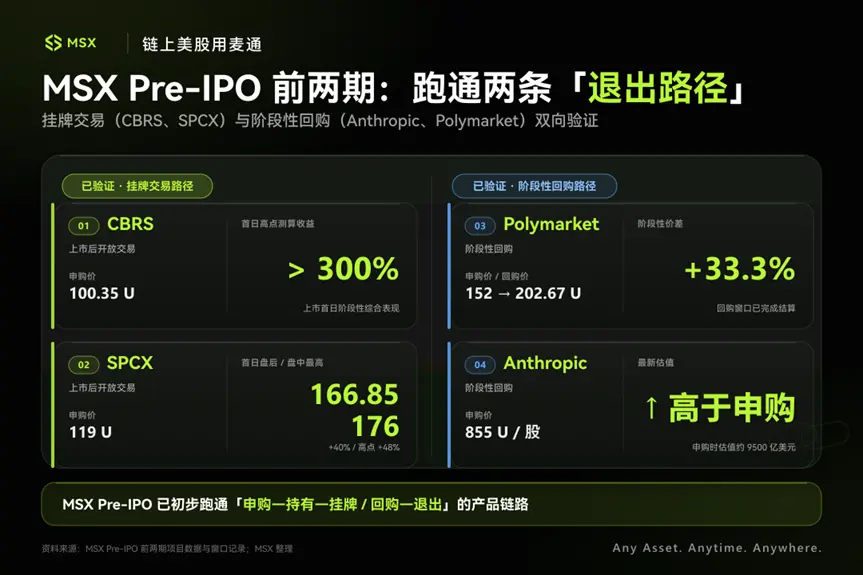
Among them, the first phase of MSX Maitong's Pre-IPO launched Cerebras and SpaceX, which successfully completed the transaction closed loop from private share confirmation to public market listing:
•Cerebras (CBRS): Users participated in the subscription at a price of 100.35U. With the listing of Cerebras, MSX Maitong simultaneously opened CBRS spot trading, and based on the intraday high on the first day of listing, the stage comprehensive return rate for early participants once exceeded 300%;
•SpaceX (SPCX): The early subscription cost after MSX Maitong's stock split adjustment was about 119U, while the post-listing price reached 166.85 USD on the first day, with an intraday high of 176 USD, a stage increase of nearly 50%;
At the same time, in addition to the liquidity exit path after listing, another crucial piece of the puzzle during the unlisted phase—the buyback exit—has also undergone multiple successful validations.
This includes the recent August 20, when MSX Maitong officially opened the buyback for the second phase projects Anthropic and Polymarket. Eligible holding users can choose to exit and settle in USDT at the current buyback price based on their own judgment, or continue to hold and wait for subsequent valuation changes or future IPO:
•Among them, Polymarket's performance is the most intuitive. Previously, the Pre-IPO subscription price was 152U/ share, and the latest buyback price has risen to 202.67 U/ share, with a return of about 33.3%, meaning early participants have the option to convert their paper gains into actual exit profits;
•The second phase subscription price for Anthropic was 855U/share, corresponding to a valuation of about 950 billion USD. Currently, its private market valuation has further increased, and there are reports of discussions about a 2 trillion USD IPO valuation. Investors can also choose to continue holding and enjoy the long-term growth dividends as it rushes to the public market;
Of course, a single project rising by 30%, 40%, or even more does not mean that all Pre-IPO assets will replicate similar performances in the future.
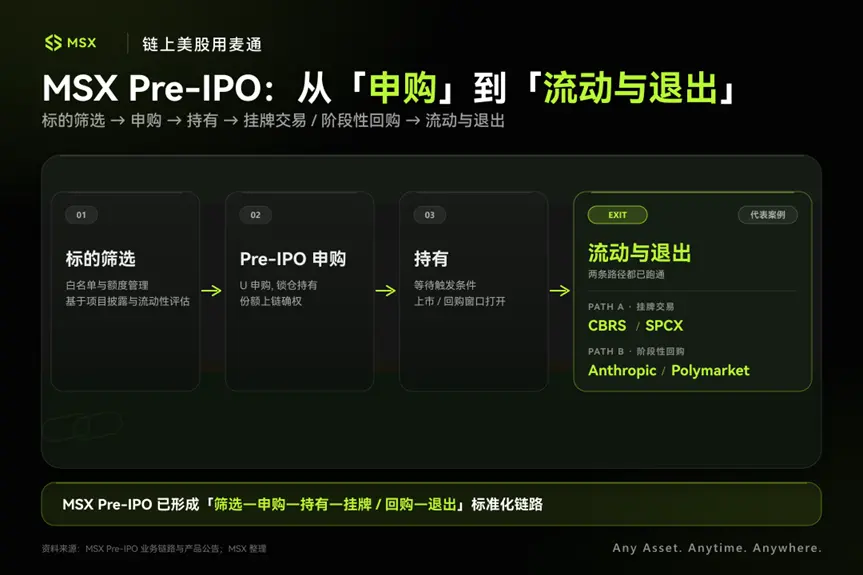
What is truly worth noting is that the two most core exit paths have begun to be validated, and the product chain of MSX Pre-IPO is gradually becoming complete: Target Selection → Pre-IPO Subscription → Holding → Listing/Buyback → Liquidity and Exit.
This also gives the upcoming third phase a completely different starting point compared to the first phase launched five months ago.
This time, MSX has turned its attention to Neuralink and Anduril.
2. Neuralink and Anduril: One Connects the Human Brain, the Other Enters the Battlefield
For the third phase of Pre-IPO targets, MSX Maitong has chosen two companies: Neuralink and Anduril.
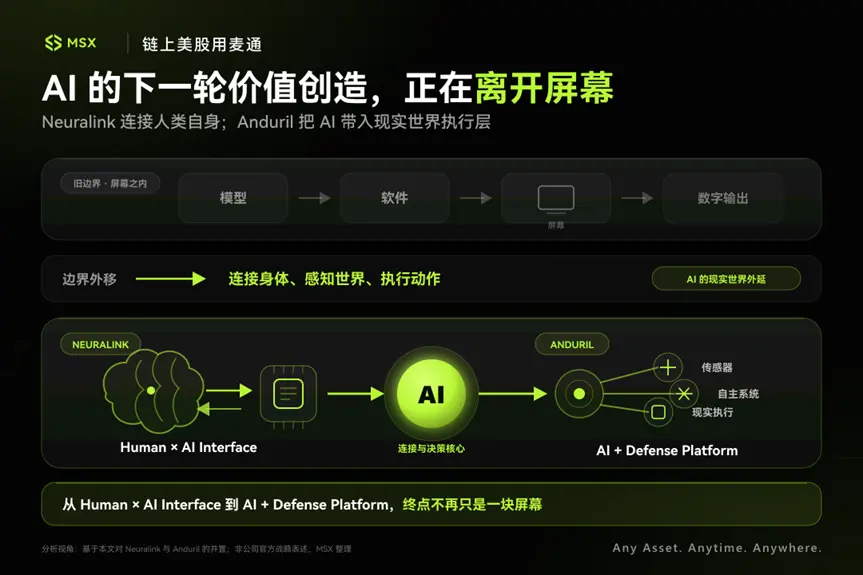
The industries of these two companies seem far apart, yet they both point to an increasingly clear change in the next phase of AI, which is that AI is increasingly penetrating the physical world from the digital world.
1. Neuralink: If the next generation of AI entry is the human brain
Among all the narratives of cutting-edge technology today, Neuralink may be the company with the highest cognitive threshold and the most difficult long-term ceiling to estimate.
Founded by Elon Musk in 2016, Neuralink is a brain-computer interface company. To understand Neuralink merely as a "medical device company that implants chips in the human brain" undoubtedly underestimates what it truly aims to achieve.
From implantable devices and flexible electrodes to neural signal decoding, wireless communication, and surgical robots responsible for precise implantation, Neuralink has been building a complete brain-computer interface system from the very beginning.
In the past two years, its most significant change has been making brain-computer interfaces truly transition from the laboratory to the human body.
In 2024, Neuralink completed its first human implantation; thereafter, clinical projects continued to expand, and by early 2026, over 20 participants worldwide had received implants. For Neuralink, this means it has taken a significant step from 0 to 1.
The question has become, if it can really be done, how big can it ultimately become?
Today, when we complete the most ordinary interaction with AI, we still need to go through "Brain → Hand → Keyboard → AI → Screen → Eyes."
Neuralink's most radical endgame is to compress this chain into "Brain ⇄ AI," allowing people to control computers, smartphones, robotic arms, and potentially more machines in the future using "thought" by directly reading neural signals.
Currently, healthcare remains the most realistic and important entry point.
If brain-computer interfaces can overcome long-term limitations of safety, bandwidth, implantation efficiency, and scalability in the future, the market corresponding to Neuralink may no longer be simply measured by the TAM of any current medical device industry.
What it ultimately competes for may be the Human × AI Interface, a new generation of interface between humans and AI.
This is also why its valuation is rapidly changing—during the Series E financing in 2025, the company's valuation was about 9.65 billion USD; entering 2026, some private market transactions and buyer quotes have already raised the valuation to the hundreds of billions range.
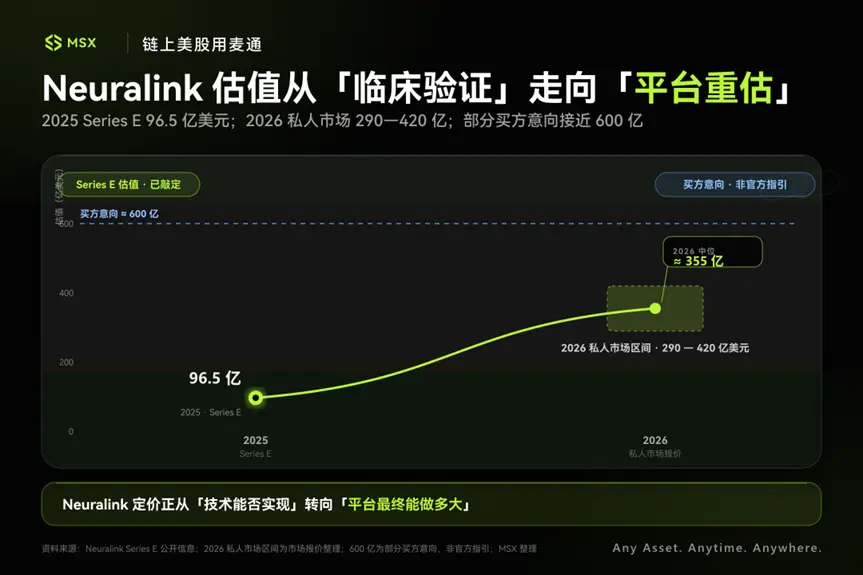
Capital is pricing in a future that has not yet fully occurred.
To some extent, today's Neuralink easily reminds one of an earlier stage of SpaceX, which was also difficult to explain using traditional aerospace company valuation models.
What truly drives its value to continue rising is not that every timeline is accurately fulfilled, but that Musk has repeatedly proven that some engineering problems once thought to be nearly impossible to commercialize can ultimately be turned into products and then into industries.
Neuralink may be Musk's most challenging bet to date.
And because of this, the imaginative space corresponding to Neuralink is also large enough—it has proven part of the concept, but the aspects that truly determine the upper limit of valuation are far from being fully proven.
2. Anduril: AI is Reshaping the "Execution Layer" of National Defense
If Neuralink is bringing AI into the human brain, then what Anduril is doing is bringing AI into the real battlefield.
Founded in 2017, Anduril's most well-known products were border surveillance and anti-drone systems.
Less than a decade later, the company has expanded its product line to include unmanned combat aircraft, cruise missiles, underwater unmanned systems, anti-drone defenses, solid rocket engines, and the AI command and control platform Lattice, which serves as the core of the entire system.
Thus, viewing Anduril as merely a "drone company" today is clearly insufficient; what it is truly challenging is the traditional military-industrial system that has persisted in the U.S. for decades.
The traditional defense industry often means long R&D cycles, high costs, and a relatively fragmented procurement and development system between hardware and software. Anduril brings a logic closer to Silicon Valley, namely software-first, AI-driven, autonomy, rapid iteration, and scalable manufacturing;
If Palantir has already proven that AI can penetrate the decision-making layer of the defense system to help process data, form judgments, and assist in decision-making, then Anduril has pushed forward a new step: entering the execution layer of defense, beginning to truly connect sensors, drones, fighter jets, and weapon systems, and participating in mission execution.
This is also why the capital market is redefining Anduril.
By 2025, the company's revenue had reached about 2.2 billion USD; entering 2026, the U.S. Army established a corporate-level procurement framework with it worth up to 20 billion USD over ten years, allowing Anduril to transition from a Defense Tech Startup constantly vying for single military contracts to a more long-term, scaled U.S. defense procurement system.
At the same time, the company is also advancing the Arsenal manufacturing system, further addressing the capability that military startups find most difficult to overcome—large-scale production.
In other words, what Anduril aims to do is combine "AI + Autonomy + Software + Hardware + Manufacturing" into a new defense industrial platform.
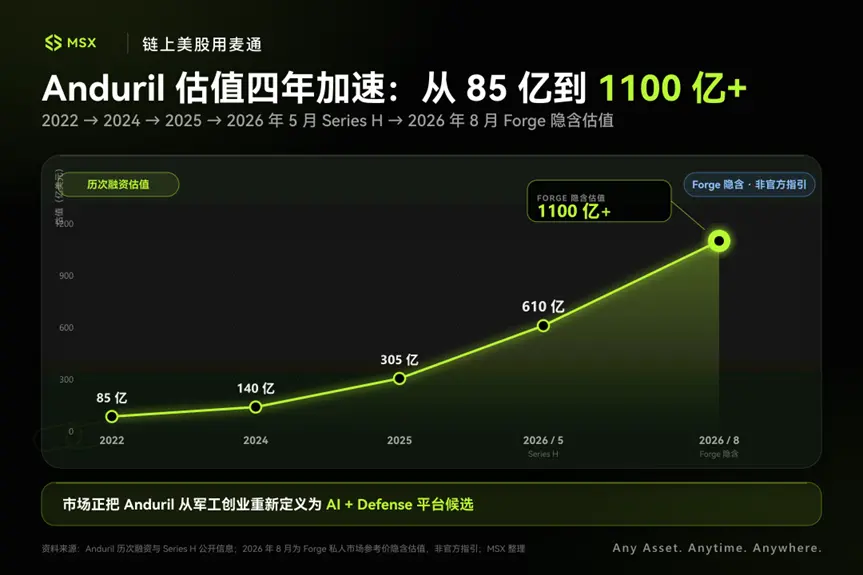
Valuation is also reflecting this identity change:
•In 2022, Anduril's valuation was about 8.5 billion USD;
•In 2024, about 14 billion USD;
•In 2025, about 30.5 billion USD;
•In May 2026, during Series H financing, the valuation had risen to 61 billion USD;
•By August, the implied valuation corresponding to the private market reference price of Forge had further surpassed 110 billion USD;
This cannot be considered cheap.
But for Pre-IPO investors, Palantir has already proven that the capital market is willing to pay a valuation premium far above traditional military companies for "AI + Defense + Platform capabilities."
What Anduril is competing for is the next round of similar identity reassessment.
3. Pre-IPO, Focusing on Early Opportunities Not Fully Priced by the Market
Overall, Neuralink and Anduril operate in completely different industries, but when put together, one finds a very similar aspect: the market is trading what they might become in the future.
Neuralink is evolving from a "brain-computer interface medical company" to a potential Human × AI Interface; Anduril is evolving from a "defense technology startup" to a potential AI + Defense Platform.
This is also the most noteworthy common thread when Neuralink and Anduril are both included in the third phase of MSX Pre-IPO:
The next round of value creation in AI may no longer only occur within models and screens.
From the first phase to the third phase, the asset boundaries covered by MSX Pre-IPO are also continuously expanding. From Cerebras and SpaceX to Anthropic and Polymarket, and now to Neuralink and Anduril, the directions covered have extended from AI computing power and commercial space to generative AI, prediction markets, brain-computer interfaces, and AI military applications.
But more important than industry labels is a gradually clear asset selection logic behind it, which is that MSX Maitong Pre-IPO will continue to seek leading unlisted companies that have completed part of the technical or commercial validation but are still before being fully priced in the public market.
Ultimately, the value of Pre-IPO has never been just about "buying earlier than the IPO."
Because "early" does not itself mean cheap, nor does it mean profit.
What is truly important is to judge whether a company's technological capabilities, commercial scale, and market identity are rapidly changing when determining if it is crossing a node significant enough to alter the future valuation system.
After all, changes in a company's identity often mark the beginning of changes in the valuation system. Just as SpaceX is no longer just a rocket company, Palantir is also no longer just seen as a government software contractor.
The market's re-understanding of what a company "is" often coincides with the most important round of value reassessment.
Of course, this also means higher uncertainty.
Neuralink still needs to face long-term tests of clinical, safety, regulatory, and commercialization cycles; Anduril needs to continue proving that large-scale orders and procurement frameworks can ultimately translate into sustained revenue and profits while digesting the significantly increased private market valuations.
This is also an aspect that all Pre-IPO investors cannot ignore.
In Conclusion
Good Pre-IPO assets rarely appear after all the answers have been revealed.
Because when technology is fully mature, business models are thoroughly validated, and growth paths become clear, the public market has often completed the most important round of pricing.
What is truly worth observing are those companies that are changing their identities:
•SpaceX has gradually grown from a rocket company to a platform-level asset spanning commercial space, satellite communication, and next-generation infrastructure;
•Palantir has also been reinterpreted from a controversial government software contractor to a data and decision-making platform in the AI era;
And today, Neuralink is betting on the next way to connect humans and AI, while Anduril is betting on the next defense industrial system in the AI era.
One is aimed at the human brain, the other enters the battlefield.
They operate in completely different industries but stand at similar nodes of value reassessment—the market is curious about what these companies will ultimately become.
For MSX Pre-IPO, the true continuation of the third phase is also this longer-term asset search logic:
Discovering those platform-level assets that are redefining themselves and may redefine an industry before the next generation of technology companies are fully recognized by the public market.
 Risk warning


Popular articles