Who killed BitMart?
 Core Viewpoint

 What truly pushed it towards shutdown is more like the disorder of internal governance, a sudden shift in top-level will, and some motivations that remain unclear to this day; these cannot be summarized by the word competition alone.
Author: Zhou, ChainCatcher
After the shutdown of the perpetual contract pioneer BitMEX, BitMart has also fallen.
On July 15, BitMart had just released its 2026 H1 report. This report, themed around its eighth anniversary, focused on long-termism and building for the next cycle, even listing six major development directions for the second half of the year.
Just 11 days later, BitMart announced an orderly cessation of trading platform operations.
However, this does not mean the company will disappear immediately. The official announcement stated that platform trading services would continue until August 26, and the account withdrawal window would remain open until January 2027, allowing users to retrieve their assets within the timeframe.
According to MSX founder Bruce's public post, he has called for the acquisition of BitMart and claimed to have made contact with them (as of the time of publication, BitMart had not responded to this). Meanwhile, platforms like Huobi HTX and Websea quickly opened channels to compete for BitMart's users and departing employees.

Company CEO Nathan Chow stated that he was only informed of his termination on July 24 and was completely unaware of the shutdown decision, learning about the platform's closure through the public announcement.
The sudden shutdown, with the leader excluded from the decision-making process, has sparked considerable discussion about its "cause of death."
Do small and medium exchanges really have no way out?
The most mainstream explanation surrounding the death of BitMart is that it was eliminated by industry competition.
Colin Wu and others pointed out that non-first-tier offshore exchanges generally cannot make money and see no hope, thus choosing to shut down voluntarily. He even predicted that, apart from the leading first-tier exchanges, the rest would gradually exit the market.
Many similar judgments exist. Some observers believe that the survival space for small and medium exchanges is being severely squeezed, making a wave of closures inevitable; others bluntly state that small exchanges are destined to be abandoned by the times.

Supporting this logic is a set of structural industry changes.
First, there is a high degree of monopoly among the top players, with industry estimates suggesting that only about five large exchanges may still be profitable this year.

Second, stricter compliance has compressed offshore space, with the U.S., South Korea, and European markets tightening successively, leaving less maneuvering room for offshore exchanges. Industry insider Haotian pointed out that under the overall trend of compliance, competition among CEXs is far more brutal than imagined, with requirements for licenses, proof of reserves, KYC/AML, etc., becoming almost a ticket for exchanges to survive. The previously existing zero-sum game space of "one whale falls, everything thrives" has been significantly compressed, and many shutdowns seem more like proactive exits in the face of competitive pressure.
Third, there is the impact of Binance Alpha. KOL Phyrex stated that Alpha has provided better sources for altcoins and community tokens, directly reducing the listing income and joint trading profits of third- and fourth-tier exchanges. He also mentioned the migration of trading instructors—once a new platform with higher profits appears, these instructors quickly move their users.
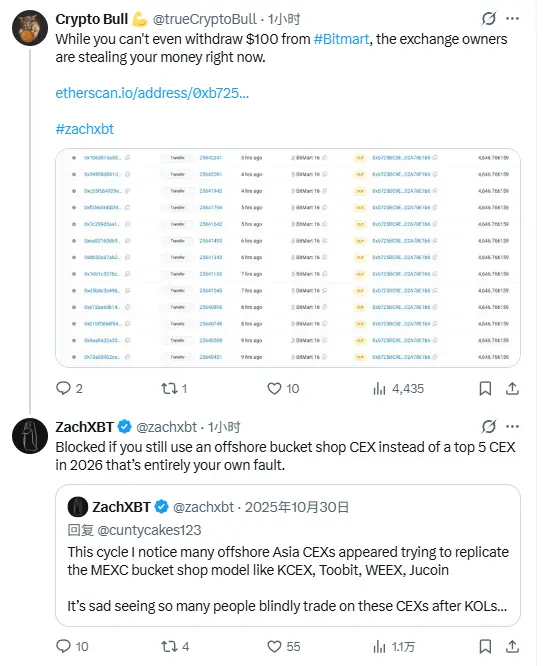
On-chain investigator ZachXBT also pointed out that during this cycle, many Asian offshore exchanges have been mimicking gambling models, which are inherently difficult to sustain. However, he pointed to the risks of the entire offshore gambling model rather than specific issues with BitMart.
There are also views that TradFi and the tokenization of U.S. stocks cannot save non-top exchanges. According to KOLs like Skanda, users do not buy into CEXs offering U.S. stocks except for a few leading ones. BitMart, which acquired licenses from multiple U.S. states, still easily fell, serving as a corroboration of this judgment.
This logic is self-consistent and explains many phenomena. If we follow this reasoning, the fate of small and medium exchanges seems to be predetermined?
It is actually difficult to make such a judgment.
In the past, exchanges competed on who could do ground promotion, who could achieve viral growth, and who could offer lower rebates; this space of homogenized competition is actually shrinking. Meanwhile, a large influx of TradFi assets continues, and the variety of trading products is expanding.
However, what most pessimists say about TradFi not being able to save exchanges may only be half true.
Simply listing a few U.S. stock products indeed fails to create competitiveness. But combining stocks with contracts and stocks with forex to create truly differentiated products that allow investors from different backgrounds to enter the crypto market more smoothly is another concept. This, for exchanges, actually increases the possibility of competing on strength and innovation.
Haotian also mentioned that small and medium exchanges must find differentiated positioning to survive—either by deeply cultivating specific regional licenses and localized services, focusing on certain niche products like TradFi assets, Perps, RWAFi, or fully embracing innovative narratives native to crypto.
If this judgment holds, the competitive dimensions of the industry are shifting. The focus is moving from who offers lower rebates to who can better develop products and whose finances and governance are more transparent. The space for small and medium exchanges may not be completely blocked; only the way of survival has changed.
Returning to BitMart, it was still aggressively promoting TradFi and differentiated products before its shutdown. If a way out for small and medium exchanges truly exists, its sudden demise becomes harder to attribute solely to competitive clearing.
II. The real issue points to internal governance
Looking at the existing public clues together, the more prominent problem lies internally.
1. Lack of transparency in decision-making
Some believe that CEOs of crypto projects are often just spokespersons pushed to the forefront by investors, lacking real power is the norm, and there is no need to be surprised. However, in the case of BitMart, where even a life-and-death decision like shutting down the platform was completely concealed from the nominal highest management, letting him learn about the closure from the public announcement like an ordinary user is still rare.
A former employee responsible for operations in the Chinese market also stated that he only learned about the relevant adjustments after the announcement was released. A normally functioning organization would not operate this way; this itself is a strong signal of governance disorder.
2. Divergence between business direction and shutdown outcome
According to BitMart's H1 report, the platform not only expanded its TradFi section and IPOPrime business, but also saw a 203.7% quarter-on-quarter increase in newly added perpetual contract trading pairs, a year-on-year increase of about 256% in asset management scale, and launched prediction market products, completing the construction of licensed entities in Australia.
This means that the company was still intensively investing in TradFi, perpetual contracts, and prediction markets in the first half of the year, indicating that the team had a clear judgment on the direction the industry should take, aligning with the currently validated direction. However, the company suddenly moved towards shutdown, which precisely indicates that the force pressing the shutdown button came from outside the business, largely driven by top-level will.
3. Doubts about internal operational willingness
Several individuals who have interacted with or understand BitMart internally described a similar picture. Crypto influencer (Skanda) mentioned that his previous neighbor was a BitMart executive, who often spoke privately about the chaos within the platform and outrageous business decisions, leading to high turnover and a disconnect from the times, with the boss showing no interest in operations.
Another account claiming to be a former insider (@Start16Start) stated that the closure news was not surprising to him, as the platform had issues with unrealizable KPIs affecting salaries, refusing to pay deserved bonuses, and lacking integrity towards employees and partners.
There are also voices mentioning that internally, there has been a long-term preference for parachuting leaders, demoting those who fail assessments, leading to an imbalance in the power structure, with rewards preferentially tilted towards specific departments.
These statements come from personal perspectives and cannot be independently verified, serving only as indirect references. However, they collectively point in one direction: the platform's internal operational willingness is insufficient, and long-term management disorder is a problem that did not suddenly appear after the shutdown.
4. Transparency gap in withdrawal execution
This is also where market skepticism is most concentrated. After the shutdown announcement, a group of large users began to publicly defend their rights.
According to a rights protection group led by user @MINGLIbtc, dozens of affected users have registered, reporting that the total assets that cannot be withdrawn amount to millions of dollars, many of which were attracted by high-interest stablecoin investments like USDG and PYUSD.
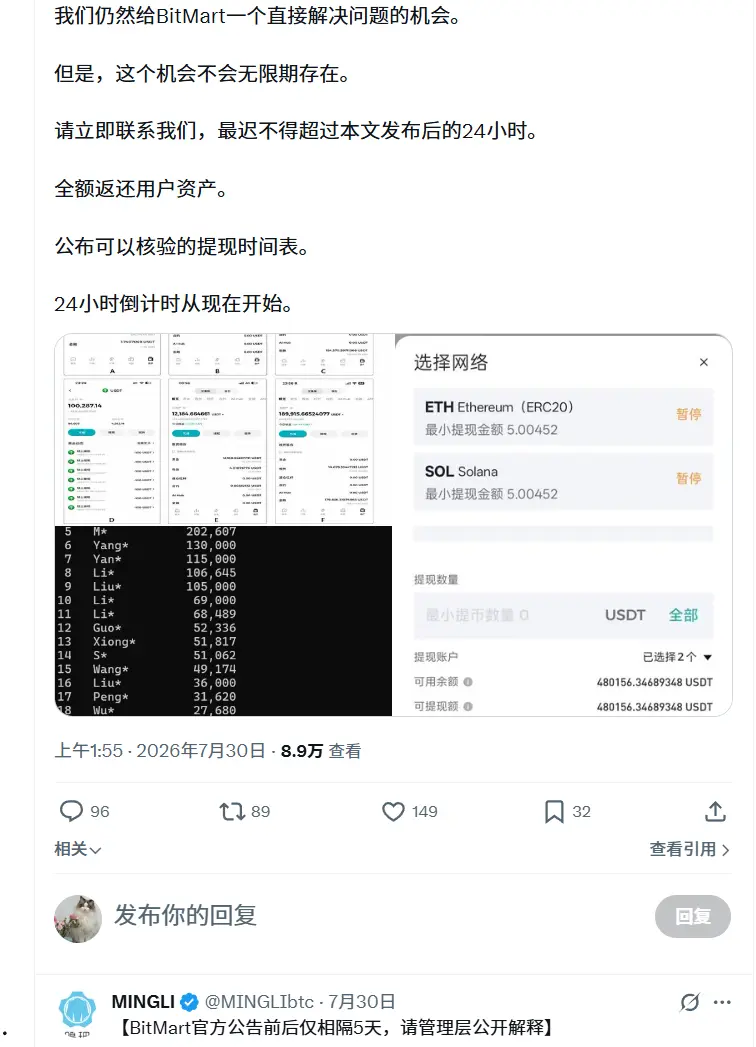
Multiple users reported that the main issue was the inability to withdraw funds. Withdrawals of USDG on both ERC20 and Solana networks are showing as paused, and the exchange outlets for USDG/USDT and PYUSD/USDT are also unusable, with large USDT withdrawals being stuck for a long time or returned, while the platform only sporadically releases small amounts of 100 USDT. (Currently, the number of people and amounts in the rights protection group are unilateral statements and have not been independently verified.)
Moreover, the situations described by these users are clearly inconsistent with BitMart's previous announcements.
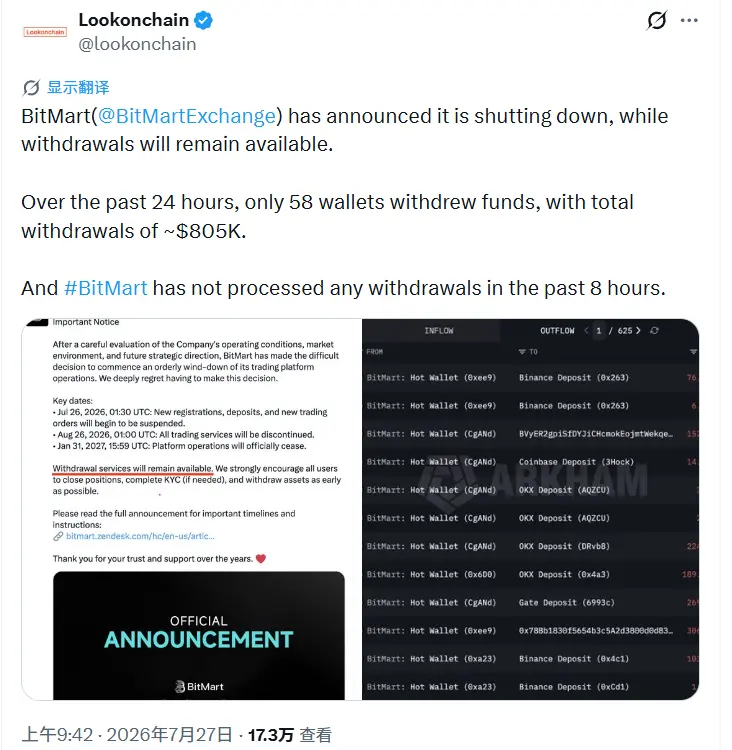
The shutdown announcement on July 26 clearly stated that withdrawal services would continue and urged users to redeem financial products, check balances, and withdraw in a timely manner. However, users reported widespread withdrawal suspensions.
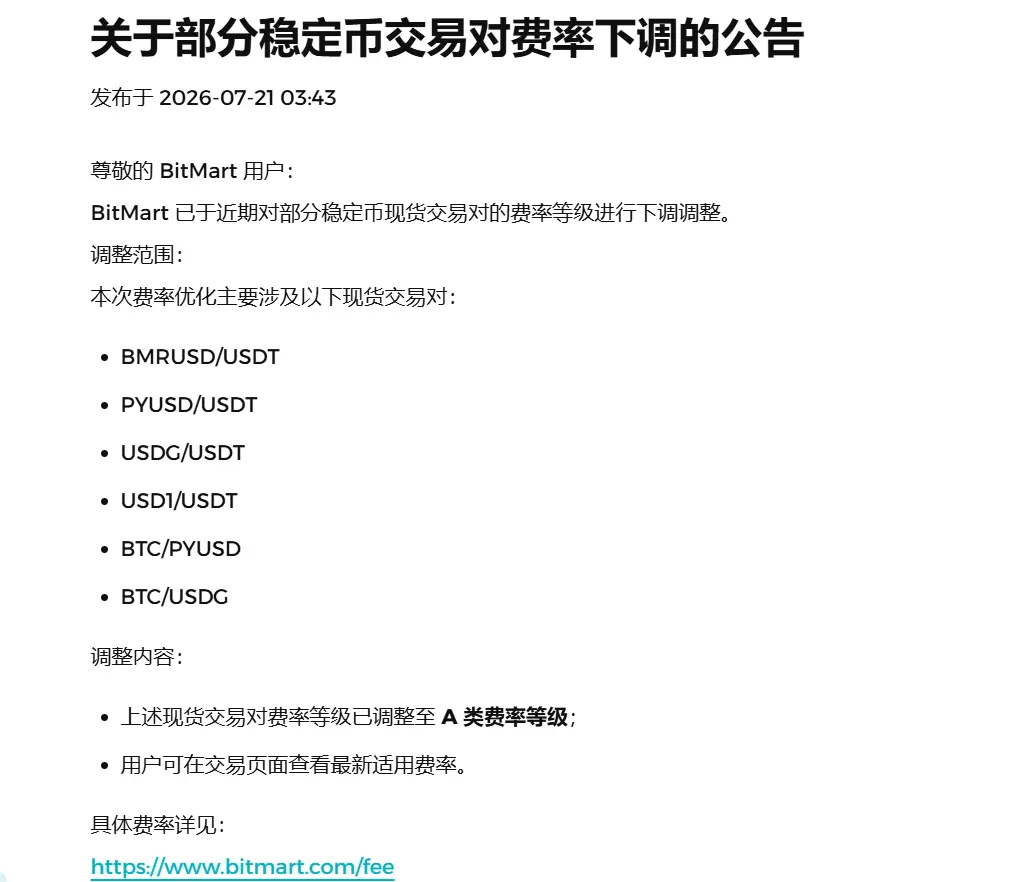
Earlier, on July 21, BitMart had also released an announcement about reducing trading fees for stablecoin trading pairs, moving six trading pairs including PYUSD/USDT and USDG/USDT to Class A rates, stating the intention to lower trading costs and provide a more transparent and efficient trading environment.
According to Arkham data, the balance of wallets associated with BitMart dropped from about $102 million on July 6 to about $69 million after the shutdown. Within 24 hours of the shutdown announcement, only 58 wallets completed withdrawals, totaling about $805,000.
It is common for exchanges to consolidate funds during the withdrawal period; relying solely on wallet dispatch and some users' withdrawal complaints cannot determine the existence of misappropriation. However, the official side simultaneously lowered fees and promised continued withdrawal before the shutdown while leaving withdrawal obstacles and declining balances, which together raise reasonable doubts about the transparency of this orderly withdrawal.
Conclusion
Looking back at the entire industry, second-tier exchanges have recently experienced a series of shutdowns or contractions. However, their causes of death are difficult to attribute solely to the broad clue of industry competition.
The same goes for BitMart. What truly pushed it towards shutdown seems more like internal governance disorder, a sudden shift in top-level will, and some motives that remain unclear to this day, none of which can be summarized by the word competition.
Perhaps the more pressing question is whether this industry lacks builders who genuinely prioritize products and users, and whether it lacks a level of transparency that can withstand scrutiny.
As such situations become more frequent, the fallen will not only be BitMart but also the trust that users should have in this business.

 Risk warning