The invisible cryptocurrency landscape of Japanese financial giant SBI
 Core Viewpoint

 When trading long positions, one should enter the market at the cyclical lows, as this will yield substantial profits once the market reverses.
Author: Chloe, ChainCatcher
Recently, Japanese financial group SBI Holdings has made intensive moves in the digital asset field: within three weeks, it acquired the Japanese licensed exchange Bitbank for 46.7 billion yen (approximately 289 million USD), led a 76 million USD Series C funding round for the institutional crypto platform EDX Markets, exclusively invested 125 million USD in the DeFi risk analysis company Gauntlet, and announced a strategic partnership with the Solana Foundation on July 13 to jointly build a local on-chain financial market in Japan.
In the past, SBI has primarily engaged in joint ventures, equity stakes, and overall acquisitions in the crypto field, rarely acting as a lead investor in venture rounds. If we carefully analyze the content, timing, and statements from various parties regarding this series of transactions and collaborations, as well as the evaluations from multiple institutional analysts on its strategy, how should the market interpret this traditional financial giant's accelerated layout?
Intensive Moves Within Three Weeks
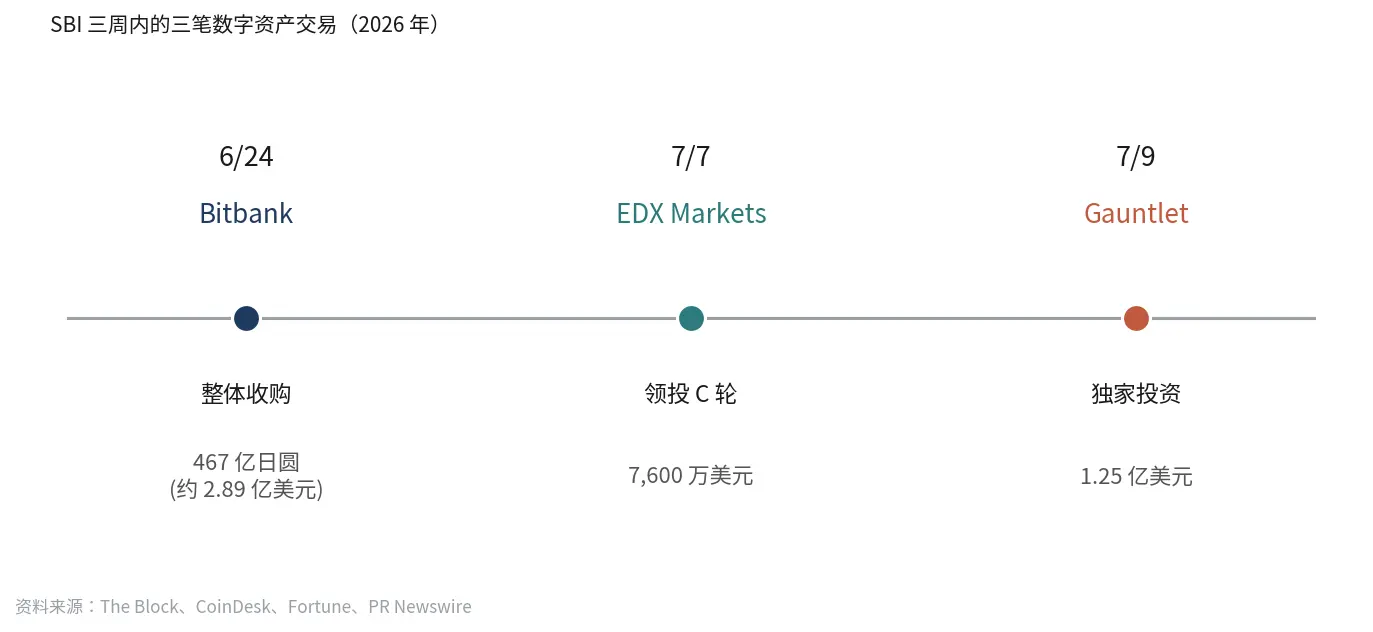
On June 24, SBI announced that it would acquire all shares of Bitbank through its wholly-owned subsidiary SBICAH for 46.7 billion yen. The transaction will be conducted in two phases, with delivery expected around October after approval from the Japan Fair Trade Commission. SBI stated that, based on data from the end of April, the combined crypto assets of SBI VC Trade (SBI's proprietary exchange) and Bitbank's customers would amount to approximately 1.1 trillion yen (about 6.8 billion USD), with around 2.92 million crypto accounts, surpassing bitFlyer and Coincheck to become the largest in Japan.
On July 7, the institutional-only crypto trading platform EDX Markets announced the completion of a 76 million USD Series C funding round, led by SBI. EDX launched in 2023, with shareholders including Citadel Securities, Fidelity Digital Assets, Charles Schwab, Virtu, Sequoia, and Paradigm. EDX stated that this funding will be used to expand trading, clearing, and settlement capabilities and to drive expansion in the Asia-Pacific market.
On July 9, Fortune reported that the DeFi asset management and risk analysis company Gauntlet completed a 125 million USD financing, which was delivered in June this year, exclusively invested by SBI through its U.S. subsidiary, with no other participants in the round. This is Gauntlet's largest financing since its establishment in 2018, more than five times the approximately 24 million USD raised in its Series B round led by Ribbit Capital at a 1 billion USD valuation in 2022.
The three transactions are different in nature, but the commonality is that SBI is the sole or primary investor in each, rather than a co-investor.
SBI's Crypto Layout Is Not New
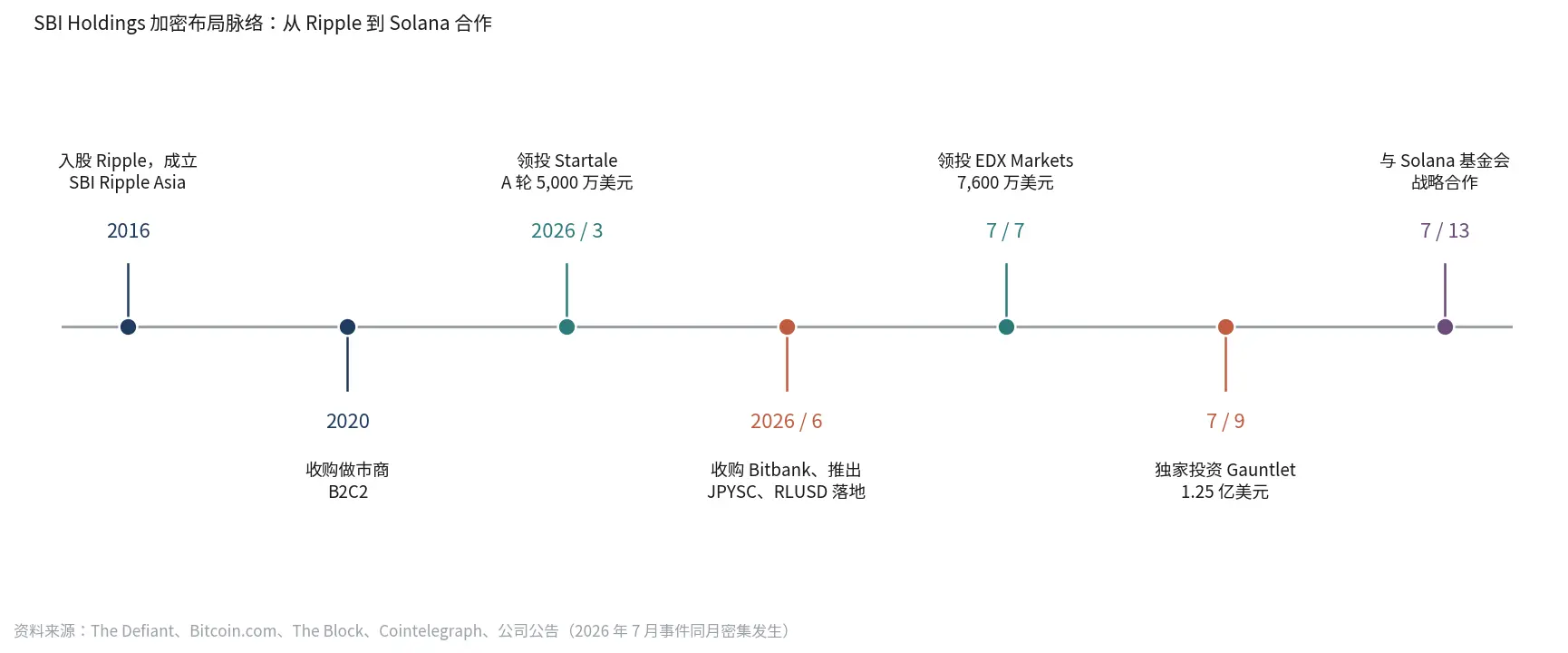
SBI Group was established in 1999, initially as an investment institution under SoftBank, and became fully independent in 2006. The group is currently listed on the Tokyo Stock Exchange, with a market capitalization of over 10 billion USD, making it one of the earliest and most actively involved traditional financial giants in the crypto industry. The company invested in Ripple in 2016 and established a joint venture, SBI Ripple Asia, subsequently holding shares in companies such as Morpho and Circle.
However, in most historical cases, SBI's role has been that of a strategic partner, joint venture partner, or acquirer, rather than a lead investor in venture rounds. For example, in the case of market maker B2C2, SBI first took a 30 million USD stake in July 2020 and acquired 90% of the shares to make it a subsidiary in December of the same year. This model only changed this year: in March, when Startale Group completed a 63 million USD Series A funding round, SBI led with 50 million USD, and Startale was the technical partner that launched the yen stablecoin JPYSC with SBI three months later. The exclusive investments in EDX and Gauntlet continue this "lead investment equals binding" model.
What Each Transaction Complements
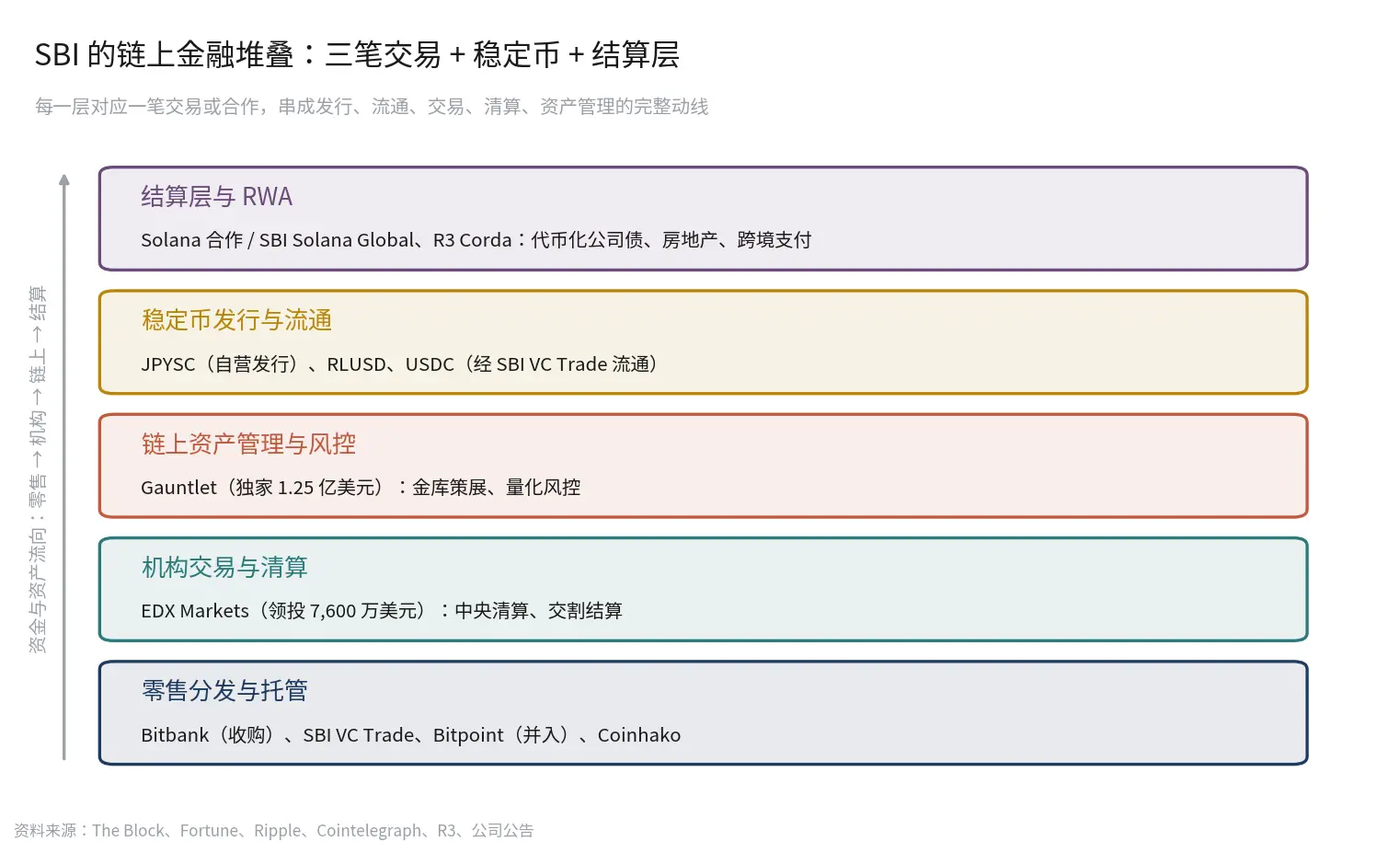
If we compare the three transactions to SBI's business landscape, we find that they correspond to three levels: retail, institutional, and on-chain.
Bitbank: Japanese Retail Market
Bitbank was established in 2014, and the company claims that there have been no hacking incidents since its inception. SBI VC Trade only merged with the Japanese exchange Bitpoint in April this year, and with this acquisition of Bitbank, SBI has integrated two licensed peers in Japan within a year. In the context of the Japan Financial Services Agency promoting the transition of crypto assets from existing laws to the Financial Instruments and Exchange Act framework, with compliance thresholds continuously rising, licenses and existing customer assets are scarce resources.
SBI stated in the announcement that this transaction will strengthen the group's presence, competitiveness, and profitability in the crypto and digital asset fields, and it plans to develop new financial products linked to digital assets such as stablecoins.
EDX Markets: U.S. Institutional Infrastructure
EDX Markets does not cater to retail investors but provides a trading venue specifically for institutions, covering central clearing, settlement, and the FlowConnect service launched this year that allows financial institutions to embed crypto trading capabilities.
EDX has also applied for a national trust bank license, EDX Trust, from the Office of the Comptroller of the Currency (OCC) in the U.S. If approved, it will be able to directly provide regulated custody, clearing, and settlement for institutional clients. EDX's current business includes a U.S. spot exchange and a perpetual contract platform for non-U.S. institutions in Singapore, with the next geographical expansion focus being the Asia-Pacific region.
Gauntlet: On-Chain Asset Management and Risk Control
Gauntlet was founded in 2018 by former Wall Street quantitative researcher Tarun Chitra, initially providing stress testing for protocols like Aave and Compound, and later transforming into an on-chain vault curation business. The operation of vault curation is similar to mutual funds: investors deposit assets into the vault in exchange for returns, and Gauntlet uses quantitative models to assess the risk of return strategies.
According to Fortune, Gauntlet currently manages approximately 1.5 billion USD in vault assets, with clients including Apollo, Coinbase, and Circle, and the automated platform monitors user assets exceeding 42 billion USD. After securing funding, Gauntlet plans to expand stablecoin coverage from USD and EUR to JPY and Mexican pesos.
Stablecoins and Settlement Layer: From JPYSC to Solana Cooperation
Beyond the three transactions, SBI is also actively collaborating with Solana to enhance its on-chain layout.
In the highly competitive stablecoin space, SBI Group is accelerating its land grab. On June 24, the same day it announced the acquisition of Bitbank, SBI, in collaboration with Startale Group, launched Japan's first yen stablecoin "JPYSC" using a trust structure, issued by its subsidiary SBI Shinsei Trust Bank and exclusively circulated by SBI VC Trade. Subsequently, the USD stablecoin RLUSD from Ripple, with which SBI has collaborated for many years, also launched on the SBI VC Trade platform on the same day after passing the Japan Financial Services Agency's review.
This means that the three major compliant stablecoins currently in Japan (JPYSC, USDC, RLUSD) have their key gateways for fiat and crypto assets firmly controlled by SBI VC Trade. To further expand the on-chain financial ecosystem, SBI also announced the launch of JPYSC lending services starting July 16, offering an annualized interest rate of 3%.
If the circulation of stablecoins is a land grab, then SBI's announcement of a strategic partnership with Solana on July 13 extends the battle to the deep waters of underlying settlement and RWA. The announcement stated that the Swiss Solana Foundation will invest in "SBI R3 Japan," which will be renamed "SBI Solana Global." This means that Solana will join forces with SBI and Japanese financial giant Sumitomo Mitsui Trust (SMFG) to jointly create a local on-chain financial market in Japan.
The newly established SBI Solana Global will fully embrace the Solana public chain ecosystem. Its key business, in addition to accelerating the issuance of stablecoins like JPYSC, will focus on tokenizing and circulating RWA assets such as corporate bonds, commercial papers, funds, and real estate. Additionally, the team will build a cross-border payment network, institutional-grade on-chain financial services, and lay the groundwork for next-generation payment infrastructure for the future AI Agent era.
This marriage of traditional finance and top public chains has actually been in the works for some time. SBI's R3 blockchain alliance allied with the Solana Foundation in May 2025, allowing Solana to serve as the security verification layer for institutional permissioned chains. Now, R3's Corda platform manages over 10 billion USD in compliant RWA. SBI has stated that Solana's high scalability, extremely low costs, and global ecosystem are essential core infrastructures for on-chain finance. SBI's core mission is to act as a bridge, packaging Japan's regulated assets and traditional institutional heritage onto Solana's global liquidity giant.
How Do the Market and Analysts View This?
This series of actions has sparked considerable discussion in the industry. Multiple institutional analysts and venture capitalists interviewed by The Block provided evaluations from different perspectives.
Structural Theory: Buying the "Pipelines" of the Financial System
Joseph Goh, Asia-Pacific head of investment banking advisory firm Areta, believes that SBI is doing what other traditional financial groups in Asia have not attempted: spanning issuance, settlement, market infrastructure, asset management, and retail distribution to create an end-to-end, cross-border digital asset industry chain. He characterizes this series of transactions as SBI buying not crypto risk exposure, but the "pipelines" of the next-generation financial system.
Goh specifically pointed out two main lines: in asset management, connecting Gauntlet's institutional-level on-chain capabilities with the distribution controlled by SBI through Bitbank and Singapore's Coinhako, which has the potential to become Asia's first scaled on-chain asset management business; in settlement, he believes that whoever controls the "yen end" of on-chain settlement may hold a strategic position for the future of Asian finance, and the circulation of JPYSC and USDC in Japan, along with the cooperation with Solana, is precisely where SBI is focusing its efforts.
Timing Theory: Long-Term Logic of Entering During a Bear Market
Another group of commentators approaches from the perspective of market cycles. Quynh Ho, head of investments at GSR Ventures, and Mike Bucella, co-founder of Neoclassic Capital, both believe that bear markets are often the best times for long-term positioning because valuations are lower and competition for deals is less intense; Bucella states that long-term investments should enter at the trough of the cycle, as market reversals will yield substantial returns.
In fact, this round of moves is occurring against the backdrop of digital assets declining for the third consecutive quarter. Yat Siu, co-founder and chairman of Animoca Brands, added from a regulatory perspective that SBI is positioning itself ahead of Japan's upcoming regulatory changes rather than waiting for clarity before taking action; he also revealed that some large crypto exchanges are being evaluated by traditional financial institutions.
Investee Perspective: Valuing Distribution and Access Beyond Money
The two invested companies focus on the "value beyond money." Gauntlet CEO Tarun Chitra stated when asked what SBI brings beyond capital that it is mainly distribution and market access, as SBI's network in Japan and Asia can help Gauntlet reach financial institutions and tokenization plans that were previously out of reach.
EDX CEO Tony Acuña-Rohter mentioned that they can access SBI's broader digital asset ecosystem, including market makers, stablecoin initiatives, tokenization, and brokerage services, exploring opportunities to jointly advance institutional market infrastructure.
However, the evaluations are not overwhelmingly positive. Joseph Goh cautioned that "execution and regulatory rhythm" will be the key to ultimate success or failure. However, he also believes that since both Bitbank and Coinhako are regulated licensed exchanges, combined with SBI's flexible use of minority equity investments, the potential risks of cross-border integration and operations have been effectively reduced.
SBI's Own Statement
Regarding why it concentrated its efforts at this time, SBI stated in an interview with The Block that the group is promoting an overall on-chain transformation, aiming to provide a complete set of functions from exchanges, asset tokenization to market platforms, with recent acquisitions, investments, and collaborations being part of the group's strategy. Group head Kefei Lin told Fortune that as U.S. regulations become clearer, SBI will increase its investments and operations in the U.S. this year.
This confidence largely stems from the upcoming regulatory dividends in Japan. Last month, the Japanese House of Representatives passed a key bill intending to bring crypto assets under the Financial Instruments and Exchange Act and regulate them similarly to stocks, paving the way for crypto ETFs, and plans to significantly reduce the highest capital gains tax from 55% to 20%, consistent with stocks and bonds, by 2028. SBI Chairman Yoshitaka Kitao has repeatedly emphasized: "The shift of traditional finance to on-chain is irreversible, and building a reliable infrastructure that gives investors peace of mind is the group's top priority."
It is noteworthy that SBI unusually chose to "lead" rather than "fully acquire" or "joint venture" in this round of transactions. From a business strategy perspective, this is a highly intelligent move: the shareholders behind the invested companies EDX and Gauntlet include top Wall Street giants like Citadel, Fidelity, and Apollo, and only by maintaining their "neutral third party" status can they continue to attract giants to dance together. By leading investments, SBI secures the strategic high ground of being the "largest single shareholder" without compromising neutrality. Whether this on-chain financial empire assembled by traditional financial giants can operate as intended remains to be seen by the global market.

 Risk warning

Popular articles