A century later, Nado moved the collateral status of US stocks onto the blockchain

 Perp DEX Nado officially integrates xStocks, with tokenized US stocks transforming into "contract margin" for the first time. Deposit or trade now to earn up to 30% in xPoints rewards, fully opening a new era of RWA capital efficiency.
Preface: The Underestimated Second Identity
If we consider the 1792 "Buttonwood Agreement" as the starting point of the modern U.S. securities market, the U.S. stock market has already traversed 234 years. During these 234 years, it has experienced countless moments that have been rewritten: exchanges taking shape, indices being born, ETFs becoming popular, and electronic trading. These changes continuously expand the boundaries of the securities market: making stocks easier to trade, easier to price, and easier for ordinary investors to hold.

Figure: "The First New York Stock Exchange," Ezra Winter, 1930 mural
However, what has changed more is the form of the securities market. A true singularity that changed the financial identity of stocks occurred in the 1920s. At that time, New York's short-term lending market pushed stock collateralization to unprecedented scales. Stocks were no longer just assets that could be bought and sold; they began to serve as the underlying fuel in the margin, credit, and financing systems.
Since then, the U.S. stock market has had two identities: one as an asset and the other as collateral. The former represents ownership in a company, index exposure, and price fluctuations; the latter means it can be recognized, calculated, and called upon by the financial system, thereby supporting more transactions and greater liquidity.
In recent years, the narrative around RWA has revolved more around "access." Who can issue compliant tokenized securities, which stocks and ETFs can be brought on-chain, and whether users can bypass traditional brokerage accounts to directly gain exposure to SPY, QQQ, Nvidia, or Tesla in their wallets. These questions are certainly important. They allow the U.S. stock market to leave its original account system for the first time and enter the wallets, trading interfaces, and 24/7 markets familiar to crypto users.
However, what they primarily address is the first financial identity of U.S. stocks: being held, traded, and priced as assets. The truly critical question is: can U.S. stocks regain their second identity on-chain? That is, can on-chain U.S. stock assets transform into collateral that can truly be called upon by the on-chain financial system?
The On-Chain Migration of U.S. Stocks
The reason this question is worth revisiting today is that the on-chain migration of U.S. stocks is no longer just a conceptual experiment.
For an asset to become collateral, it must first become a sufficiently clear and observable asset pool. The market needs to know who issued it, how large it is, on which chains it flows, how many holders there are, and how many real transfers and transactions occur. Without this data, the so-called "collateral identity" is merely a vision.
Tokenized securities are crossing this threshold.
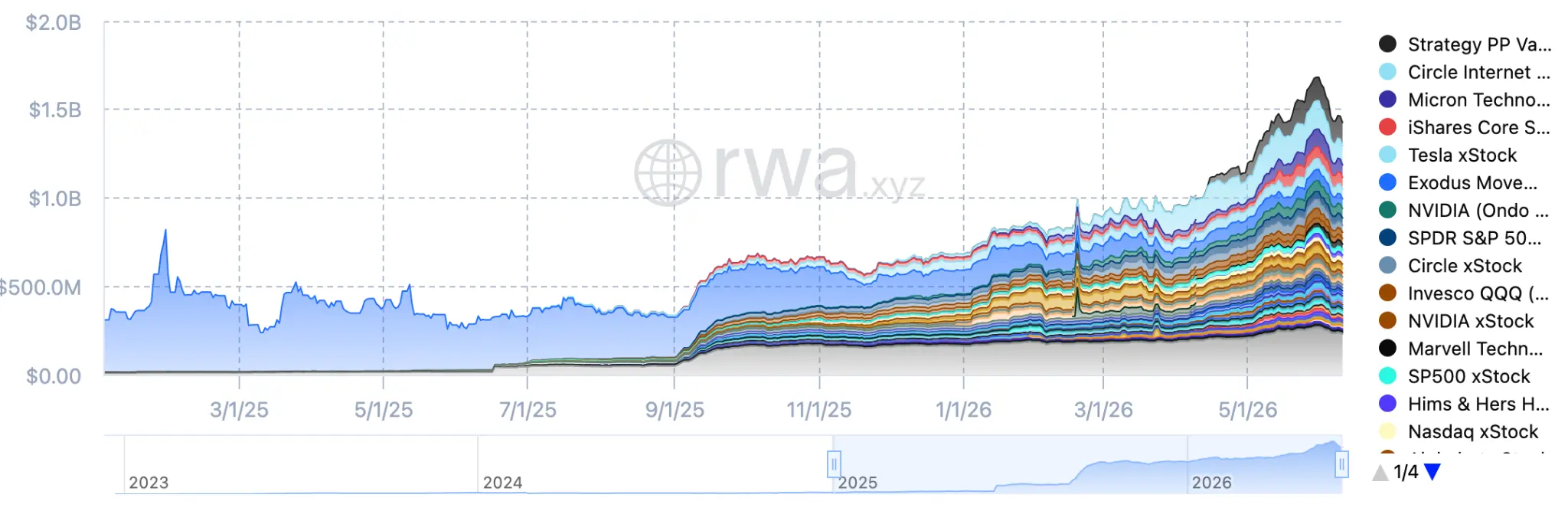
According to statistics from RWA.xyz, the monthly transfer volume of tokenized securities has reached $4.49 billion, an increase of 52.87% compared to 30 days ago; the number of holders has reached 353,380, an increase of 38.28% compared to 30 days ago; and the distributed value remains at $1.43 billion.
Data source: RWA.xyz
This indicates that tokenized securities are no longer just a few packaged on-chain certificates but are beginning to form observable and measurable asset scales, holder structures, and transfer flows.
At this point, platforms and issuance networks begin to become important.
Because the on-chain migration of U.S. stocks is not just the story of a single token, but whether a whole set of stocks and ETFs can be continuously brought on-chain, accessed by different platforms, and used in different trading scenarios. Whoever can provide a more complete asset supply and distribution network is closer to becoming the infrastructure of this asset market.
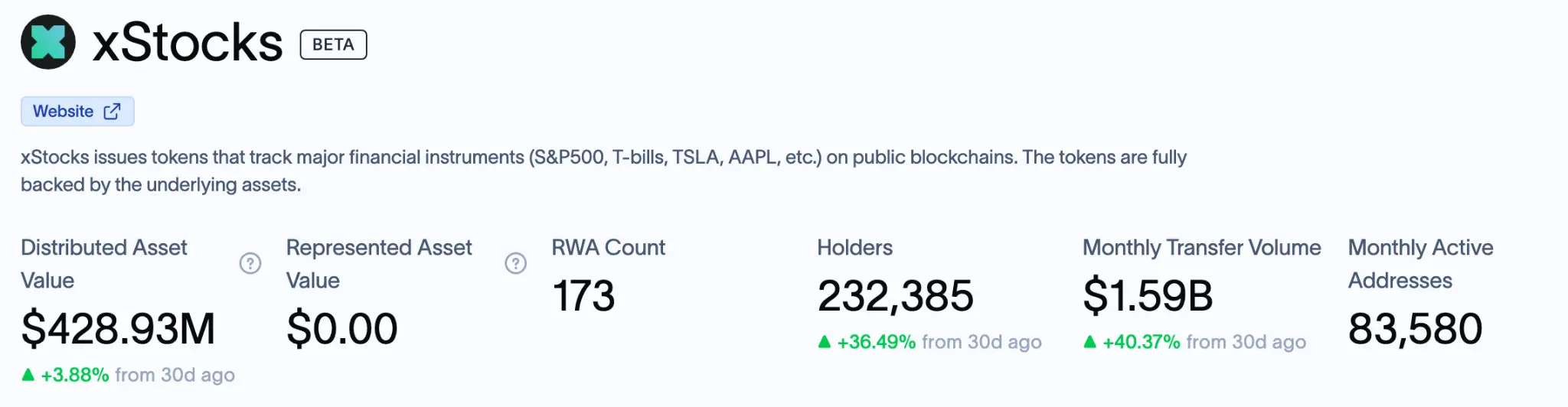
Following this line, xStocks has already become one of the most important players in this market. According to RWA.xyz tracking, xStocks has issued 173 RWAs, with a total value of approximately $421.3 million, accounting for about 26.41% of the platform ranking.
Data source: RWA.xyz
At this stage, tokenized securities are no longer just issuance experiments but are beginning to have platform distribution and trading flows.
However, from another perspective, this is still just the maturation of the first identity. It shows that U.S. stocks can be issued, held, transferred, and traded on-chain.
What truly determines the next phase is whether these assets will continue to move forward into lending, margin, perpetual contracts, and risk engines.
If it stops at the former, it is merely assets on-chain.
If it moves toward the latter, it is the migration of financial identity.
This dividing line quickly found a concrete point.
The Singularity Moment of RWA
On June 9, this moment was named: Nado.
This Perp DEX deployed on Kraken's public chain Ink officially announced the integration of xStocks.
The most crucial change this time is that the SPYx corresponding to the S&P 500 and the QQQx corresponding to the Nasdaq 100 can now be directly used as margin on Nado. In the past, they were merely on-chain U.S. stock exposures; now, they are beginning to transform into margin that can be called upon by trading systems.
This means users no longer have to sell QQQx for stablecoins to open perpetual positions in BTC, ETH, or SOL.
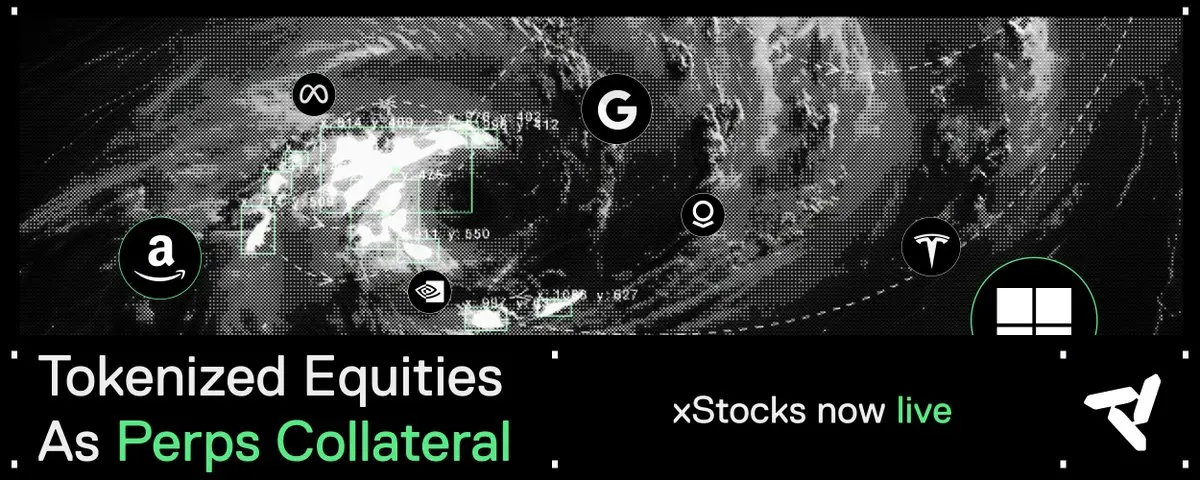
Image source: Nado official announcement
The imagination of this event does not stop at the cryptocurrency perpetual market. For those who truly engage in asset trading, the question has never been whether they can buy a certain asset, but whether the same margin can simultaneously support risk expressions across different markets: Crypto, forex, commodities, and stocks, all calculated within the same account.
Nado's ambition is to advance RWA from "on-chain holdable assets" to "the financial foundation of on-chain trading systems."
Thus, Nado becomes the first trading venue to incorporate the three on-chain identities of U.S. stocks into the same system: collateral, spot assets, and perpetual contract markets, all calculated by the same combined margin system.
The significance of this lies not only in "U.S. stocks can serve as margin" but in the fact that U.S. stocks are for the first time placed into a global risk engine. SPYx and QQQx are no longer isolated U.S. stock exposures but will enter the same risk calculations alongside perpetual positions, lending liabilities, and unrealized profits and losses.
In a fragmented system, a U.S. stock exposure can rise and fall, be bought and sold, but it is challenging to directly support positions in another market. Users wishing to trade BTC, ETH, crude oil, gold, or forex often have to first sell assets, transfer funds, convert to margin, and then reopen positions.
Nado shortens this path. xStocks can remain in the account, retaining the original U.S. stock exposure while being recognized by the system as margin, repeatedly called upon between different markets. This corresponds to Nado's official statement: "Your Tokenized Equity Is Live Capital." ------ Your tokenized stocks are no longer static holdings but live capital.
It is not just opening another entry for U.S. stocks in the Crypto world.
It is allowing U.S. stocks to enter the structure of Crypto trading accounts.
For U.S. stocks, this means that their on-chain identity is beginning to approach the most critical aspect of traditional finance: collateral.
Once the collateral identity enters the on-chain account structure, the question shifts from "can it be used" to "will it be continuously used." For assets to remain in trading scenarios, they require not only system support but also user-side reasons for use.
The Next Layer of xStocks: xPoints
If the previous discussion was about xStocks gaining "collateral identity" in Nado, then the xStocks event launched on July 8 further answers another question: why should users keep xStocks in Nado.
The answer is xPoints.
This event covers AAPLx, METAx, NVDAx, QQQx, GOOGLx, SPYx, and TSLAx. For holders, as long as they deposit supported xStocks into Nado or directly buy and hold them in Nado's spot market, this balance will count towards TVL and earn a 25% xPoints holding bonus.
For traders, Nado also adds higher limits for spot trading incentives. Buying and selling xStocks in Nado's spot market, daily trading volume will enter different tiers based on individual markets, with a maximum of 5% xPoints bonus per market; the system will select the top 5 performing markets for aggregation. If users achieve a daily trading volume of $1,000 in at least 5 markets, they can also receive an additional fixed 5% reward, with the total bonus potentially reaching 30%. Meanwhile, each spot trade will also generate Nado Points separately.
The xPoints incentive does not sacrifice asset utilization efficiency. In Nado's unified margin account, the same xStocks can earn a 25% holding bonus as TVL while continuing to serve as collateral for contract trading called upon by the system. Holding, trading, and collateralizing are no longer separate actions but continuous usage scenarios occurring within the same account structure.
Therefore, the value of Nado is not just "supporting xStocks," but allowing xStocks to have a clearer reason for use on-chain: it can be both U.S. stock exposure and collateral, while also becoming an asset that continuously captures xPoints.
For users focused on xPoints, Nado is becoming a more efficient entry point for xStocks; for RWA, this is also a key step in moving assets from "on-chain holdable" to "on-chain callable capital."
Conclusion: The Next Step for RWA
This step will not be too far away.
SPYx and QQQx are just the beginning of Nado and xStocks' ambitions. What is happening now is not that RWA has completed financialization, but that it has first appeared a sufficiently clear path: on-chain assets first enter observable asset pools, then are recognized by the margin system, and finally become underlying capital callable by trading systems.
Looking at the recently launched xPoints system for xStocks in the context of Nado, the user-side reasons for use also become more direct: bring xStocks to Nado, keep them in the account, engage in spot trading, and continue to be embedded in trading scenarios.
This path will not stop at SPYx and QQQx. More tokenized U.S. stocks will enter Nado, and commodities and other RWAs also have the opportunity to become collateral along the same logic.
The real variable is not the lengthening of the asset list, but the increasing number of real-world assets beginning to enter the same account, trading, and margin structures.
The next phase of RWA may not be defined by "who issued more assets," but by "who first makes these assets effective capital in the on-chain trading system."
 Risk warning


Popular articles