Concerns Behind the Binance Customer Service Controversy
 Core Viewpoint

 As the user base expands to the scale of Binance today, relying on the personal efforts of the founder and a few employees to fill process gaps has become an unsustainable arrangement.
Author: Zhou, ChainCatcher
Starting on the evening of June 14, there was a concentrated wave of criticism in the Chinese community regarding the quality of Binance's VIP customer service.
Several long-term high-volume users reported that after contacting the VIP dedicated customer service, there was a long period of no response. After the account manager they were connected with left or was replaced, there was no new person to continue handling their issues. The discussion quickly spread, with more users following up with similar experiences.
On Monday, Binance co-founder He Yi publicly responded. She acknowledged that the KPI design has long focused on the response speed and satisfaction of regular customer service, resulting in relatively scarce service resources for VIP and KOL users. She promised systematic adjustments at the workflow level, including assigning dedicated customer service managers to VIP users within 24 hours and fixing system failures in the VIP channel.
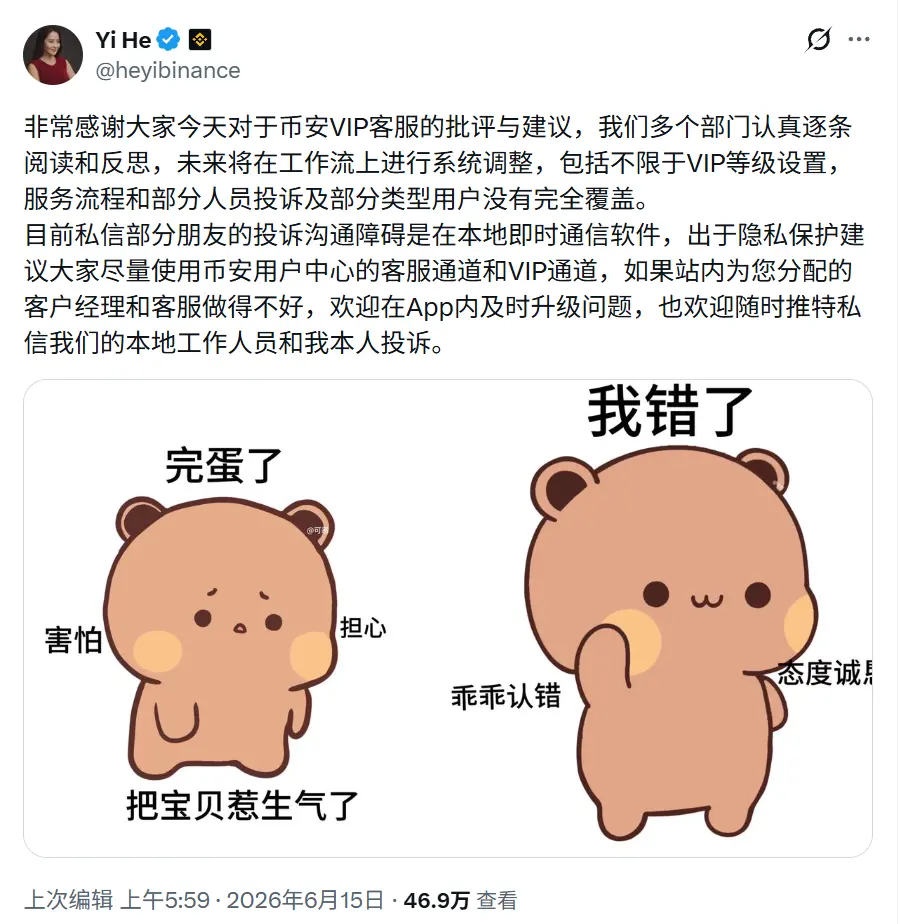
Since the beginning of this year, major exchanges have gradually lowered the VIP threshold to expand the base of high-net-worth users. This incident actually points to a mismatch between the exchange's incentive mechanisms and its service delivery capabilities.
Structural Mismatch Between KPI and Business Contribution
He Yi mentioned in her response that in the past, KPIs primarily assessed the resolution speed and satisfaction of regular customer service, which led to the VIP and KOL groups being relatively overlooked in resource allocation. There was a collaborative disconnect between customer service and VIP support, with some users experiencing information loss after switching channels within the app, resulting in a worse experience than regular users. A dedicated channel that was supposed to enhance service ultimately became a burden.
This mismatch is not uncommon in rapidly expanding platforms. When a large amount of resources is used to cover a broader base of regular users, the top users who contribute the majority of trading volume and fee income can easily find themselves marginalized in the daily service system.
Lowering the threshold allows more users to enter the VIP ranks, but high-touch resources like dedicated managers and closed-loop problem handling are difficult to scale proportionally in the short term. Rate discounts are just a line of code adjustment, while customer managers require recruitment, training, and acclimatization, making the expansion speed inherently slower.
As a result, top users are the first to feel the service squeeze. They have higher demands for platform stability and stronger voices, making their issues more likely to surface at the community level.
Easy to Start an Incentive War, Hard to Deliver
ChainCatcher mentioned in an article titled “Cryptocurrency Exchanges Start the VIP Customer Competition” published in April that in March, Binance directly lowered the entry-level VIP 1 capital threshold by nearly 80%. In a bear market, exchanges collectively lowered VIP thresholds, bringing the private banking customer cultivation logic into the exchanges.
This incentive logic can indeed play a significant role in attracting liquidity and short-term retention, but when the VIP base expands rapidly, the organizational capacity for service delivery, system support, and feedback loops becomes a bottleneck.
Cryptocurrency trader @yuyuvkx mentioned that as a long-term high-volume user, they encountered a situation where there was no response from the VIP department for half a month. Other users also reported issues with unreasonable contract index components, receiving no response on the platform or Twitter.
This gap is not an isolated case; it results from the incentive logic outpacing organizational execution capabilities. VIP status already enjoys corresponding rights in terms of fees and limits, but when encountering specific issues, the difficulty of finding a stable contact person and a predictable resolution path increases.
After the incident gained traction, He Yi quickly responded, with multiple departments sorting through the feedback and proposing adjustment directions, including VIP level settings, service process optimization, and user coverage improvements. Meanwhile, Binance customer service team member Sisi also publicly stated that they would continue to follow up on the issues, emphasizing that regardless of user scale, they are welcome to contact directly.
Many voices in the community recognized the speed of this response, believing that for a company of such size, providing a clear statement within a day is not easy.
However, looking at it from another perspective, if the service issues of VIP and KOL users can only be seen by higher-ups through social media fermentation, it indicates that the regular customer manager reporting and ticket escalation mechanisms are not functioning effectively.
Attitude issues can be resolved with a public response, but certainty at the process level requires verifiable systems, not one-time commitments. As X user @taresky said, holiday greetings and care are meaningless; what is truly needed is the ability to find a real person to handle issues when they arise and provide clear timelines for resolution.
When Processes Are Unreliable, Relationships Matter
From another angle, when users' actual capabilities in the problem-solving process also begin to show stratification, the situation becomes not just a service experience issue, but rather a matter of whose problems can be advanced and who can find the right person in charge.
The current organizational structure of the exchange exacerbates this uncertainty to some extent. After the public outcry, Sisi's team released a contact list for different business lines, including VIP, Plaza, Wallet, and Community.
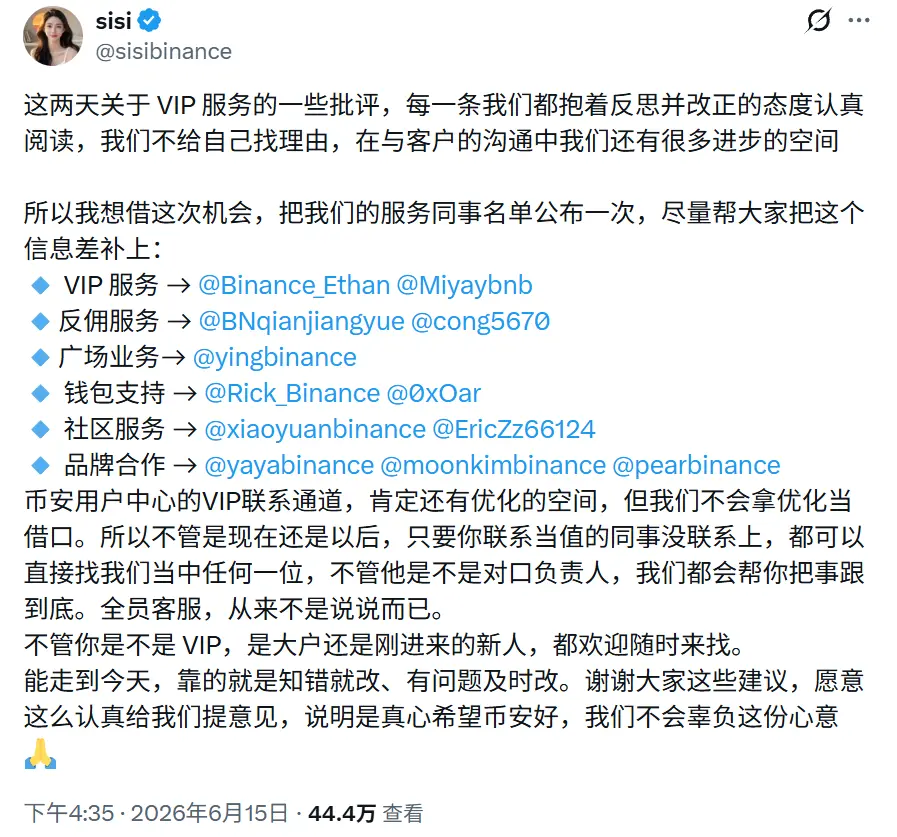
Users' issues were originally handled in a decentralized manner by department. Once a problem requires cross-department coordination, there is a lack of a unified escalation path and responsible parties within the platform.
In this structure, private chats, Telegram, and X direct messages have become common informal escalation channels. Cryptocurrency KOL Tuao Dashi mentioned that he met Sisi years ago due to account compliance issues, and over the years, when encountering similar problems, confirming through her is often faster and more reliable than going through formal processes. Many KOLs have also stated that they have resolved business issues through similar means.
Where processes fail, "relationships" become the effective system. A contrasting example is that a post that circulated widely during this public discourse came from @yuyuvkx, who claims to have assets worth tens of millions of dollars and a long-term trading volume exceeding hundreds of millions, yet was neglected for half a month until publicly criticizing on X brought attention.
This indicates that whether one can access private channels is not a competition of asset size or influence, but rather whether one happens to know the right person. However, this variable of private channels is more elusive than asset size and harder to institutionalize, which is precisely the danger of relationship-based governance.
This model may have been an advantage when the platform was smaller, allowing founders to directly perceive users' real experiences. But as the user base expands to the scale of Binance today, relying on the personal efforts of founders and a few employees to fill process gaps is no longer a sustainable arrangement.
It can accommodate the loudest voices but cannot support the silent majority.
The exchange has reached a global infrastructure level, yet whether customers can be treated equally in resolving issues still depends on whether they know the right person or how loud their voices are. If this gap is not institutionalized, it will only grow wider with the expansion of scale.
Conclusion
Ultimately, the root of this incident lies in the exchange's organizational capabilities not keeping pace with the speed of business scale expansion.
Looking deeper, this misalignment is almost inevitable. Companies that have reached today's scale in the cryptocurrency industry rely precisely on the quick, flexible, and unbound response capabilities of the startup phase. However, to truly complete the transformation from a startup to an institution, this "human touch" needs to be solidified into a stable operating system.
This is also a lesson that all exchanges pursuing scale must learn as they move towards becoming mature financial infrastructures.

 Risk warning