Who is leading the price discovery in the cryptocurrency market? Measured delays on platforms like Binance and Hyperliquid
 Core Viewpoint

 There is a saying circulating on crypto Twitter: Hyperliquid has replaced Binance and become the center of crypto price discovery. Arrakis conducted a cross-platform test using the tick-by-tick transaction data from 29 perpetual markets, and the truth lies in the milliseconds.
Author: Arrakis
Compiled by: Jiahua, ChainCatcher
Delayed testing of perpetual contracts across 3 major platforms and 29 crypto assets, in-depth analysis of the PerpDEX architecture.
This content is for informational exchange and educational purposes only and does not constitute investment advice. Arrakis has made reasonable efforts to verify the accuracy of the data provided but does not guarantee that all information is absolutely accurate, complete, or up-to-date. Thanks to @0xArchiveIO for their contribution to this research.
Introduction
Hyperliquid is the largest on-chain perpetual contract platform by trading volume and open interest. It has expanded from crypto perpetual contracts to real-world assets, prediction markets, and permissionless DeFi tech stacks.
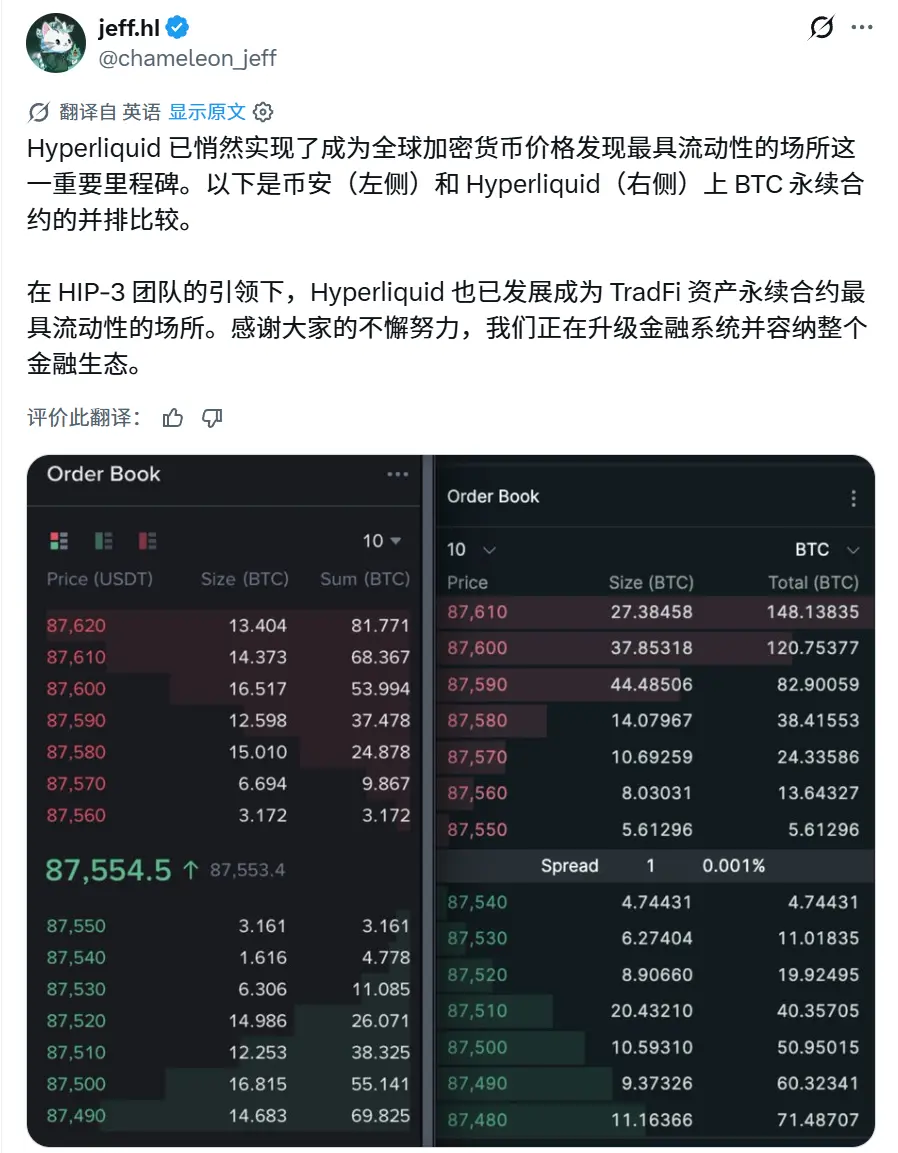
If you spend enough time on crypto Twitter, you will hear statements like: Hyperliquid has replaced Binance as the current center for cryptocurrency price discovery.
We verified this claim. Inspired by the paper by Hoffmann, Rosenbaum, and Yoshida, we ran an improved version of the Hayashi-Yoshida lead-lag estimation model on three trading platforms (@HyperliquidX, @binance U-based contracts, and @Lighter_xyz).
What We Measured
Core question: How long does it take for a price change of an asset on one platform to be reflected on other platforms?
Each platform publishes trading records, which are detailed transaction records with timestamps.
The most intuitive way to measure cross-platform lead-lag is to extract two trading records, shift one in time relative to the other, and select the time shift that maximizes the correlation of price changes on both platforms among a series of possible time shifts. The time shift that produces the clearest alignment is the lead-lag time between the two platforms.
If we shift Hyperliquid's timeline back by 700 milliseconds to perfectly align its price changes with Binance, it means Binance is leading by 700 milliseconds.
We used the Hayashi-Yoshida estimation model, which is designed for two price series where trades occur at irregular, asynchronous times. At each candidate time shift point, it calculates:

Where Cov(X, Y) is the covariance between X and Y, which in our case are the return series of trades from the two platforms we are comparing. σX and σY are the standard deviations of these two distributions.
We ran the model separately on buyer trades (market sell orders) and seller trades (market buy orders) to avoid noise from bid-ask spread fluctuations at sub-second resolution.
For each pair of platforms, we calculated the ρ value from -2000 milliseconds to +2000 milliseconds in 100-millisecond increments, then read the time shift at which ρ peaks. A positive time shift indicates that the leading platform is ahead.
We analyzed the top 29 crypto assets by market capitalization that have trades on all three platforms:
$BTC · $ETH · $BNB · $XRP · $SOL · $TRX · $DOGE · $HYPE · $ZEC · $ADA · $XMR · $BCH · $LINK · $TON · $XLM · $LTC · $SUI · $AVAX · $HBAR · $NEAR · $TAO · $DOT · $UNI · $ONDO · $WLFI · $ASTER · $ICP · $MORPHO · $AAVE
Our analysis window was 16 days ending on February 26, 2026, with the platforms tested including: Hyperliquid vs. Binance, Hyperliquid vs. Lighter, and Lighter vs. Binance.
The complete analysis methodology can be found in our blog post.
What We Found
Each analysis reached a highly consistent conclusion:
- Among all 29 assets: Binance leads Hyperliquid
- In 27 of the 29 assets: Lighter leads Hyperliquid
- In 23 of the 29 assets: Binance leads Lighter
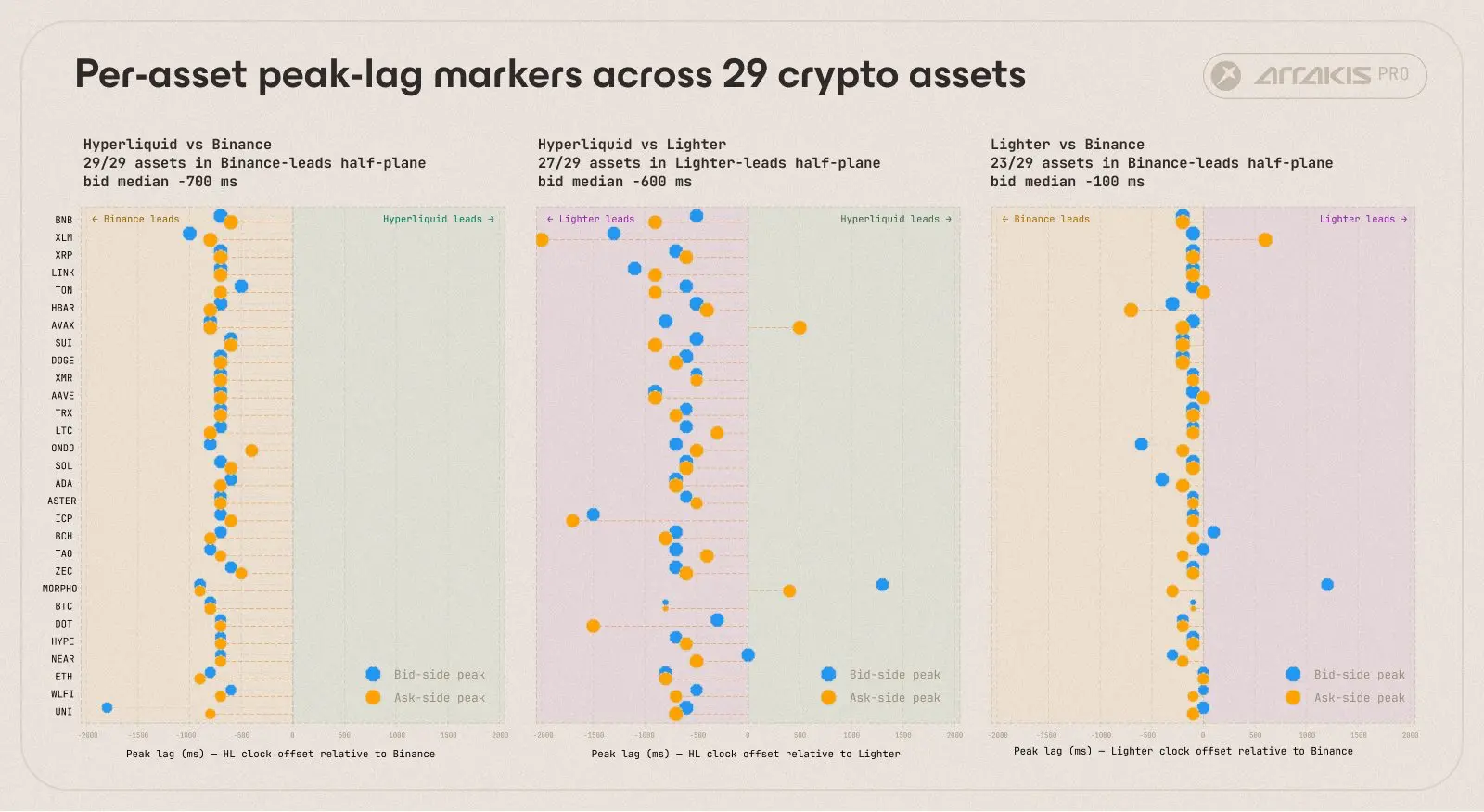
Peak delay markers for all assets across the three platforms, with the same asset ordering in each panel. Regardless of which platform is on the other end, the two panels involving Hyperliquid look almost identical. The panel comparing Lighter to Binance collapses into a dense cluster at the negative delay edge.
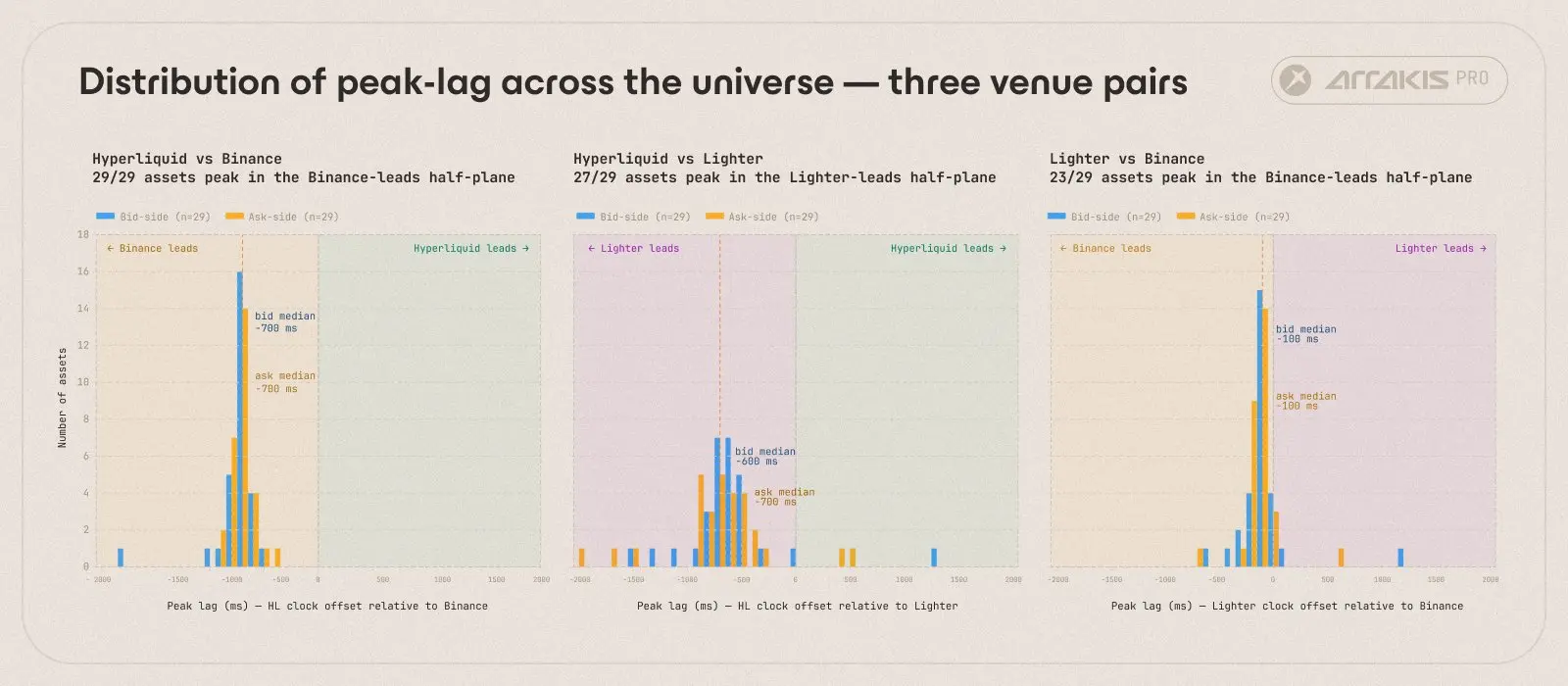
Distribution of peak delay ranges for the 29 underlying assets, from -2000 to +2000 milliseconds, in 100-millisecond intervals. Both panels involving Hyperliquid peak between -600 and -700 milliseconds. The panel comparing Lighter to Binance peaks at -100 milliseconds.
The two panels involving Hyperliquid look extremely similar: regardless of which platform is on the other end, they cluster tightly around -700 milliseconds.
From Hyperliquid's perspective, the delays from Binance and Lighter are very close, and both lead it by roughly the same amount. The panel comparing Lighter to Binance is compacted by an order of magnitude, around -100 milliseconds, which is also the smallest incremental unit we tested for lead-lag in the model.
This phenomenon is clearly visible at the single asset level when observing BTC transaction data. The correlation between Hyperliquid and Lighter and between Hyperliquid and Binance consistently peaks at -800 milliseconds, indicating that Hyperliquid is always lagging behind these two platforms at both levels.
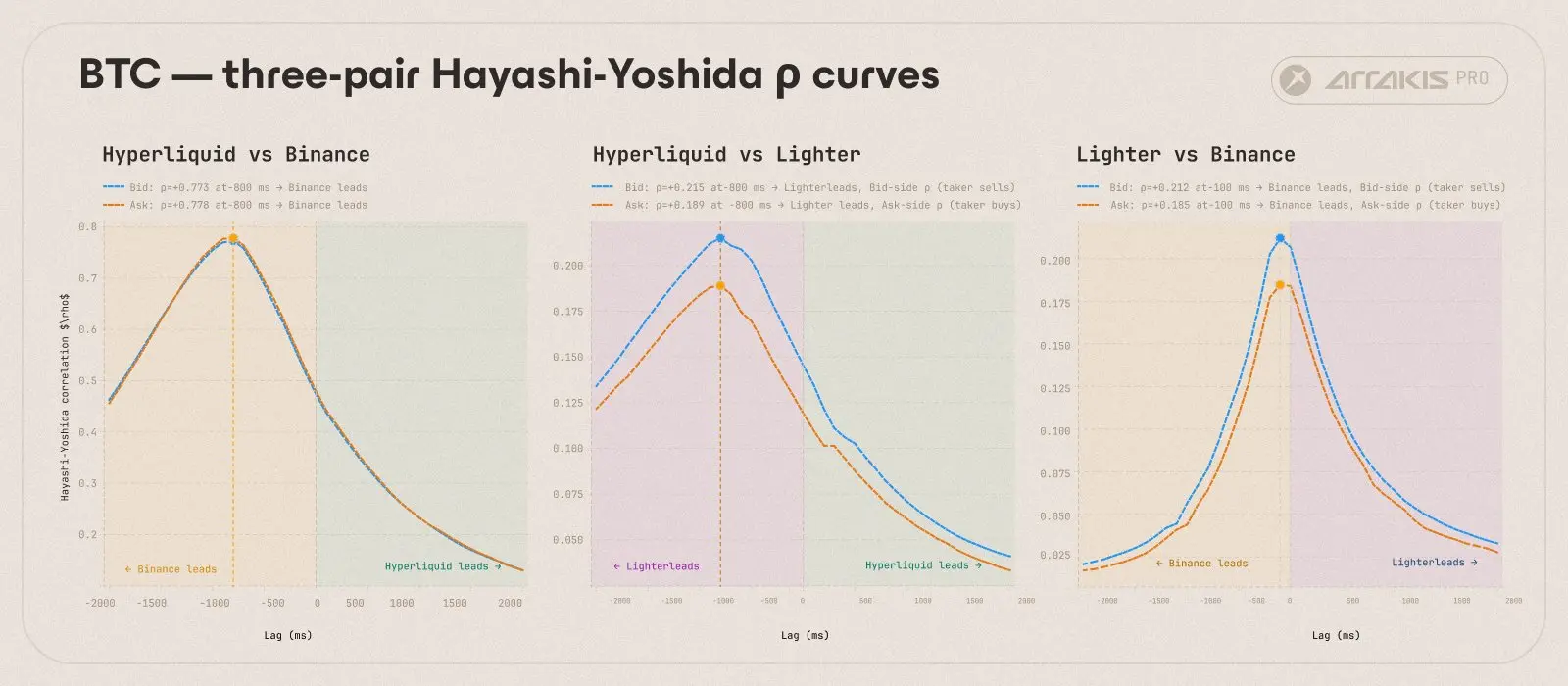
Comparison of BTC correlation delay curves across all three platforms. The direction of delay is consistent: both panels involving Hyperliquid are at -800 milliseconds, while the panel comparing Lighter to Binance is at -100 milliseconds.
Transitivity Test
If these three paired delays reflect the same underlying microstructure, they should be additive: the delay from Binance to Hyperliquid should equal (Binance to Lighter) plus (Lighter to Hyperliquid). We tested this across the 29 markets we analyzed.
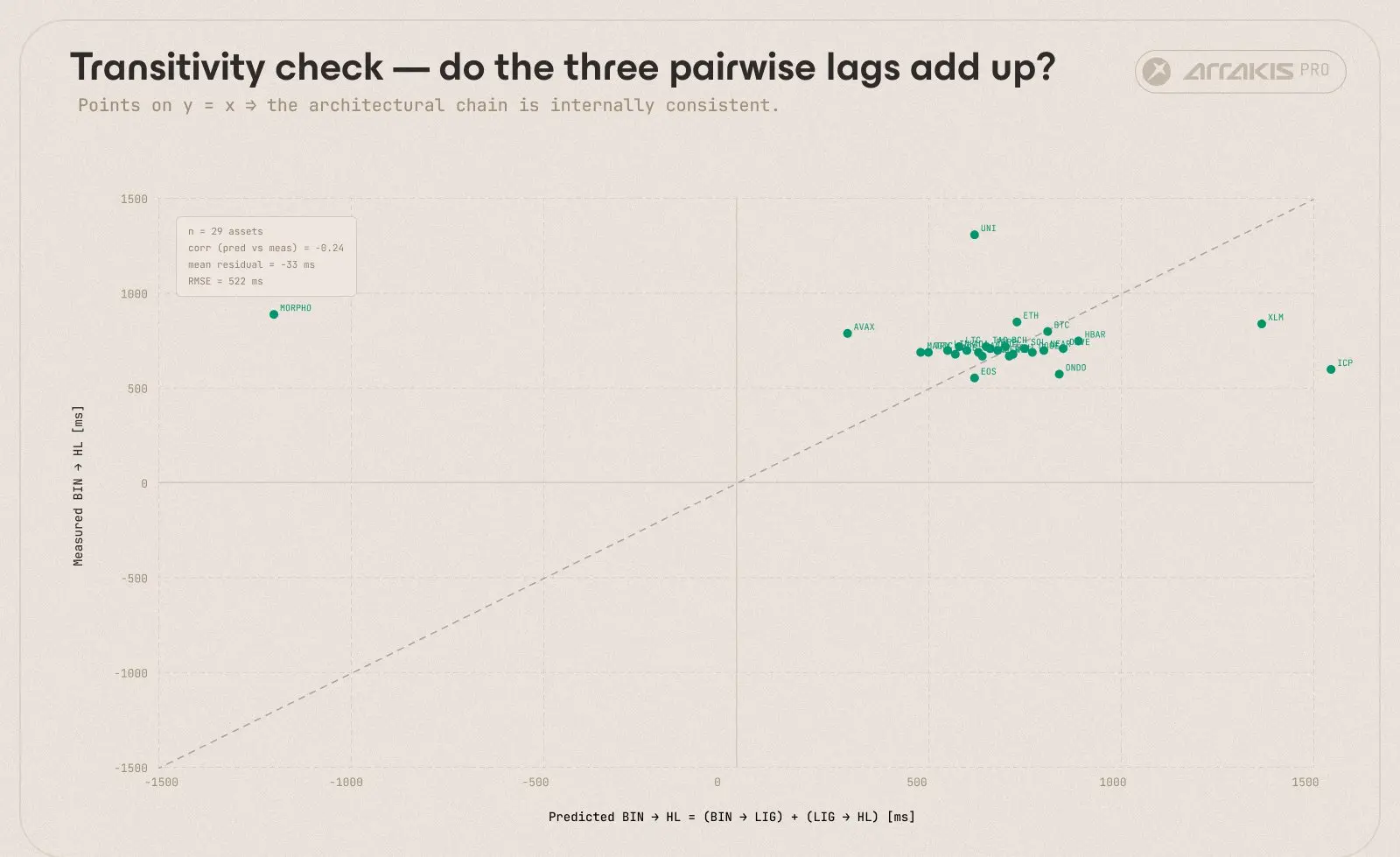
The X-axis represents the predicted delay from Binance to Hyperliquid (i.e., the sum of Binance to Lighter and Lighter to Hyperliquid), and the Y-axis represents the actual measured delay from Binance to Hyperliquid. Each data point represents an asset. The overall median residual is -33 milliseconds.
The median residual is only -33 milliseconds, indicating that these assets satisfy transitivity. Outliers (MORPHO, ICP, XLM, UNI) have more noise because their delay correlation curves never truly peaked within our ±2000 milliseconds window. Our estimation model could not accurately compute a clear lead-lag value for them.
All other markets conform to the transitive relationship. This consistency suggests that this lead-lag phenomenon is determined by structural factors such as the matching and settlement mechanisms of these platforms, rather than being a mere artifact of comparing a specific set of platforms.
Where Does Hyperliquid's Delay Come From?
The three platforms employ three completely different matching architectures.
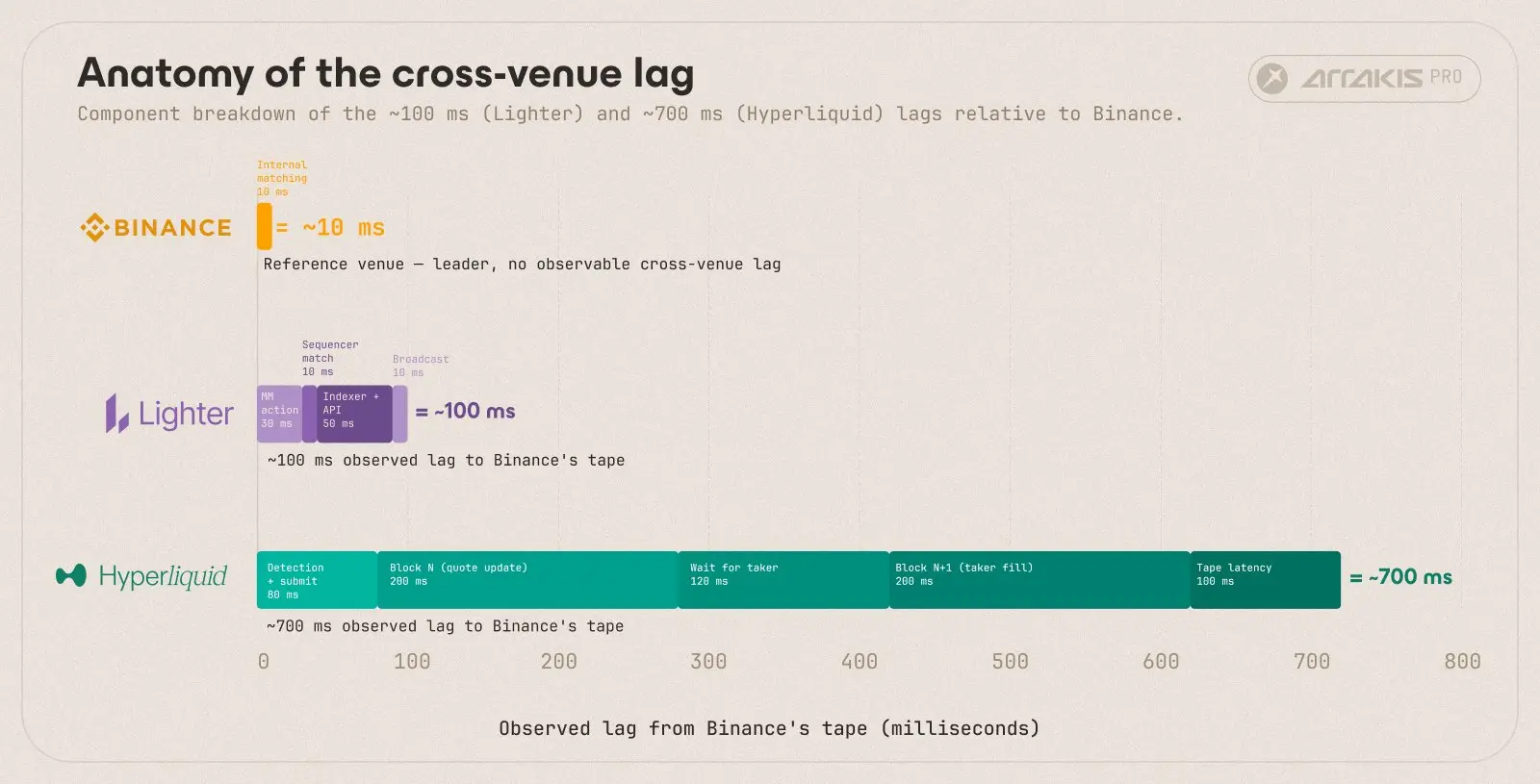
Cross-platform delay analysis. Using Binance as a reference. The approximately 100 milliseconds delay for Lighter is primarily due to the time taken from the sequencer to the indexer and then to the API.
The approximately 700 milliseconds delay for Hyperliquid is mainly composed of two complete HyperBFT consensus cycles: one for the maker's quote update (block N) and another for the natural taker's transaction (block N+1).
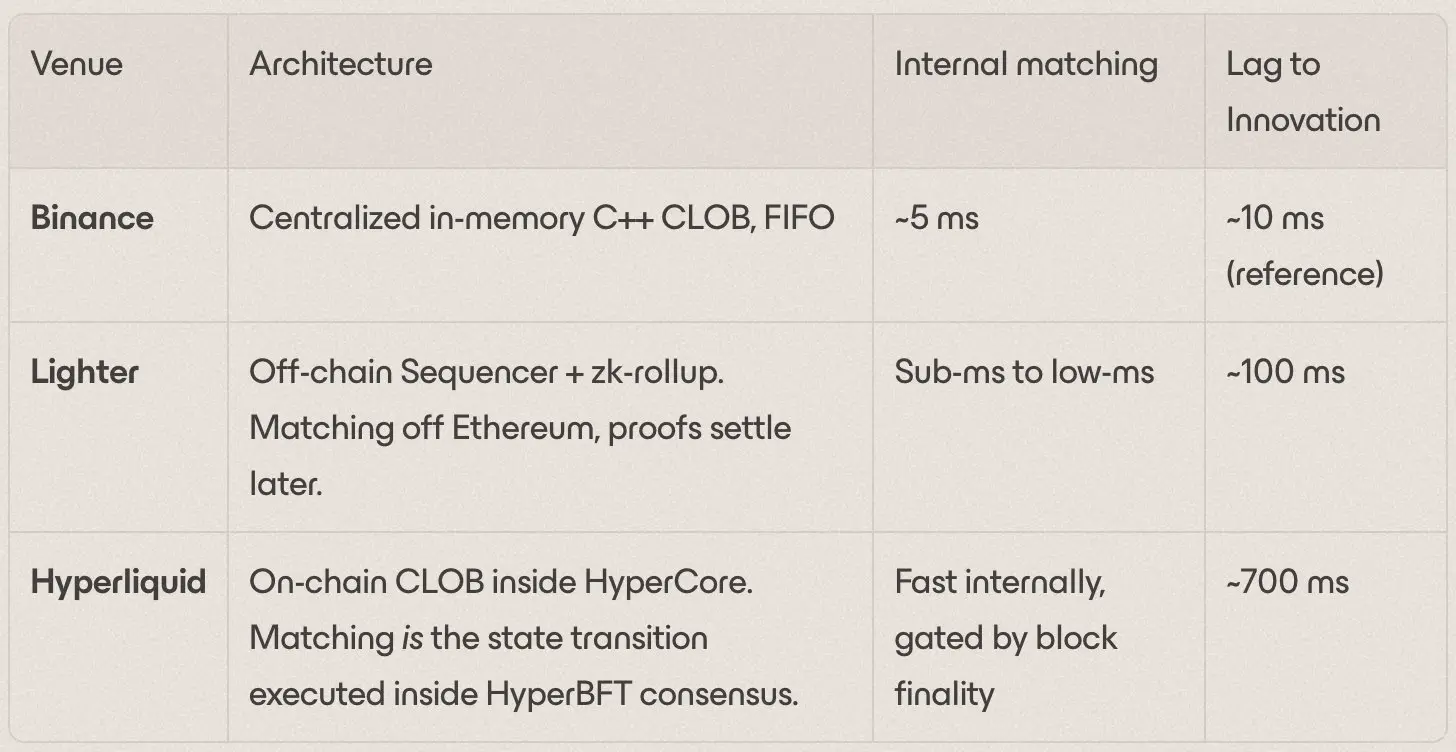 Both Binance and Lighter complete matching in memory at millisecond speed, while Hyperliquid's matching process is essentially a state transition of HyperBFT, meaning each transaction must wait for about 200 milliseconds for block finality (according to Hyperliquid's official documentation).
However, the actual delay observed in transaction records is about 700 milliseconds, not 200 milliseconds. The additional approximately 500 milliseconds comes from the maker-taker round trip process built on single block finality.
The most reasonable explanation is that this is a maker-taker round trip interaction spanning two consecutive blocks. Here’s a series of processes that occur after a price change on Binance:
Stale liquidity remains on Hyperliquid. Existing market maker quotes deviate from Binance's new price.
Memory pool racing. Arbitrageurs speculatively send large amounts of IOC (Immediate or Cancel) orders targeting the expected stale liquidity. Market makers send cancellation and re-quote trades to refresh their quotes, designed to ensure these operations enter the top of the block. Market makers that fail to refresh their quotes in this block will be arbitraged.
Block N is submitted at about 200 to 300 milliseconds. Cancellation instructions remove the market maker's stale quotes. New orders publish the refreshed quotes. Surviving IOC orders consume the remaining stale liquidity at the old price, so most transactions in this block occur at the stale price relative to Binance.
At this point, Hyperliquid's order book has been cleared, but no one has traded at the refreshed quotes yet.
Takers begin trading at the updated prices.
Block N+1 is submitted at about 500 to 700 milliseconds. Takers match with the refreshed maker orders. This is the first transaction carrying new price information, which is the data our model captures related to the price movements lagging behind Binance.
This means that price changes on Binance take at least two complete HyperBFT cycles to manifest in Hyperliquid's transaction data.
In contrast, Lighter completely skips this process. Its sequencer matches in memory; quote updates and transactions against those quotes are completed within the same millisecond. The approximately 100 milliseconds delay reflects the delay at the indexer and API level, which is also the finest granularity we added for lead-lag time series in the model.
What Lighter Proves
Lighter's pricing closely follows Binance, with very little delay relative to Hyperliquid. This breaks the assumption that "Hyperliquid has delays because it is a DEX," as Lighter is also a DEX. Order flow goes to a centralized off-chain sequencer, but the entire system achieves verifiable decentralization through settlement to Ethereum's zero-knowledge proofs (zk-proofs).
The difference lies in where decentralization is enforced. Hyperliquid enforces decentralization at the matching layer: every order, cancellation, and transaction is confirmed by a collection of validator nodes; whereas Lighter executes decentralization at the settlement layer: the sequencer matches in memory and then proves the correctness of its transactions to Ethereum.
Lighter trades speed for shifting the trust boundary from the matching layer to the settlement layer. Hyperliquid retains the trust boundary at the matching layer and thus pays the price of delay.
What Hyperliquid Can Do
To improve its price delay issues relative to price discovery platforms like Binance, Hyperliquid can make the following adjustments to its current design:
More compact HyperBFT pipeline. By optimizing leader rotation, parallel voting, or network efficiency, compress the median block time to below 200 milliseconds. Every millisecond saved reduces the time taken by two blocks in the round trip cycle.
Although this cannot eliminate the structural reasons for the delay, any substantial improvement in block time can exponentially reduce price delays.
Pre-confirmation or soft finality layer. Establish a separate fast channel for pre-confirming block packaging, then asynchronously achieve HyperBFT finality. Market makers can publish quotes based on the pre-confirmed state, effectively reducing the latency of market updates.
The cost is that pre-confirmation requires trusted infrastructure or a collateralized guarantee backed by a penalty mechanism. Both approaches would reintroduce trust assumptions that Hyperliquid currently avoids.
Decoupling matching from consensus. This is the most ambitious and costly option. Running an off-chain fast matching layer to generate preliminary transaction results, then batch submitting them to the consensus mechanism, is structurally closer to Lighter's design.
While this approach can significantly lower the lower bound of delays, the trust assumptions will undergo substantial changes, completely deviating from the current fully free validator model.
Each path requires deep modifications to the architecture at different layers and introduces trust assumptions that do not currently exist in the system. Whether the delay improvements brought by these methods are worth the cost of new trust assumptions needs to be decided by the team and the community together.
What This Means
Hyperliquid has established its leading PerpDEX position in terms of liquidity, open interest, and retail participation. It is pioneering new frontiers in DeFi, launching innovative markets that do not exist in traditional finance: weekend trading for stocks and commodities, perpetual contract markets for equity before IPOs, inflation outcome markets, and more.
However, as the market matures and more participants join, the next round of competition in on-chain perpetual contracts will unfold in the realm of delays. Hyperliquid has built the most liquid platform on the foundation of a decentralized on-chain matching engine.
The suspense now lies in whether Hyperliquid can continue to dominate the price discovery of these innovative markets while adhering to this design.
 Risk warning