Caitong Strategy Xu Chenyin: The History of Growth in the US Stock Market, The History of War in the US
 Core Viewpoint

 Caitong Securities reviews a century of American war history: the impact of war on the US stock market has shifted from being driven by emotions to being driven by economic fundamentals, with upstream resource industries often achieving excess returns during various conflicts.
Original text: Sincerity Strategy Tongcai
Core Viewpoints:
Report Guide: At the end of the 19th century, the United States became the world's largest economy and gradually established its hegemonic status through a series of wars. The U.S. stock market thrived under the baptism of war. This report systematically studies the wars the U.S. has participated in over the past century and their impact on the U.S. stock market, summarizing the patterns.
- The U.S. global hegemonic status is built on the foundation of super-imperialist policies: By the end of the 19th century, the U.S. gradually transformed its economic advantages into political and military power. In the early 20th century, World War I enabled the U.S. to gain a dominant position in the capitalist system. In the 1940s, with the defeat of fascism and Nazism in World War II, no capitalist power could threaten the U.S. position, and super-imperialism officially took the stage of history, solidified as a cartel among Western industrial powers in conflict with the socialist camp led by the Soviet Union. Under the super-imperialist system, the U.S. could dominate international politics through the alliance system established after World War II and exert interference through military deterrence to achieve its interests.
Through a systematic review of the gains and losses of U.S. interests in various wars and the performance of U.S. stock indices and industries, three patterns emerge:
The U.S. benefited from wars other than the Vietnam War, gradually transforming from a participant to an initiator of wars: Before the Vietnam War, only the Spanish-American War was initiated by the U.S. The U.S. gained substantial benefits from four wars; the Vietnam War was the only war the U.S. lost and did not benefit from, marking a turning point in U.S. war strategy. Conflicts after the Vietnam War were initiated by the U.S. under various pretexts, characterized by short time and space spans, primarily revolving around oil, and ultimately achieving their goals.
The main impact of war on the stock market has shifted from direct emotions to indirect economic factors: During wars, the fluctuations of stock indices vary significantly based on time spans. The main impact of wars on the stock market has shifted from direct emotions to indirect economic factors. Before and during World War II, war-related events directly disturbed the market through emotions. Starting from the Korean War, the marginal influence of war events began to diminish, and subsequent wars guided stock market trends more through economic channels.
The characteristics of war models and the historical context endow specific industries with unique genes: The characteristics of war models and historical context endow specific industries with unique genes. Upstream resource industries benefited from military orders and war inflation, while consumer industries appeared more frequently among underperforming sectors. During World War II, coal was the main resource; during the Korean War, oil consumption began to rise significantly; inflation during the Vietnam War allowed upstream resource industries to outperform; during the Kosovo War, raw materials and energy sectors still yielded the best returns. During the Gulf War, the transmission path of war to the stock market changed, with consumer sectors, less negatively affected, outperforming in the short term. Tobacco and grocery stores ranked among the bottom five performers during World War II and the Korean War; during the Kosovo War, discretionary consumption ranked among the bottom five industries, with health and essential consumption also included.
Risk Warning: Historical experience does not guarantee future outcomes; industry progress may fall short of expectations; trade protection policies in various countries may intensify.
Main Text:
Preface: The 1854 Black Ship Incident not only marked the end of Japan's isolationist era but also the beginning of the U.S. strategy of "opening the door." In 1894, as the U.S. economy surpassed the U.K. to become the world's largest, super-imperialism was on the horizon. Over the following century, the U.S. participated in and initiated nearly ten wars, gradually seizing and consolidating its global hegemonic status. The U.S. stock market thrived under the baptism of war. This report systematically studies the wars the U.S. has participated in over the past century and their impact on the U.S. stock market, summarizing the patterns.
1 Super-imperialism: The Path of U.S. Aggressive Expansion
The U.S. global hegemonic status is built on the foundation of super-imperialist policies. By the end of the 19th century, the U.S. gradually transformed its economic advantages into political and military power. In the early 20th century, World War I enabled the U.S. to gain a dominant position in the capitalist system. In the 1940s, with the defeat of fascism and Nazism in World War II, no capitalist power could threaten the U.S. position, and super-imperialism officially took the stage of history, solidified as a cartel among Western industrial powers in conflict with the socialist camp led by the Soviet Union. Under the super-imperialist system, the U.S. could dominate international politics through the alliance system established after World War II and exert interference through military deterrence to achieve its interests.
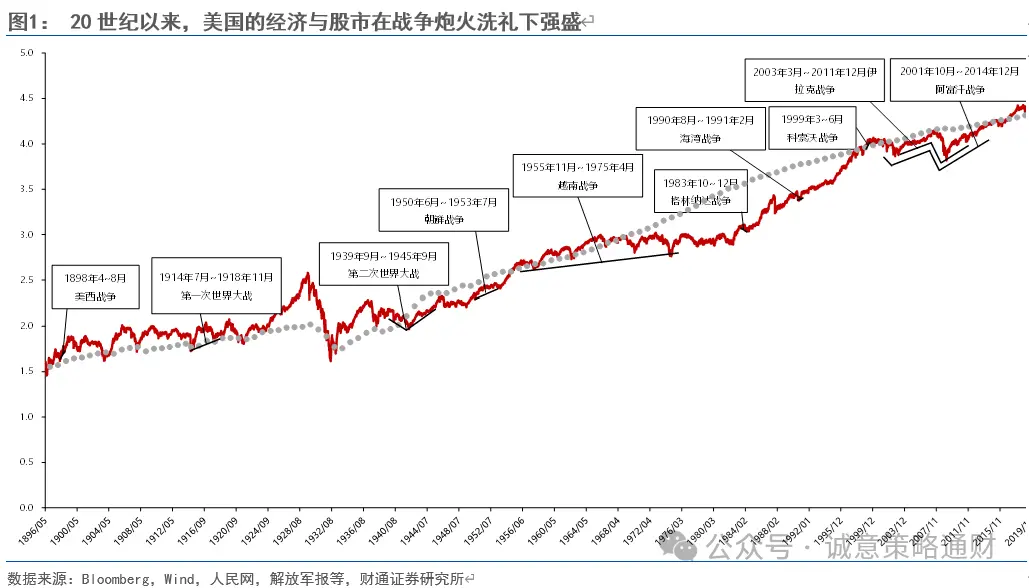
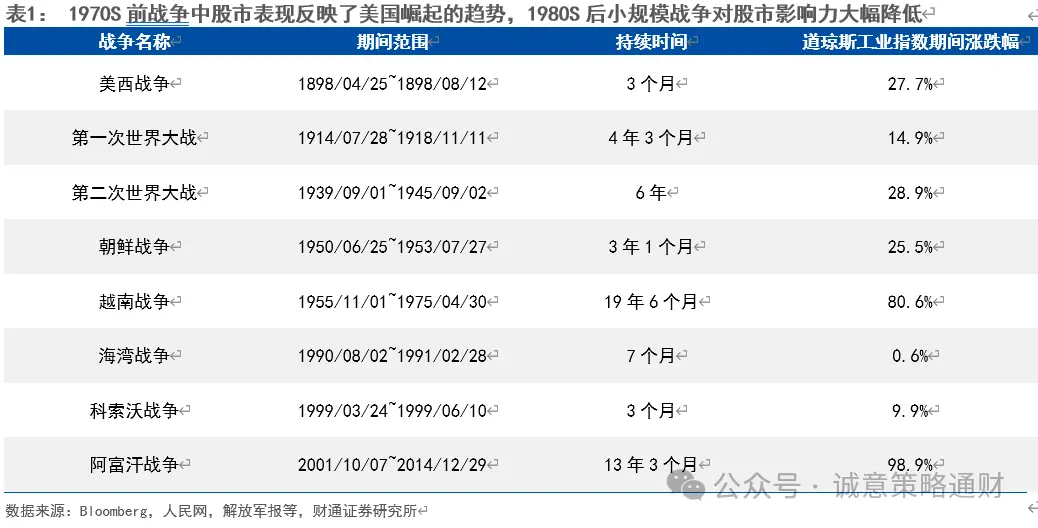
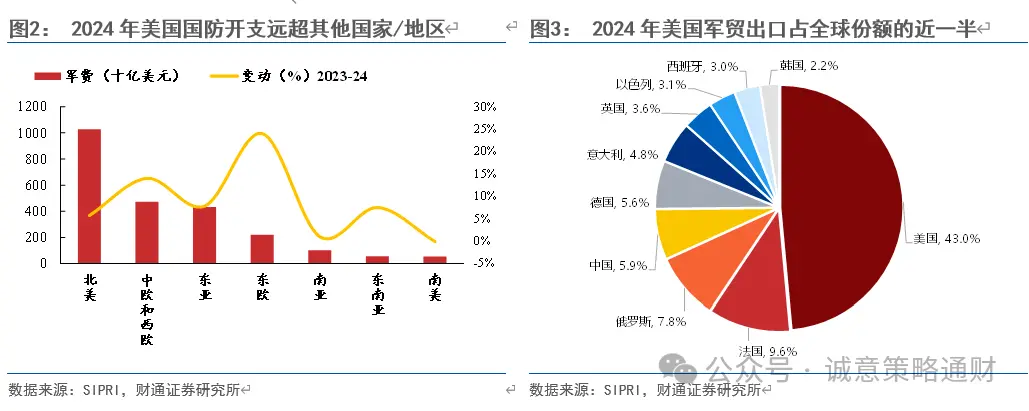
The military-industrial system is the foundation of America's rise, serving not only as a powerful force to defend national interests but also driving economic growth. Over the years, defense spending, which constitutes 3% of GDP, forms the basic foundation of the military-industrial sector, while military orders can surge in the event of regional conflicts; simultaneously, the U.S. ensures its energy and raw material supply through a global network of military bases, allowing domestic multinational companies to invest and capture local markets, maintaining its "comprehensive dominance" position.
2 Spanish-American War: The Beginning of American Imperialism, Market Rise Synchronizes with Victories on the Battlefield
The Spanish-American War was a war initiated by the U.S. in 1898 to seize Spanish colonies in the Americas and Asia, marking the first imperialist war for the great powers to re-divide colonies.
2.1 Gains and Losses: The U.S. Seizes Important Overseas Colonies from Spain at a Low Cost
By the end of the 19th century, the U.S. entered the imperialist era, with domestic monopolistic conglomerates urgently needing to open new markets, investment locations, and raw material sources. Against the backdrop of the world being divided among established colonial powers, the Cuban War of Independence created an opportunity for the U.S. to seize the remnants of the Spanish colonial empire. The U.S. already had economic interests related to sugar, coffee, and tobacco in the Spanish islands, and controlling Cuba was crucial for securing the safety of the Gulf of Mexico and the Panama Canal. The Philippines could provide the U.S. with a favorable position in the populous Asian market.
After the war, the U.S. gained control over Cuba while acquiring the Philippines, Guam, and Puerto Rico through purchase and cession. On December 10, 1898, the U.S. and Spain signed a treaty in Paris, where Spain relinquished control of Cuba and recognized its independence, ceded Guam and Puerto Rico, and transferred sovereignty over the Philippines to the U.S. for $20 million.
2.2 Index Performance: Fluctuating Gains, Two Major Victories Catalyze Rapid Upswing
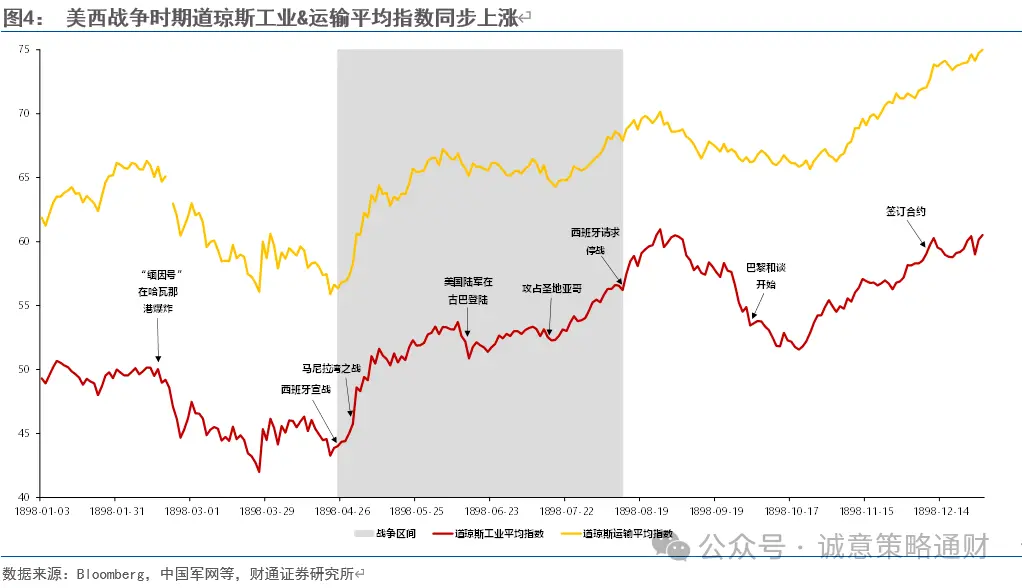
During the Spanish-American War, the stock market overall showed an upward trend, with the Dow Jones Industrial Average rising by 28% and the transportation index by 20%. Before the war, on February 15, 1898, the explosion of the USS Maine, which was sent to evacuate Americans from Cuba, caused panic in the market, leading both indices to drop nearly 20% within a month, reaching the lowest point of 1898, which the U.S. used as an excuse to initiate war. After the war broke out, the victory at the Battle of Manila Bay on May 1 led to the first wave of market upturn, with both indices rising about 10% within ten days, continuing to rise further. The initial victory's uplifting effect on the stock market lasted until early June, followed by about two months of sideways fluctuations; on July 3, the Spanish Caribbean fleet was defeated in the Battle of Santiago Bay, and on July 17, 220,000 Spanish troops in Santiago surrendered, clarifying the war's prospects, leading to a second wave of market upturn, with indices rising about 5% within half a month, continuing until Spain's surrender on August 12.
3 World War I: The Biggest Beneficiary of European Conflict, Panic Unveils War Trends, Indices Retreat After Official Entry
World War I was a global-scale war that erupted between two imperialist blocs in the early 20th century over the re-division of the world and the struggle for global hegemony.
3.1 Gains and Losses: The U.S. Becomes the World's Largest Creditor, Leading Post-War International Order Construction
The war broke out suddenly but unexpectedly placed the U.S. in a favorable position. During World War I, the U.S. was in a unique position, as its homeland, far from the European battlefield, would not be impacted, allowing it to continuously produce and export goods to arm militarism. The military-industrial sector undoubtedly met the needs of the war, with arms exports to the U.K., France, and Belgium bringing enormous profits; simultaneously, as Russia halted food exports during the war, the demand for U.S. agricultural products from warring nations surged, bringing benefits to the U.S. that extended beyond military orders.
The war brought enormous profits to the U.S., while the weakening of European powers indirectly enhanced its international political influence. In terms of export trade, U.S. steel exports rose from $250 million in February 1914 to $1.1 billion in 1917, arms exports increased from $40 million in 1914 to $1.3 billion in 1916, and explosives exports rose from $6 million in 1914 to a total of $1.7 billion in 1916-1917, with DuPont supplying two-fifths of the total ammunition consumed by the Allies. The four-year war significantly depleted the national strength of Germany, Russia, Austria-Hungary, and the Ottoman Empire, leading to the disintegration of the German Empire, Austria-Hungary, and Russia, thereby destroying the colonial system that European nations had expanded in Africa and Asia since 1881.
3.2 Index Performance: Initial Panic Followed by Rebound, Significant Retreat After Official Entry
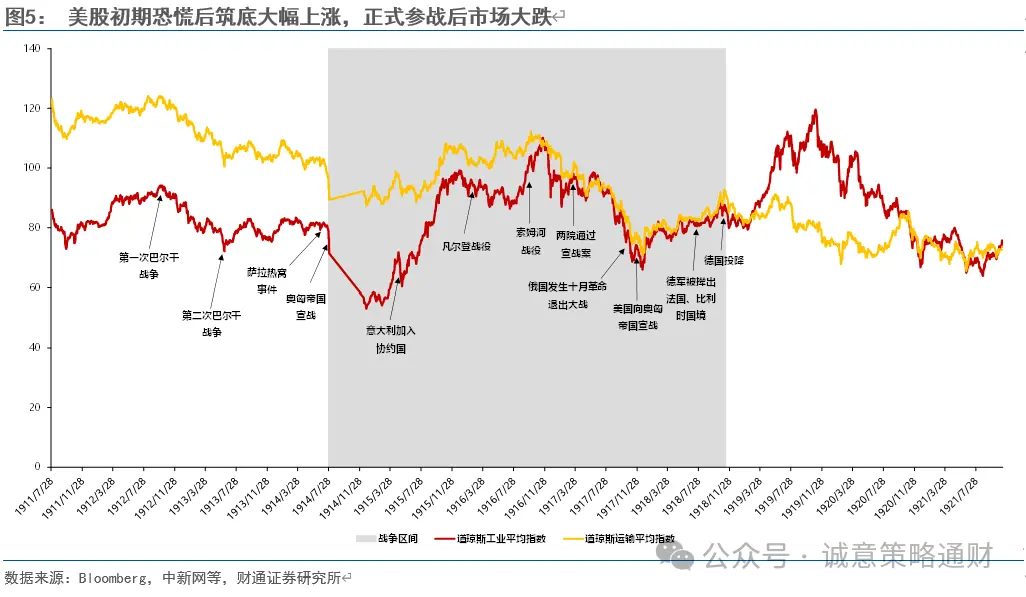
During World War I, the U.S. stock market operated in two phases: from July 1914 to March 1917, when the U.S. did not directly participate in the war, the Dow Jones Industrial Average rose about 22%, and the transportation index rose about 5%, with the industrial index rising about 107% from its lowest to highest point; from April 1917 to November 1918, after the U.S. officially intervened, the market began to decline, with both major Dow indices falling about 10%, with the maximum drop nearing 30%.
From July 1914 to March 1916, the sudden outbreak of war caused panic in the market, and during the closure, traders realized that the U.S. would become the biggest beneficiary of the European conflict. On July 28, 1914, Austria-Hungary declared war on Serbia, leading to the closure of major European stock markets, after which European investors frantically sold stocks to hoard gold and cash; panic quickly spread to New York, with the Dow Jones Industrial Average dropping nearly 7% on July 30, and the New York Stock Exchange announced an indefinite closure the next day; during the closure, investors recognized that the U.S. would supply arms and raw materials to the warring nations, significantly increasing public interest in U.S. stocks. On December 12, 1914, when the New York Stock Exchange reopened, stock prices quickly rose, recovering above the pre-closure prices within that week, and the index continued to rise thereafter. The market's expectations were confirmed, as by 1917, American banks, including Morgan, had provided $10 billion in loans to the British and French governments for arms purchases, with U.S. exports and lending fully benefiting from the war's developments.
From April 1917 to November 1918, after the U.S. officially entered the war, concerns about the war's prospects led to a decline in the market, which later rebounded as the Allied forces began to counterattack. In early 1917, the new German Chief of Staff initiated unrestricted submarine warfare, sinking about eight supply ships bound for the U.K. and France within weeks, which became the catalyst for U.S. entry into the war; simultaneously, Washington realized that remaining aloof would at least lead to the collapse of the European economy, adversely affecting the recovery of loans in Europe. After officially declaring war on April 16, 1917, both major indices immediately fell nearly 10%, and by the end of the year, the indices further declined. In early 1918, the Allies gradually gained control of the battlefield, leading to a market rebound; in the second half of the year, Allied forces began counterattacks, quickly dismantling the main German forces, resulting in the surrender of Turkey, Austria-Hungary, and Germany in succession, with indices continuing to rise until the war's end, although they were still down nearly 12% from the official entry point.
3.3 Industry Comparison: Military Stocks Bubble Early, Peaking Before the Market
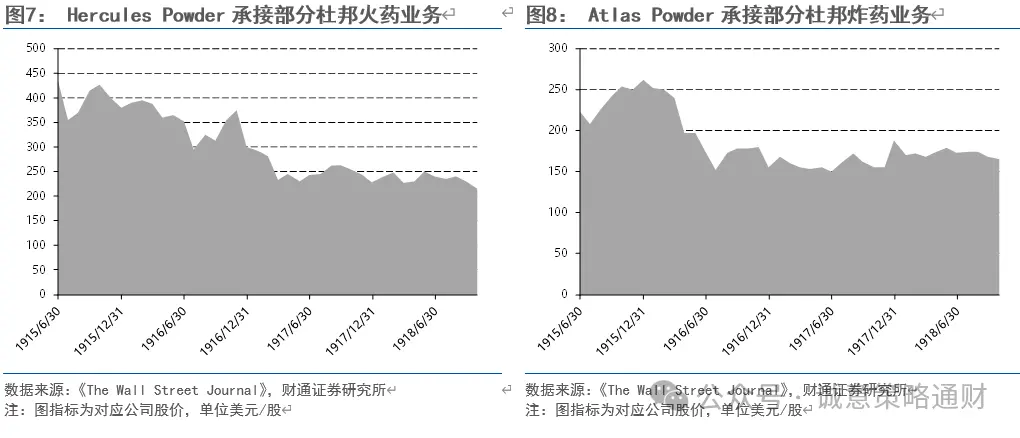
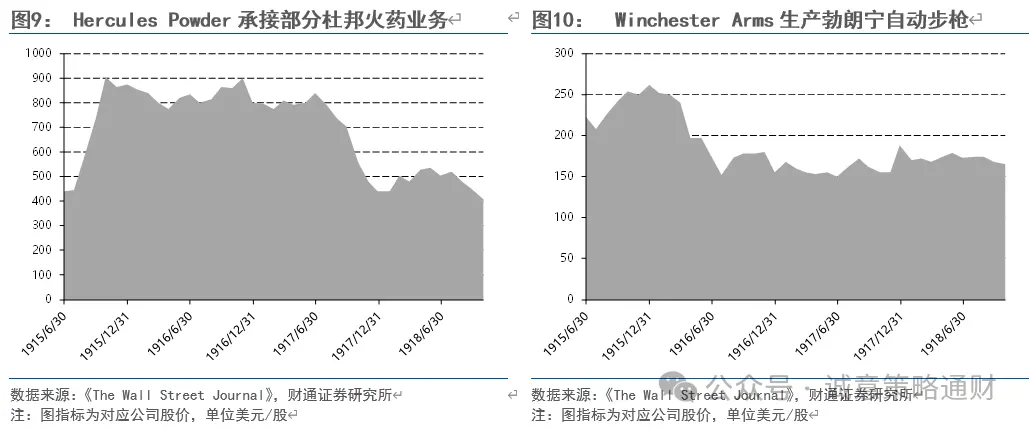
Due to the lack of complete and reliable individual stock data from World War I, it is impossible to conduct a comprehensive industry comparison. However, historical records from the paper Wall Street Journal's War Stocks section indicate that major war beneficiaries peaked in mid-1915, without following the index to create new highs in the following year. Military stocks were the first to be favored at the beginning of the war and were also the first industry to bubble, as stock prices quickly reflected optimistic expectations for war orders. Once the scale of the war did not expand further, the industry's prosperity peaked, and the excessively high valuations faced downward adjustments. After the U.S. entered the war in mid-1917, related stocks only saw a slight rebound, then continued to remain flat until the war's end, with some individual stocks experiencing a downward correction.
4 World War II: Establishing U.S. Global Hegemony, Excess Profits Tax and War Panic Suppress U.S. Stocks, Indices Reverse After Emotional Low Points
World War II, also known as the World Anti-Fascist War, was the second global-scale war fought between the Axis and Allied powers from the 1930s to the 1940s.
4.1 Gains and Losses: Economic Recovery Driven by Military Demand, Establishing a U.S.-Led World Political and Economic Order Post-War
The conflict of interests with Germany foreshadowed the inevitability of U.S. entry into the war, aligning with the needs of U.S. military-industrial economic development. Restrictions on imports and exports were imposed, but this system conflicted with Roosevelt's "New Deal," suppressing the export of various U.S. industrial products. By 1938, Germany surpassed the U.S. to become Brazil's largest importer, planting the seeds of conflict between the U.S. and Germany. After the 1929 crisis, Roosevelt hoped to revitalize the U.S. economy through the military-industrial sector, increasing naval personnel from 79,000 in 1933 to 150,000 by 1940, with military spending reaching $1.5 billion. The renewed outbreak of war in Europe undoubtedly created another opportunity for the U.S. to "profit from the fire."
The total economic output of the U.S. doubled during the war, while major competitors suffered severe blows. At the same time, the U.S. and the U.K. reached a tacit agreement to establish a post-war world political and economic order led by the U.S. In 1939, the U.S. GDP at constant prices was about $1.2224 trillion, growing to $2.3286 trillion by 1945, an increase of 90.5%, further consolidating the U.S. economy during World War II. In July 1944, the "Bretton Woods System" was established, creating an international monetary system centered around the dollar, while also establishing the International Monetary Fund and the World Bank, facilitating the U.S. government's construction of a post-war world political and economic order to safeguard its national interests and international policy objectives.
4.2 Index Performance: War Panic and Excess Profits Tax Cause U.S. Stocks to Decline, Indices Rebound as Battlefield Turns
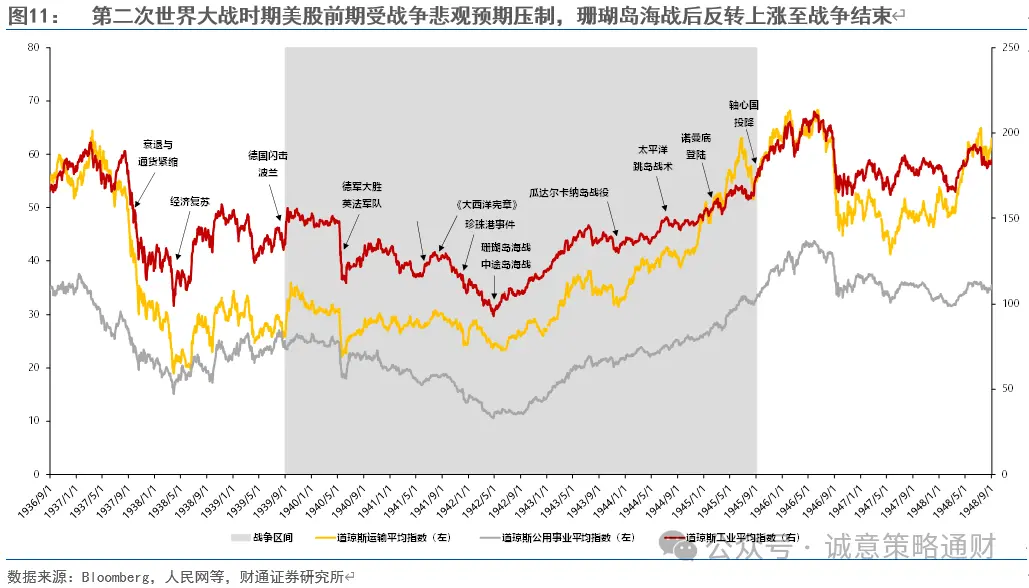
During World War II, the U.S. stock market operated in two phases: from September 1939 to April 1942, the U.S. transitioned from apparent neutrality to formal intervention, suffering a series of early defeats, with the Dow Jones Industrial Average falling by 29%, the transportation index by 7%, and the utilities index by 55%; from May 1942 to September 1945, after the Battle of Midway, the U.S. gradually shifted from strategic defense to strategic offense, with the Dow Jones Industrial Average rising by 82%, the transportation index by 127%, and the utilities index by 203% until the end of the war.
From September 1939 to April 1942, the experience of World War I led to an initial rise in U.S. stocks at the outbreak of war. As the Allies suffered defeats on the battlefield and the excess profits tax hindered the transmission of war orders to corporate profits, the failure of profit expectations and worsening risk appetite led to a market downturn. On September 3, 1939, Britain declared war on Germany, and on that day, the New York Stock Exchange opened with a frenzy of buying, with the Dow Jones index closing up 7%. However, this enthusiasm quickly dissipated, as the public recalled that during World War I, while young men died on the battlefield, domestic companies made substantial profits, leading to a social imbalance in the distribution of benefits. Consequently, during World War II, all domestic companies were subject to excess profits taxes imposed by Congress, suppressing the numerator of the DDM. Meanwhile, while the U.S. maintained a facade of neutrality, it was actually preparing for war through a series of measures. The victories of Axis forces on the battlefield heightened investors' concerns about the war's prospects. In November 1939, the Neutrality Act was amended to allow private enterprises to export military products; in May 1940, the "One Billion Dollar Defense Plan" was implemented; in January 1941, Roosevelt proposed a defense budget of $10.8 billion (a 1000% increase from 1931); in March, the passage of the Lend-Lease Act facilitated arms exports; in July, all trade with Japan was halted; and in August, the Atlantic Charter was announced, declaring an alliance with the U.K. As Japan retaliated against economic sanctions with the Pearl Harbor attack, Roosevelt seized the opportunity to counter domestic isolationist sentiment and enter the war. Initially, the U.S. suffered a series of defeats, further pressuring the market, while the European battlefield was on the brink of survival, leading to further declines in indices.
From May 1942 to September 1945, the Coral Sea and Midway battles marked a turning point in the war, with investors keenly sensing the shift in the war's direction. U.S. stocks began to rebound ahead of the market, and as the battlefield turned, indices rose until the war's end. The significance of the Coral Sea and Midway battles lay in their dismantling of the main Japanese fleet in the Pacific, causing Japan to lose strategic initiative on that front, leading to a prolonged war of attrition. Given the vast industrial manufacturing gap between the U.S. and Japan, Japan's defeat became inevitable. U.S. stocks reversed and entered a bull market, further rising alongside victories in the Guadalcanal campaign and the success of the island-hopping strategy, with the upward trend reaffirmed by victories on the European battlefield, maintained until the war's conclusion.
4.3 Industry Comparison: War-Related and Essential Consumption Perform Best
We retrieved all U.S. stock data from the CRSP database and compiled it based on SIC industry classification weighted by market capitalization to compare industry performance during previous wars before the 1990s.
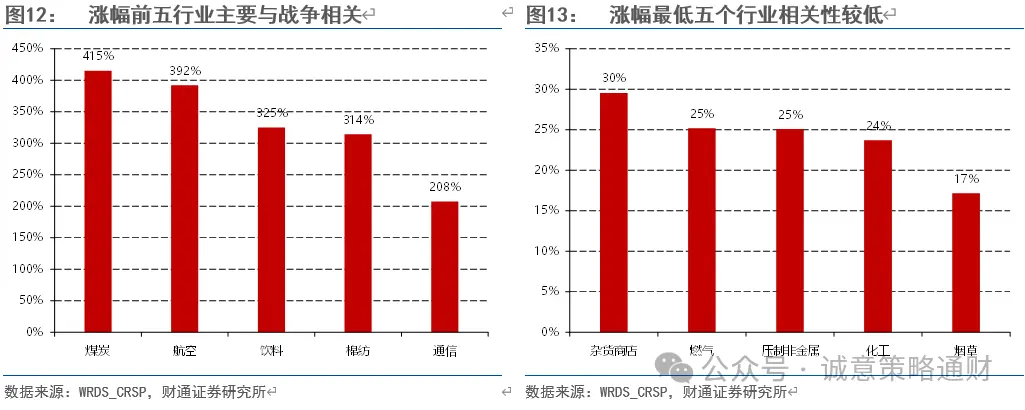
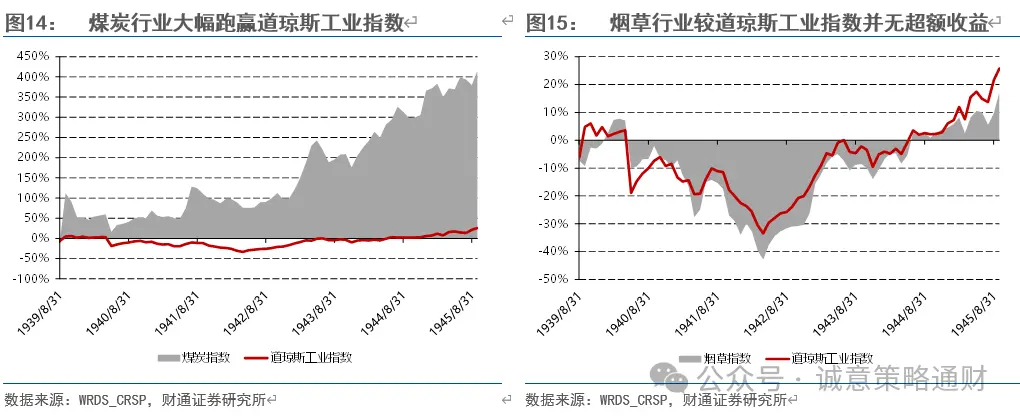
During World War II, the top-performing industries were coal, aviation, beverages, cotton textiles, and communications, with all but beverages being war-related industries. Anthracite coal was the primary energy source at the time, with its usage share rising from 43.8% in 1938 before the war to 48.9% in the mid-war period in 1944, driven by military production and naval expansion. The coal industry's profitability maintained an upward trend throughout the war, with a total increase of 415%, only experiencing a significant pullback in the early stages.
During World War II, all industries achieved gains, while the five industries with the lowest increases were tobacco, chemicals, non-metallic minerals, gas, and grocery stores. During the war, tobacco companies provided free cigarettes to frontline soldiers, using patriotism as a marketing gimmick and cultivating consumer habits. Due to declining corporate profits, the tobacco industry's profitability fell in tandem with the index during the early war period, then rebounded until the war's end, with a total increase of 17%.
5 Korean War: "A War Without Results," U.S. Stocks Show an Upward Trend, Transportation Index Performs Best
The Korean War was a large-scale international conflict that erupted in June 1950 between the North and South sides of the Korean Peninsula, with varying degrees of intervention from countries such as the U.S., China, and the Soviet Union.
5.1 Gains and Losses: U.S. Intervention Faced Obstacles, Limited Achievements
Although concerns about the Soviet response could escalate the war, Japan's strategic significance in East Asia to counterbalance the Soviet Union led the U.S. to decide on direct intervention. At the outbreak of the Korean War, South Korea had not yet been included in the U.S. Asian strategic defense perimeter. Truman was more concerned about security issues in Europe facing the Soviet Union than East Asia, fearing the prospect of another world war after China and the Soviet Union intervened. However, considering the defeat of the Kuomintang, the balance in East Asia had tilted towards communism, making Japan an important counterweight to the Soviet Union and China, and if South Korea fell, Japan's defense would face significant pressure.
The Korean War somewhat stimulated the weak post-World War II U.S. economy, but the U.S. military failed to achieve its objectives against the resolute resistance of the Chinese People's Volunteer Army. During the war, the U.S. primarily promoted investment and consumption by increasing government spending, while military expenditures relied on taxes from tobacco and alcohol, excess profits taxes, etc., avoiding excessive currency issuance, allowing the Federal Reserve to control inflation and achieve economic growth through increased total demand driven by the war. From the war's outcome, the U.S. did not achieve victory. After Eisenhower was elected president, he realized the futility of the Korean War and, after multiple negotiations, signed an armistice agreement on July 27, 1953, with North Korea and China.
5.2 Index Performance: All Three Indices Show an Upward Trend, Industrial and Utilities Indices Narrowed Volatility in Later Stages, Transportation Index Performed Best
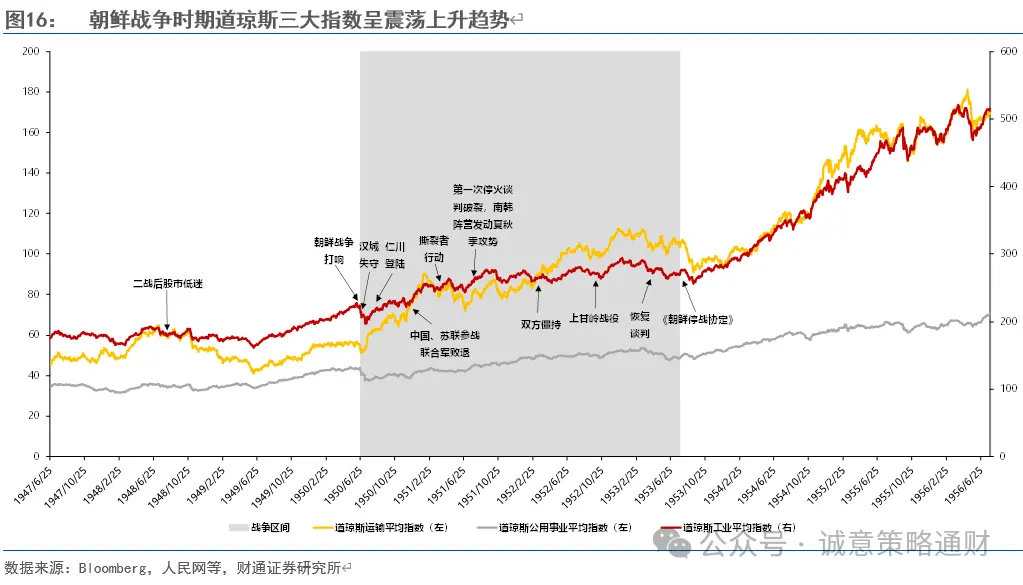
From June 1950 to July 1953, during the entire Korean War, the Dow Jones Industrial Average rose by 20%, the transportation index by 86%, and the utilities index by 11%. On June 25, 1950, the Korean War broke out, and the Dow Jones index fell by 4.65%, a larger drop than the day after the Pearl Harbor incident; before the Incheon landing, the market reached its lowest point during the war, then reversed and maintained an overall upward trend until the war's end; by 1952, both sides fell into a stalemate, and the upward slope of the market also slowed.
The market's reaction to the war was relatively muted, with only the transportation index showing significant volatility, as economic factors gradually dominated. From November 1950 to February 1951, although the U.S.-Korean joint forces retreated under Chinese intervention, the U.S. stock market continued to rise, diverging from the battlefield. In terms of results, the Korean War was the fourth deadliest war for the U.S., second only to the Civil War from 1860 to 1864 and the two World Wars, and ultimately did not achieve victory. However, the market managed to maintain an upward trend throughout the period, primarily due to the post-World War II stagnation of the economy starting to activate during the Korean War, with U.S. GDP at constant prices growing by about 8.7% in 1950 compared to the previous year, and the growth rate continuing above 8% in 1951, slowing to 4% by 1952.
5.3 Industry Comparison: Oil-Related Industries Show Significant Outperformance, Discretionary Consumption Ranks Last
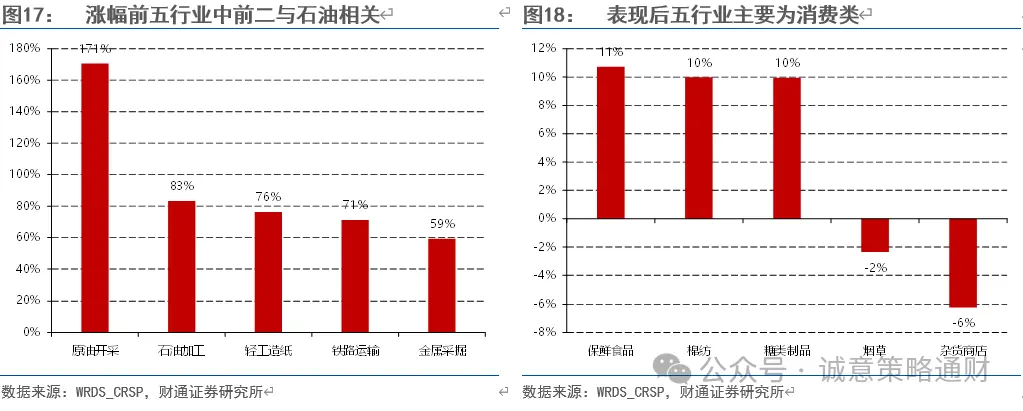
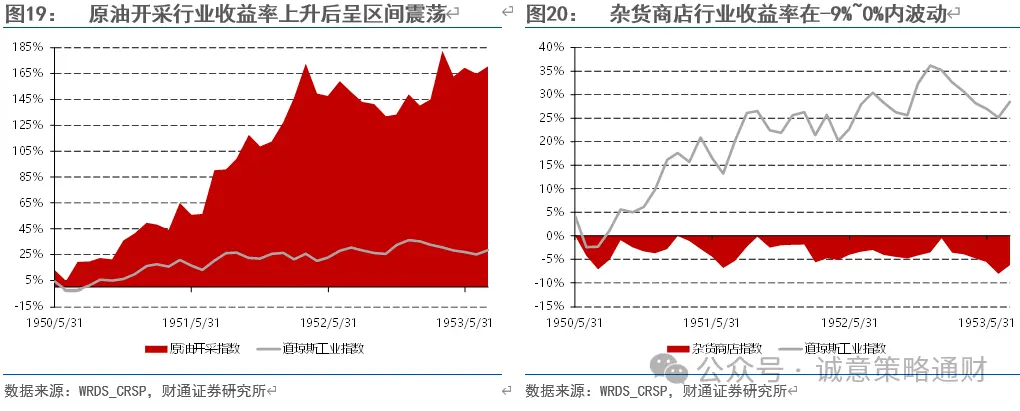
During the Korean War, the top-performing industries were oil extraction, oil refining, light industry and paper, railway transportation, and metal mining, with the first two being oil-related industries. After World War II, oil became an important resource for the U.S. Although crude oil prices remained around $25 per barrel throughout the 1950s, Eisenhower's interstate highway system promoted automobile sales, indirectly driving crude oil consumption from 5 million barrels per day in 1950 to 10 million barrels per day by 1960. The profitability of the oil extraction industry maintained an upward trend from mid-1950 to the first half of 1952, then fluctuated in a high range.
During the Korean War, the industries with the worst performance were grocery stores, tobacco, sugar products, cotton textiles, and preserved foods, primarily discretionary consumer products. During the war, the profitability of the grocery store industry fluctuated between -9% and 0%, with no clear operational direction.
6 Vietnam War: The Longest and Most Unpopular War, Various Factors Disrupt Expectations, Major Indices Rise but Trends Diverge Significantly
The Vietnam War began in November 1955, initially involving the Republic of Vietnam (South Vietnam), supported by the U.S. and other capitalist countries, and the Democratic Republic of Vietnam (North Vietnam), supported by socialist countries such as China and the Soviet Union. In the later stages, the U.S. directly intervened and fought against North Vietnam led by Ho Chi Minh, seeking a "decent exit" in the face of inevitable failure.
6.1 Gains and Losses: Military Orders Eased but Insufficient to Save an Expanding Economy in Decline, War Losses Failed to Contain Communism
The war was initiated under the U.S. policy of containing communism, aligning with the mid-Cold War context. After the First Indochina War, France's rule in Vietnam ended, but U.S. politicians clearly would not tolerate the spread of Soviet influence in Southeast Asia. At that time, U.S. President Eisenhower stated in a media interview that losing Vietnam along with Laos and Cambodia would mean not only losing valuable rubber and rice supplies but also handing over a population of 24 million to communism. Thus, he immediately set about undermining the agreements reached in Geneva, supporting the Ngo Dinh Diem regime in South Vietnam, launching campaigns to "contain communism" and "exterminate communism," and massacring the North Vietnamese Communist Party, thus opening the curtain on the Vietnam War.
Although the war once again stimulated military orders, the continuously rising defense budget under tax reduction policies led to a severe fiscal and monetary crisis, accompanied by rapidly developing inflation. During the war, there were four economic recessions, and ultimately, the U.S. was forced to withdraw from the war due to domestic pressure, declaring the plan to prevent communism from taking root in Vietnam a failure. The U.S. defense budget rose from $49.6 billion during the special operations period in 1961 to $50.6 billion in 1965, showing no significant increase, but began to rise slightly to $58 billion in 1966, reaching an exaggerated $81.9 billion in 1968 (43.3% of the federal budget). Correspondingly, the fiscal deficit doubled from $3.7 billion in 1966 to $8.8 billion in 1967, and tripled to $25 billion in 1968. Meanwhile, inflation rose from about 1.5% in 1961 to 4.7% between 1968 and 1969, with U.S. GDP, which accounted for 34% of the world's total output in 1970, dropping to less than 30% by 1971, and continuing to decline throughout the 1970s. By the later stages of the Vietnam War, the U.S. was overwhelmed, and Nixon gradually abandoned South Vietnam. Unlike the "timely loss-cutting" of the Korean War, the U.S. government could only try to cover up its failure and extricate itself from the quagmire of war, ultimately leading to Vietnam's unification and the path to communism.
6.2 Index Performance: Under the Interference of War, Politics, and Economics, Expectations Became Confused and Variable, Overall Rise in the Early Stages of Direct U.S. Military Engagement, Significant Divergence After Official Entry
Based on the development of the Vietnam War, the U.S. stock market during wartime can be divided into five phases: from November 1955 to April 1961, when the U.S. supported the South Vietnamese regime in massacring the North Vietnamese Communist Party, the Dow Jones Industrial Average rose by 49%, the transportation index fell by 6%, and the utilities index rose by 76%; from May 1961 to February 1965, when Kennedy dispatched special forces and launched bombing operations, the Dow Jones Industrial Average rose by 33%, the transportation index rose by 50%, and the utilities index rose by 44%; from March 1965 to December 1968, when U.S. forces directly engaged in Vietnam, the Dow Jones Industrial Average rose by 4%, the transportation index rose by 28%, and the utilities index fell by 15%; from January 1969 to January 1973, the Dow Jones Industrial Average rose by 6%, the transportation index fell by 24%, and the utilities index fell by 17%; from February 1973 to April 1975, the Dow Jones Industrial Average fell by 18%, the transportation index fell by 17%, and the utilities index fell by 35%.
The three major indices showed an upward trend in the first two phases of the war, while significant divergence occurred after direct U.S. military engagement. During the ten years from 1965 to 1975, the industrial index exhibited a downward expanding triangle pattern, experiencing significant declines during the tightening of monetary policy by the Federal Reserve in 1966, the economic recession of 1969-1970, and the recession of 1973-1975. However, after reaching the bottom, it returned to near the highs when U.S. forces first engaged directly in Vietnam; the transportation index showed the greatest volatility, with significant declines during both economic recessions, the first rebound occurring in sync with the industrial index and to a greater extent, while the second rebound lagged slightly initially but ultimately rose to a similar extent; the utilities index, on the other hand, exhibited a monotonous downward trend, with increasingly severe fiscal deficits suppressing the industry's development.
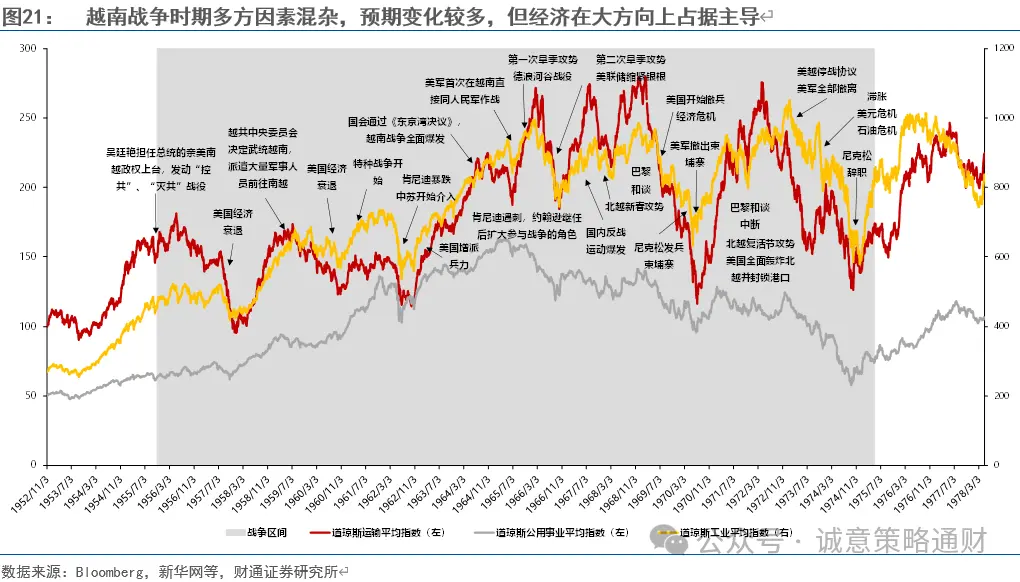
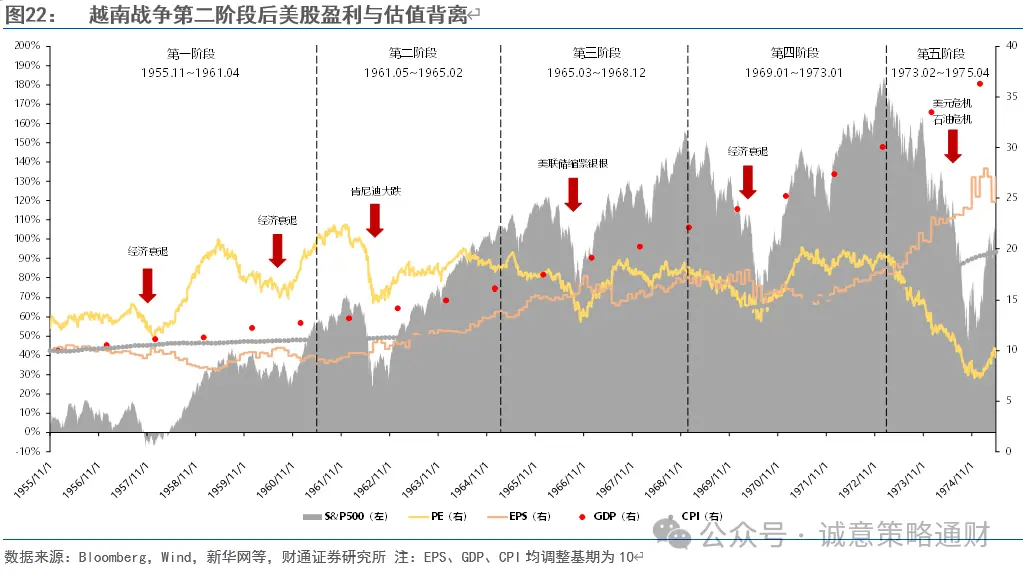
During the Vietnam War, the S&P 500 and profit and valuation-related statistics were already available. We will combine these with economic and inflation factors to observe the driving forces of the stock market during the Vietnam War from a more comprehensive perspective.
From November 1955 to April 1961, U.S. intervention in the Vietnam War was limited to political and capital support, with the stock market primarily driven by economic factors. After the Ngo Dinh Diem regime came to power on November 1, 1955, U.S. stocks continued to rise, with the S&P 500 increasing by about 10% within half a month; subsequently, information related to Vietnam did not significantly impact the stock market, with indices experiencing substantial declines during the economic recessions of 1957-1958 and 1960-1961. As shown in Figure 22, corporate profits were completely eroded by inflation, but the subsequent rise in valuations still led the index to reverse and reach new highs.
From May 1961 to February 1965, U.S. special forces entered South Vietnam for intensified secret warfare, with the stock market primarily influenced by economic and non-war-related special events. On May 14, 1961, Kennedy ordered the dispatch of 400 special operations forces to South Vietnam, but the S&P 500 did not show a significant reaction, continuing its original trend of slow upward movement; in December 1961, a significant drop began, with the index falling about 30.6% over the next 167 days from its previous high. In the context of continued profit recovery, such a sudden drop was clearly closely related to emotional impacts on valuations; market sentiment was ultimately fully released after the "Cuban Missile Crisis" in October 1962, with the index reversing and reaching new highs driven by profits.
From March 1965 to December 1968, U.S. forces directly engaged in combat with the North Vietnamese Army, with the stock market still primarily influenced by economic and financial factors. The Battle of the Ia Drang Valley in November 1965 was the first major battle of the Vietnam War, but the stock market did not react; in February 1966, as the Vietnam War and Johnson's Great Society program led to a significant increase in government spending, the Federal Reserve chose to tighten credit conditions to mitigate risks, causing the S&P 500 to fall nearly 30% over the next eight months. However, the market's downturn did not trigger a recession, as economic growth driven by government spending continued to push corporate profits upward, and the market quickly rebounded to reach new highs, with the North Vietnamese Tet Offensive not preventing the overall upward trend.
From January 1969 to January 1973, U.S. troop withdrawals "Vietnamized" the war, with economic recessions once again causing a bear market, with the market bottoming out in sync with corporate profits after the withdrawal from Cambodia. At the end of 1968, Nixon won the election to become the new U.S. president, but the market peaked shortly after his official inauguration on January 20, 1969; the campaign promise of troop withdrawal was not immediately implemented, and under a daily war burden of about $60 million, the gradually weakening U.S. economy exacerbated social tensions, with the S&P 500 experiencing a maximum drop of about 80% during the economic recession of 1969-1970. The index bottomed out after the U.S. withdrawal from Cambodia, and although profits had not yet reversed, recovery expectations had already guided valuations upward, initiating a rebound; subsequent declines in profits led to a sustained six-month pullback near previous highs, until the end of 1971, when profits confirmed a bottom and the market rose again to reach new highs.
From February 1973 to April 1975, the U.S. withdrawal did not end the war, and the outbreak of the dollar crisis and oil crisis impacted the market, with the S&P 500 experiencing a maximum drop of about 80%. On January 27, 1973, the U.S. and Vietnam signed a ceasefire agreement, and the market reached its highest point during the entire Vietnam War; although profits continued to rise during the period until the war was completely over, severe inflation distorted this data, while the pressures of the dollar crisis and oil crisis on market sentiment were very real, leading to a continuous decline in the S&P 500's PE valuation, which fell below 10 by the end of 1974, only rebounding to a certain extent after Nixon's resignation.
6.3 Industry Comparison: Emerging Industries and Upstream Resources Outperform, Financial and Utilities Sectors Experience Significant Declines
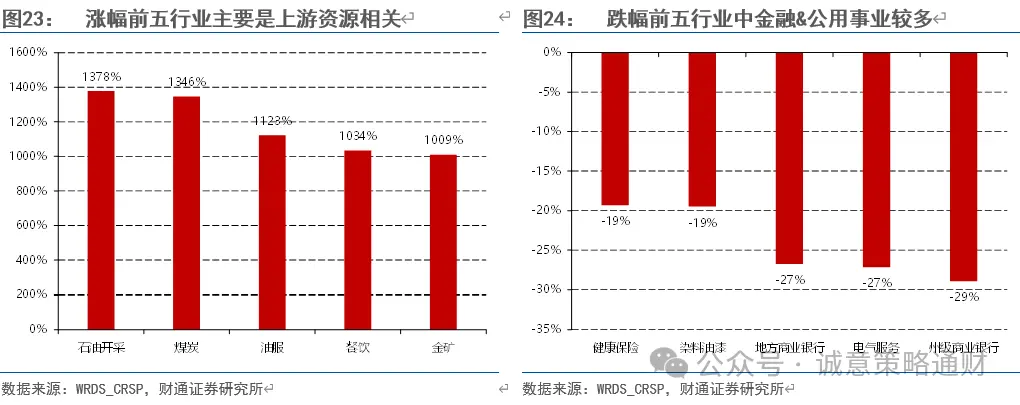
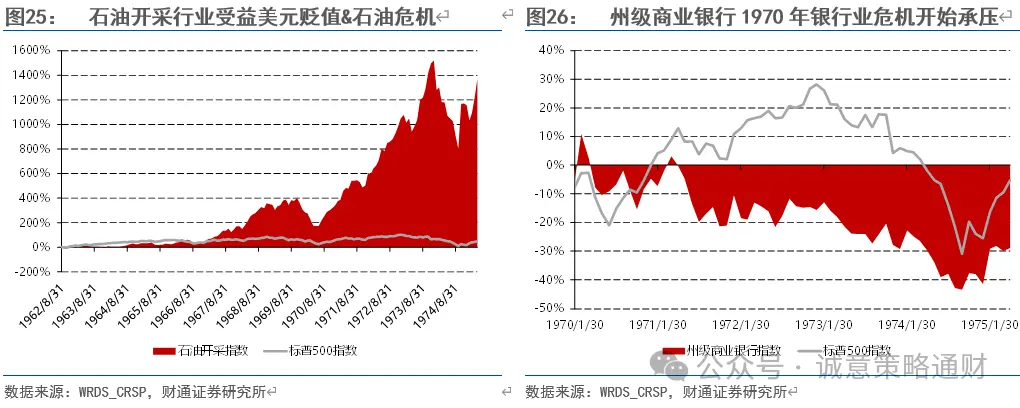
During the Vietnam War, the top five performing industries were oil extraction, coal, oil services, dining, and gold mining, primarily benefiting from inflation in upstream resources. After 1970, the Bretton Woods system centered around the dollar gradually disintegrated, leading to passive devaluation of the dollar to address escalating economic issues, allowing oil-producing countries to raise oil prices to compensate for the dollar's depreciation. The profitability of the oil extraction industry maintained an upward trend from 1962 to 1974, with a significant explosion occurring during the dollar crisis from late 1970 to early 1973.
During the Vietnam War, the five industries with the worst performance were state commercial banks, electric services, local commercial banks, dye and paint, and health insurance. In the 1970s, the international economic and financial markets underwent significant changes, with the collapse of the Bretton Woods system impacting global financial markets, two oil crises affecting the global economy, and the failure of traditional Keynesian macroeconomic policies promoting the rise of neoliberalism. Faced with an increasingly complex financial environment and intensifying competition, the operating environment for U.S. commercial banks rapidly deteriorated. Starting in 1970, the profitability of state commercial banks continued to decline.
7 Gulf War: Aimed at Defending Saudi Oil Interests, War's Impact on the Stock Market Reflected Through Oil Prices to Overall Economy
The Gulf War was a series of military strikes initiated by the U.S.-led coalition against Iraq to restore Kuwait's territorial sovereignty, marking the first large-scale armed conflict after the Cold War.
7.1 Gains and Losses: Stabilizing Oil Prices to Defend the Economy While Selling Large Quantities of Weapons
The U.S. has extensive and deep interests in the Saudi region, making any threat to Saudi Arabia a reason for the U.S. to declare war. After the 1970s, the U.S. transitioned from being an oil product surplus country to a pure oil-importing country, and the "weapons for oil" mechanism established since the Nixon era increased Saudi Arabia's importance to the U.S. economy; simultaneously, the U.S. has a vast network of military bases in the region, relating to more complex geopolitical and political interests.
The Gulf War benefited both the U.S. domestic economy and its strategic layout in the Middle East. Soaring oil prices gradually retreated after multinational forces expressed their willingness to participate in the war and fell back to
 Risk warning