Popular Science: A Brief Analysis of the Differences Between BTC Spot and ETF
 Core Viewpoint

 BTC spot ETF market = BTC spot market
Original Author: TVBee
Editor's Note: As 2023 comes to a close, the approval of Bitcoin spot ETFs by the U.S. SEC is a topic of great interest to every crypto user as we welcome the new year. Crypto blogger TVBee has explained the differences between three types of BTC ETFs on X, compiled by BlockBeats as follows:
What is the difference in BTC spot ETFs ------ A graphic to help you understand 3 types of BTC ETFs & 3 types of BTC futures
Let's start with the basics
About BTC Futures
Currently, the mainstream BTC futures include three types:
First type: Perpetual futures on platforms like Binance and OKEx.
Second type: BTC futures from CME (Chicago Mercantile Exchange), which are cash-settled, so aside from having a settlement cycle, they are quite similar to the first type.
Third type: BTC futures from BAKKT, which are settled in spot.
About BTC Futures ETFs
Currently, the vast majority of BTC futures ETFs are based on CME's BTC futures.
About ETFs
ETFs (Exchange Traded Funds) are investment funds traded on stock exchanges.
ETFs can be created based on a basket of assets or a specific asset, which we can refer to as underlying assets.
ETFs represent a portion of ownership in the underlying assets. This means that ETF products support redemption, allowing the ETF to be exchanged for an equivalent value of the underlying assets.
Therefore, ETF products cannot be issued out of thin air. Issuers need to hold equivalent underlying assets to issue ETFs.
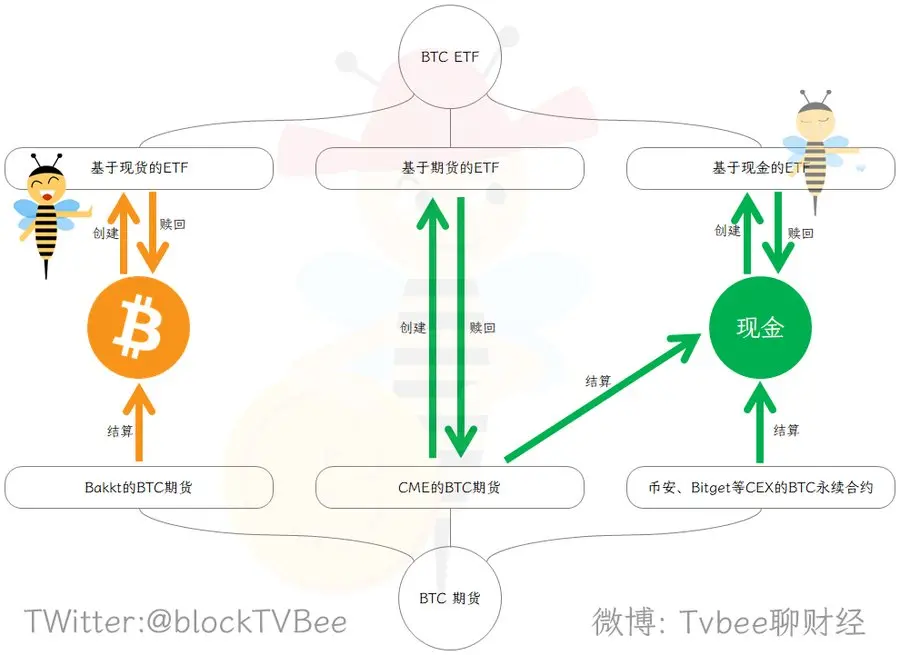
3 Types of BTC ETFs
Spot-based BTC ETFs
Many friends believe that BTC spot ETFs are a positive development, and this view is correct.
However, some friends understand it as: "Spot ETFs are different from futures ETFs; futures ETFs can be approved, but spot ETFs have not been approved due to regulatory reasons. Therefore, when the BTC spot ETF is approved, it indicates that BTC has received regulatory recognition, which is positive for BTC." This view is not incorrect, but it is insufficient.
The spot ETFs from institutions like BlackRock could be the most substantial positive development for BTC in history.
Because issuing ETF products requires holding equivalent underlying assets. To issue a BTC spot ETF, one must hold equivalent BTC in spot. Therefore:
BTC Spot ETF Market = BTC Spot Market
In other words, large global financial institutions like BlackRock are likely to attract new BTC investors who have not participated in the existing crypto market. These investors are more accustomed to, or restricted by regulatory conditions, and can only purchase ETF products issued by institutions. The greater the market demand for BTC spot ETFs, the more BTC in spot institutions will need to hold.
Thus, large financial institutions issuing BTC spot ETF products can bring incremental funds and a broader international market to the BTC spot.
The BTC spot ETF market in Hong Kong can also expand BTC's presence in the Asian market.
Futures-based BTC ETFs
Currently, several financial institutions have issued BTC futures ETF products, but these BTC futures ETFs are based on CME's BTC futures, which are cash-settled. Therefore, the BTC futures ETF market cannot bring incremental funds to the BTC spot market.
Cash-based BTC
Cash-based BTC ETFs involve issuers holding cash to issue BTC ETFs, redeeming cash upon redemption. Naturally, this will not bring cash flow to the BTC spot market.
 Risk warning Risk warning