The industry is not bad; the evaporation of 350 billion dollars from ETH and SOL is the root cause of the industry's pessimism
 Core Viewpoint


 Felipe Montealegre believes that stablecoins, tokenized assets, and on-chain finance are being implemented, and the industry's revenue has not collapsed. What truly causes pain for practitioners is the balance sheet: this year, cash inflows are about 26.6 billion dollars, but since October of last year, only ETH and SOL have evaporated approximately 350 billion dollars in wealth. Relying solely on revenue is insufficient to make up for this; the solution lies in income-generating tokens or the recovery of value storage assets like BTC, ETH, and SOL.
Author: Felipe Montealegre, Co-founder and CIO of Theia Research
Compiled by: Gu Yu, ChainCatcher
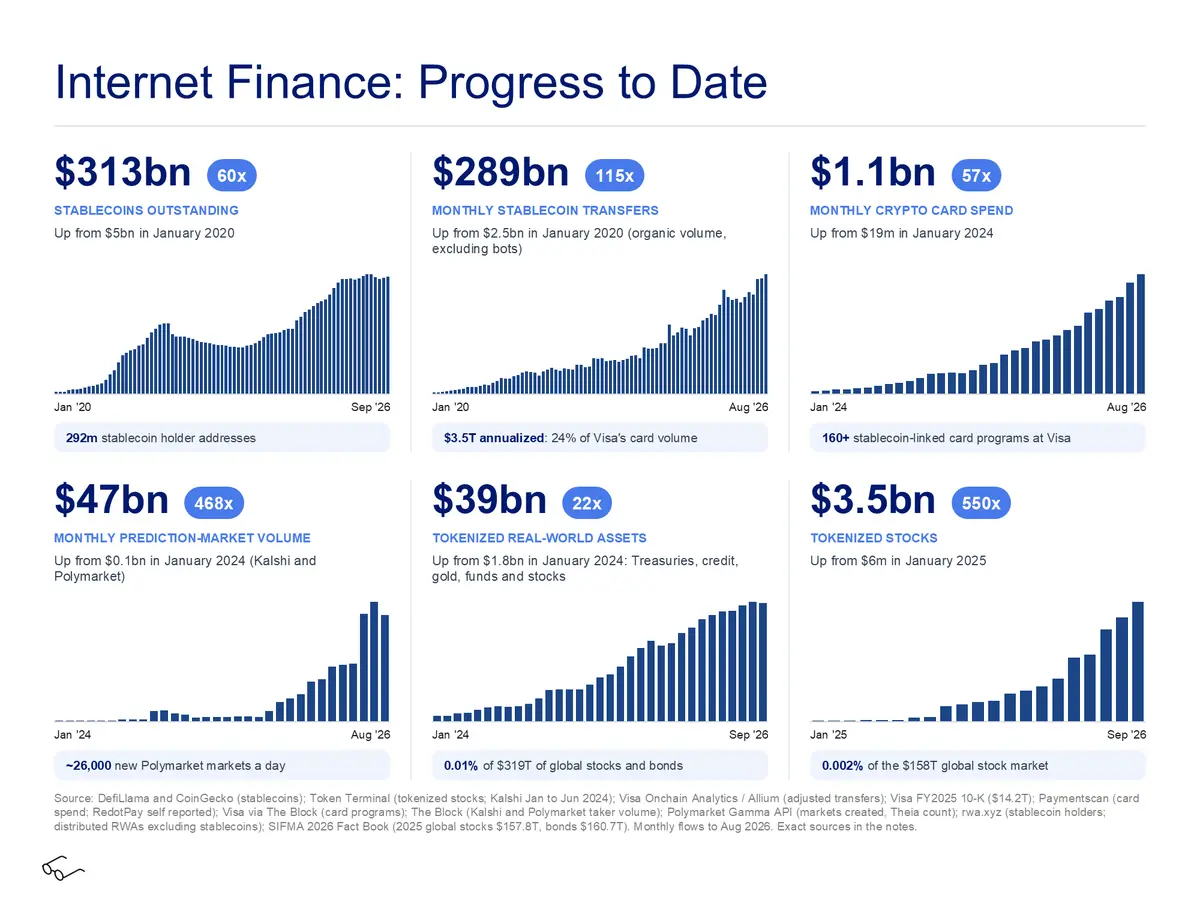
Cryptocurrency is working, yet no one cares. A few years ago, stablecoins and tokenized funds were still an unattainable dream; prediction markets, lending protocols, and AMMs were just white papers. Today, U.S. Treasury Secretary Scott Bessent tells us that the scale of stablecoins will reach $2 trillion in the short term; BlackRock CEO Larry Fink states that all assets will be tokenized; Hyperliquid is collaborating with ICE (owner of NYSE) to bring on-chain perpetual contracts to the U.S. capital markets. If you ever thought that cryptocurrency would change the global financial markets, then you were right. So why are you in so much pain?
Evidence A: Cryptocurrency is Working
Early in my career, someone advised me never to work for a company that couldn't achieve carry on its latest fund. Not because they couldn't afford high salaries—at my level, they could afford it—but because the company culture would be painful. People only feel happy when they are working hard and making money.
This applies to the entire industry as well. Before diving into the details, I want to summarize this idea into a complete three-statement financial model, including the balance sheet, income statement, and cash flow statement. Let's take a look at simplified versions for our industry.
Income Statement
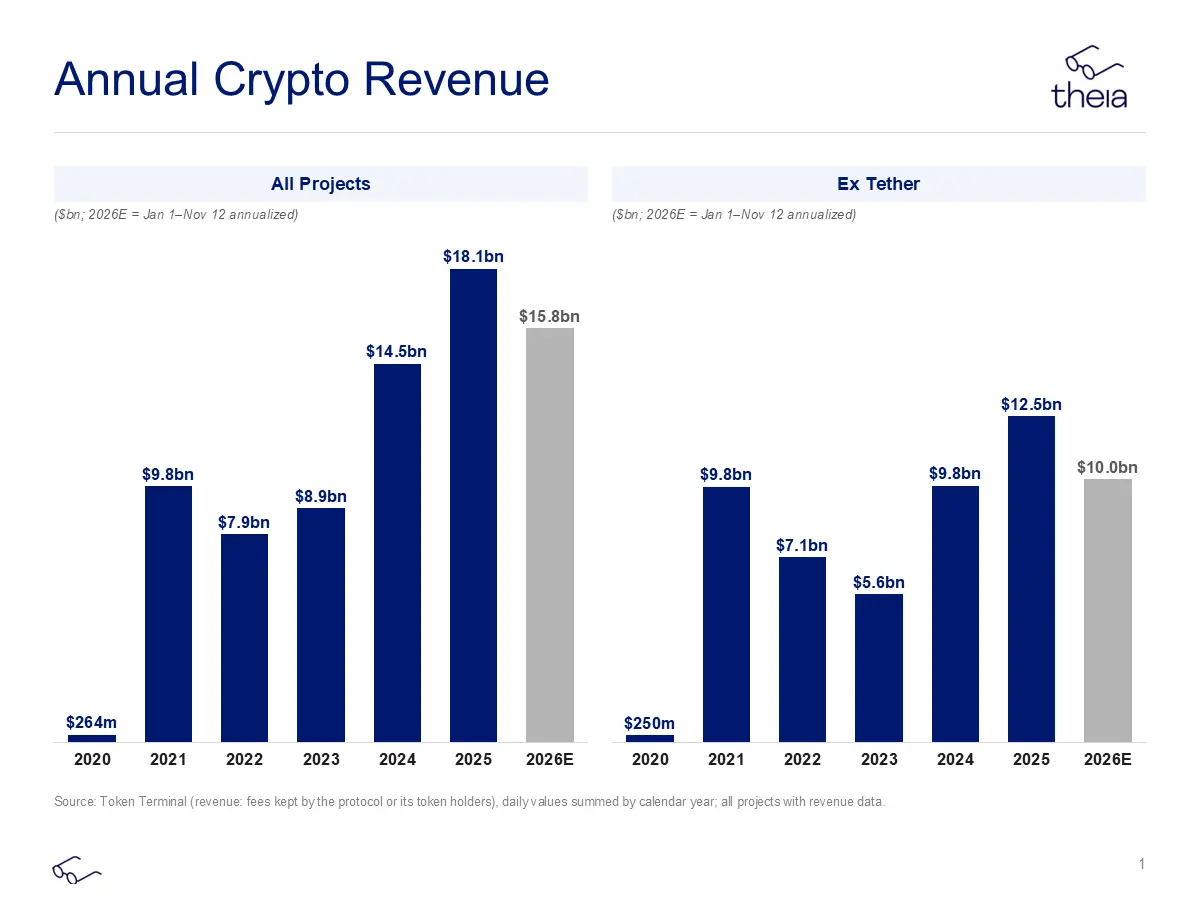
Let's first look at revenue. Most of the costs associated with this revenue flow to people within the industry—engineers, business development, validators, auditors, etc. Our revenue performance isn't too bad: it has grown by about $8 billion since 2021; excluding Tether, it has decreased by about $3 billion.
The balance sheet changes brought about by asset price fluctuations will enter the income statement (usually through net profit), but we'll leave that topic for the last section when we discuss the industry balance sheet.
Cash Flow Statement
The cash flow statement covers cash flows from operating activities, investing activities, and financing activities. Based on the brief discussion above, we can substitute revenue for operating cash flow. Cash flow from investing activities is important in industries with significant capital expenditures, but it has little impact on us because the cryptocurrency industry has almost no capital expenditures. Financing cash flow is the main component because most people's salaries and office expenses in this industry have historically been paid by the venture capital funds flowing into the industry.
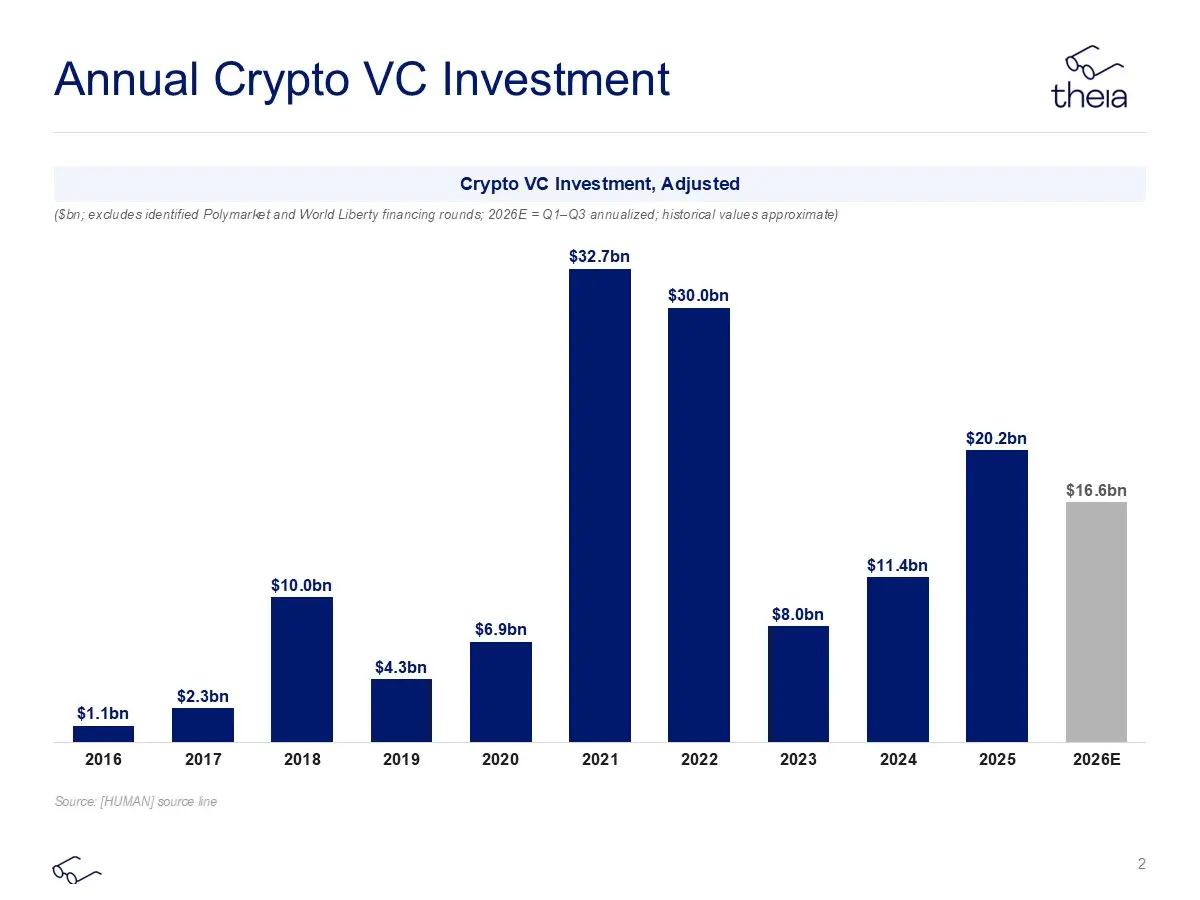
We can sum up revenue and venture capital to arrive at the dollar amount flowing into the industry to pay salaries, executives, auditors, consultants, recruiters, validators, and other expenses. What's left is the investors' profit (they need to pay returns to LPs to attract more capital).
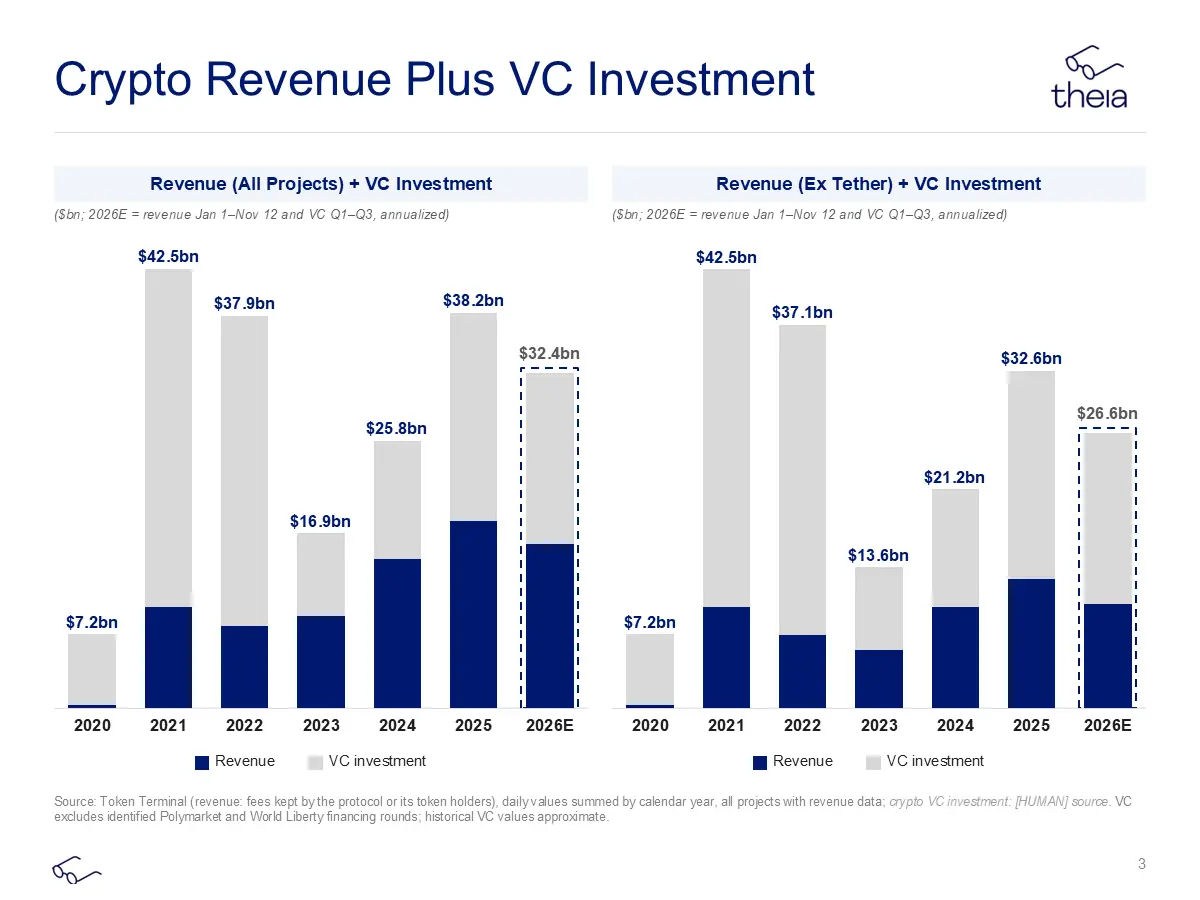
Thus, since 2021 and 2022, the cash flow into the industry has decreased by about $15 billion (excluding Tether, as that portion of cash flow remains highly concentrated). This amounts to a lot of salaries, but it still doesn't fully explain the scale of surrender we see in the cryptocurrency industry.
Balance Sheet
This is the root of the problem. We are talking about an industry that has seen $26.6 billion in cash inflows this year, while just Ethereum and Solana have wiped out about $350 billion in industry wealth since last October. We are in a unique industry where asset values are astonishingly high relative to cash flow values. No matter how much stock tokenization or stablecoin growth occurs, it cannot compensate for the $350 billion balance sheet shock. We need to grow revenue 35 times (equivalent to the revenue of 350 Hyperliquids) just to make up for the losses of ETH and SOL through revenue alone.
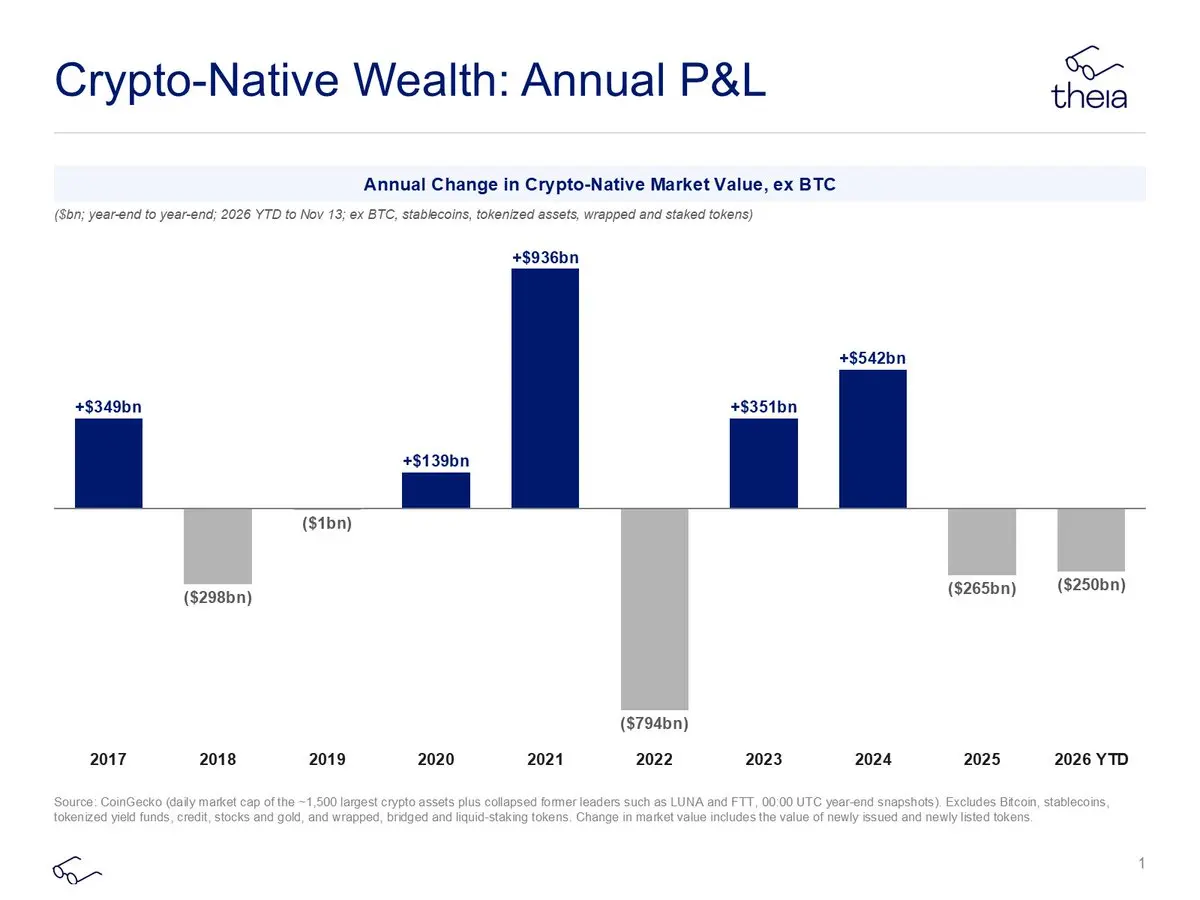
When you put all the numbers together, you will see that the industry balance sheet is the only truly important driving factor.
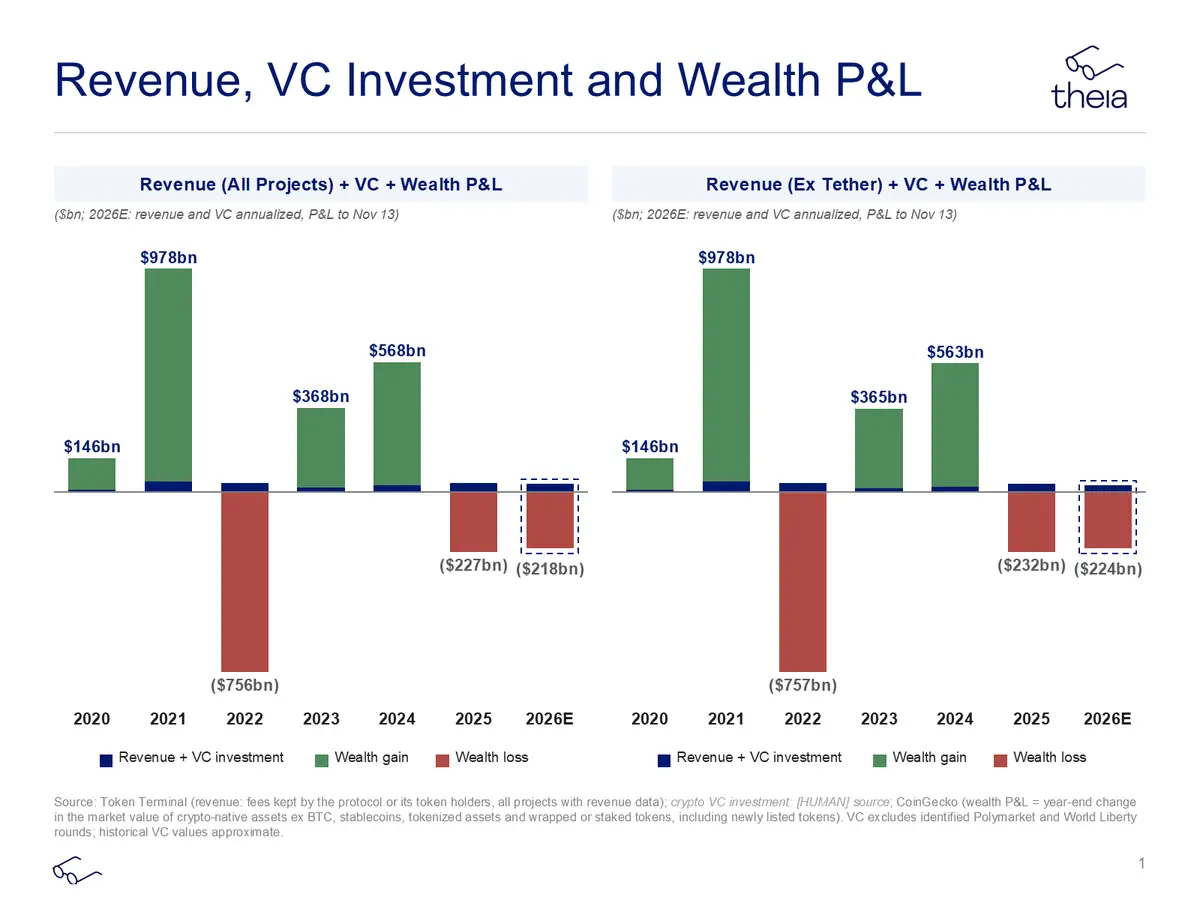
I believe you can understand the state of an industry by observing its three financial statements over time, especially when you understand how funds flow (for example, who is circulating funds within the industry, or pulling funds out of the industry, and where they are spending or investing their money). You can perform the same analysis for Silicon Valley, U.S. private equity, and AI. This article is obviously just an extremely simplified perspective on the cryptocurrency industry's financial statements, but I believe it is sufficient to explain the current state of the market (in short, people are sad because prices have fallen).
Outlook for 2027 and 2028
There are several reasons to remain optimistic. First, the worst phase is likely behind us—on-chain businesses are trading at reasonable valuations, and the market capitalization of tokens like Cardano has dropped from $80 billion to $5 billion.
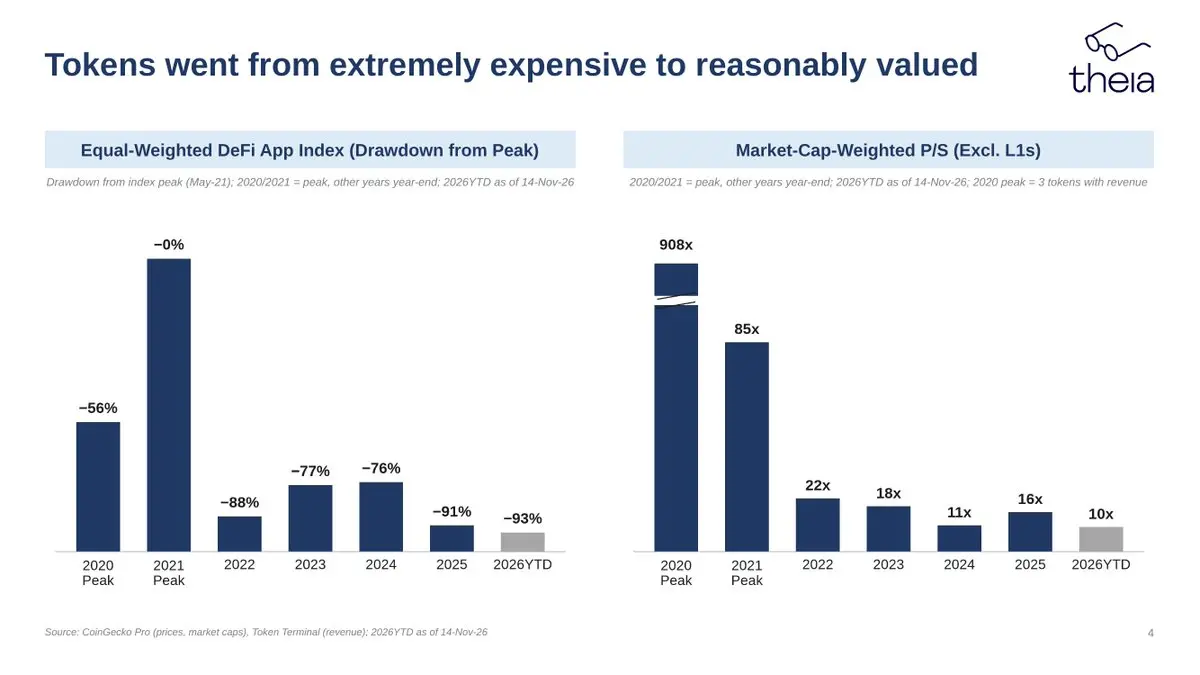
The way out lies in tokens that can generate revenue. While it is true that we would need to create 350 Hyperliquids to make up for the $350 billion balance sheet value lost from ETH and SOL solely through revenue, in terms of the industry balance sheet, we only need a few HYPE tokens to return to the best times of 2024.
Another way out is for valuable store-of-value assets like BTC, ETH, SOL, and ZEC to collectively increase by $350 billion in market capitalization. This is roughly equivalent to a 30% increase in BTC (however, if we exclude ETF holders and Bitcoiners who won't reinvest in the industry, we actually need more than a 60% increase), or for ETH and SOL to return to their historical highs. This is not a novel idea, but math is math.
This is the first article in my new series "The Future of Cash Flow in Financial Services." I will publish all of them on X.
ChainCatcher reminds readers to view blockchain rationally, enhance risk awareness, and be cautious of various virtual token issuances and speculations. All content on this site is solely market information or related party opinions, and does not constitute any form of investment advice. If you find sensitive information in the content, please click , and we will handle it promptly.



Popular articles