From Binance Alpha to Payward: RootData Emerges as a Trusted Data Infrastructure Provider for Tokenized Assets
 Core Viewpoint

 Exchanges are shifting towards comprehensive financial platforms, and data infrastructure is becoming a new competitive dimension.
By momo, ChainCatcher
Recently, Payward, the parent company of Kraken, entered into a strategic data partnership with RootData, a tokenized asset data platform. Through the partnership, Payward will integrate RootData's fundraising, tokenomics, and tokenized asset data to support a range of use cases, including information disclosure, tokenized stocks, institutional services, and business expansion.
As RWA tokenization continues to gain momentum, tokenized asset data has emerged as a key focus of the collaboration. Payward's business portfolio already spans tokenized stocks, derivatives, stablecoin payments, and institutional settlement. Meanwhile, RootData provides tokenized asset data covering underlying assets such as stocks, ETFs, and gold, alongside cross-market pricing data and rankings. These capabilities will provide valuable data support as Payward expands its operations across these areas.
Beyond a conventional data integration, the partnership reflects a broader shift in the data infrastructure requirements of trading platforms as they evolve into comprehensive financial platforms spanning both crypto and TradFi. This transition is driving growing demand for systematic, structured data infrastructure.
As Exchanges Evolve into Comprehensive Financial Platforms, Their Data Requirements Are Changing
Payward serves as the underlying financial infrastructure powering Kraken and its expanding family of businesses. Its operations are built around four core pillars: trading, banking, asset management, and B2B services. Across its portfolio, Payward's brands are seeing growth in areas including tokenized stocks, derivatives, stablecoin payments, and institutional settlement.
As its business footprint expands, so does the complexity of the information its platforms need to process.
In traditional trading environments, data requirements have largely centered on market prices, project profiles, and basic reference information. However, as platforms expand into institutional services, asset management, and tokenized assets, pricing and basic project information alone are no longer sufficient to address the full scope of research and decision-making needs. Questions such as which institutions have invested in a project, its fundraising history, how its tokens are allocated and unlocked, and how its broader ecosystem is structured are becoming increasingly important to understanding the assets involved.
At the same time, data is no longer used solely for user-facing information displays.
While information disclosure primarily addresses whether users can conveniently access relevant information, institutional services and business expansion introduce additional requirements, including project screening, background research, risk assessment, and client communication. As a result, data is evolving from a content resource into a shared capability that supports multiple business lines.
For comprehensive financial platforms such as Payward, integrating external structured data capabilities could reduce the costs associated with collecting and organizing the same information across different business units, while enabling data to play a broader role in operational workflows.
The Tokenization Wave Calls for a Parallel Upgrade in Data Infrastructure
As RWA adoption and tokenization continue to advance, demand for tokenized asset data is shifting from basic information retrieval toward more comprehensive and systematic data support.
Tokenization fundamentally changes how assets are represented, transferred, and settled. However, bringing assets on-chain does not automatically make them easier for market participants to understand or evaluate. As the market scales and institutional participation increases, expectations around data standardization, verifiability, and continuous monitoring will continue to rise.
On-chain data can provide visibility into transactions, holdings, and asset transfers, but it cannot independently capture the full picture of an asset. Off-chain information, including project backgrounds, fundraising histories, team and institutional relationships, and tokenomics, still requires long-term data collection, cross-verification, and structured processing before it can be efficiently integrated into different products and business workflows.
Under the partnership, RootData will provide Payward with not only fundraising and tokenomics data services, but also multidimensional data support covering tokenized assets.
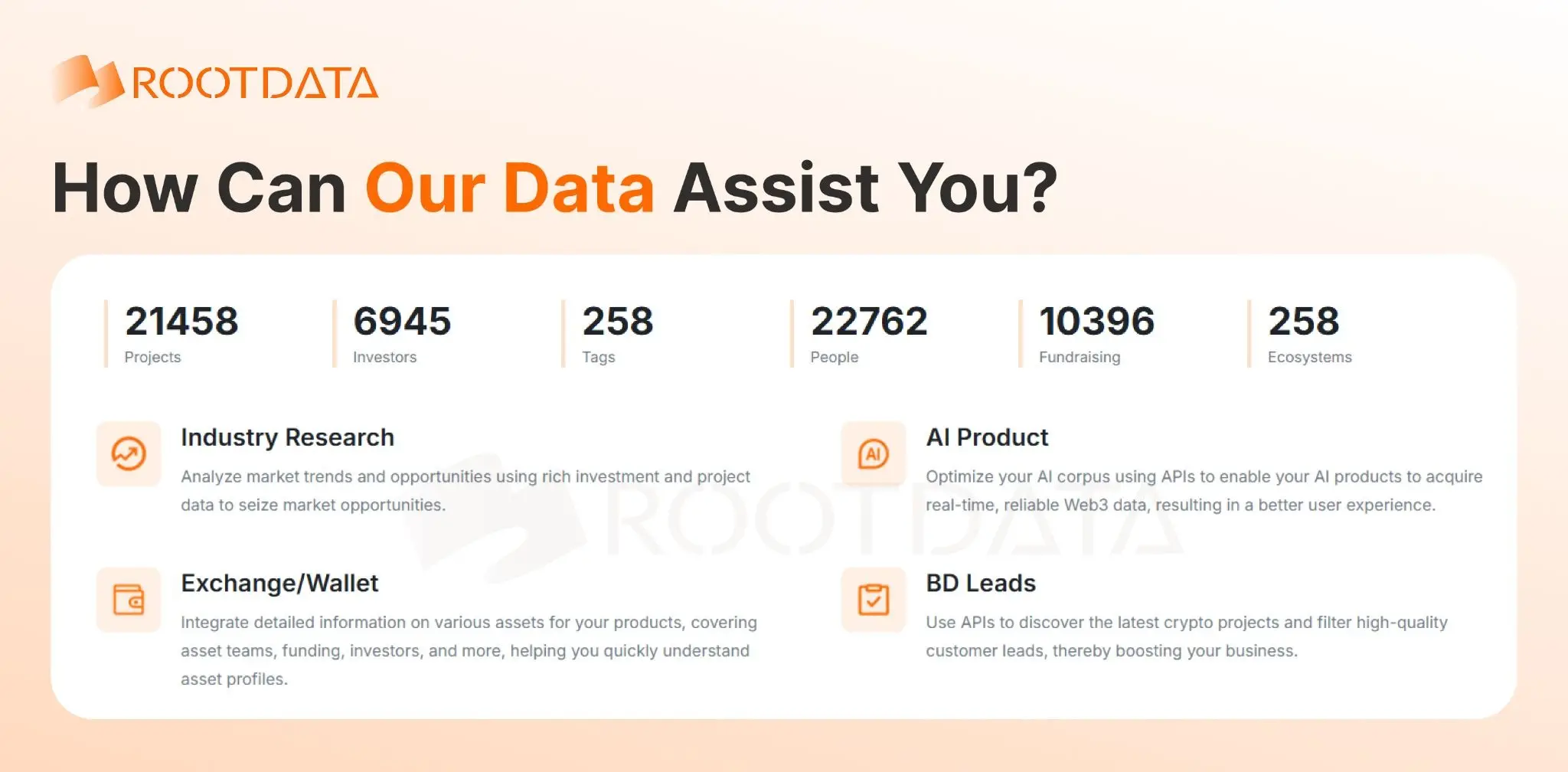
As of publication, RootData's database covers 21,458 projects, 6,945 investors, 22,762 industry professionals, and 10,396 fundraising events, supported by 258 tags and 258 ecosystem categories. This extensive dataset provides a foundation for research into fundraising backgrounds, team relationships, and project fundamentals. Within this coverage, RootData's tokenomics and token unlock data spans more than 2,000 projects, enabling platforms to access token allocations, vesting and release schedules, and related unlock information. These datasets add important dimensions to project fundamental analysis and token supply assessments.
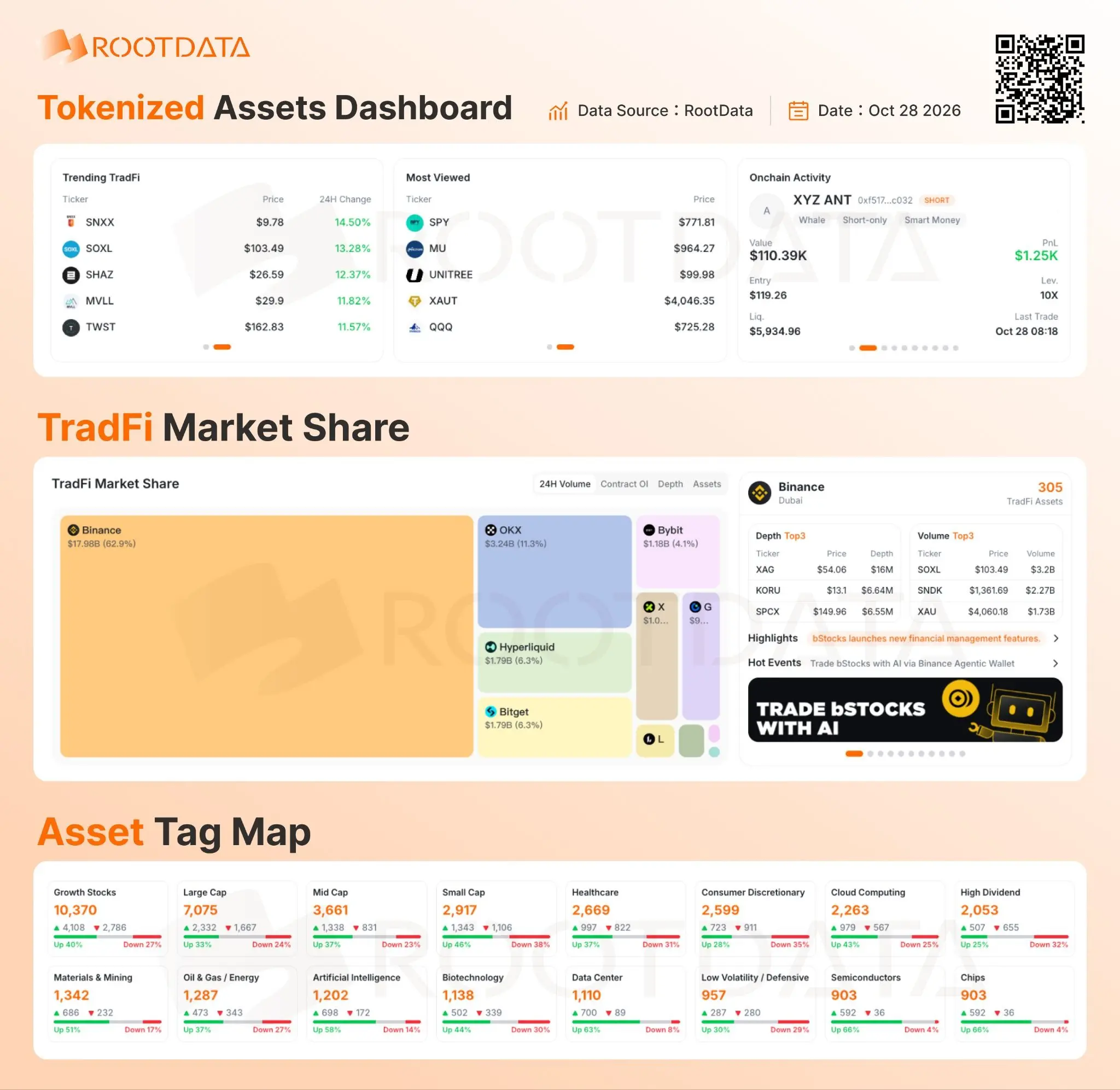
In tokenized asset data, RootData has developed coverage across its Tokenized Assets Dashboard, Stock Perpetuals Rankings, and Stock Spot Rankings. Its database now includes more than 8,000 underlying stock and ETF assets with valid market mappings, along with over 21,000 displayable records spanning stock derivatives, tokenized assets, and spot instruments.
For example, RootData's Tokenized Assets Dashboard consolidates data on popular TradFi assets, asset page views, on-chain activity, market share, asset tag treemaps, and individual asset profiles. For tokenized stocks specifically, RootData provides pricing, token supply, and AUM data across different issuers and on-chain versions. It also incorporates company financial metrics, including revenue, net income, gross margin, and free cash flow, allowing users to assess the fundamentals of underlying companies alongside their tokenized representations.
In addition, RootData leverages real-time data to compare stock derivatives and spot stocks across exchanges, covering prices, spreads, liquidity, 24-hour trading volume, open interest (OI), funding rates, leverage, and trading fees.
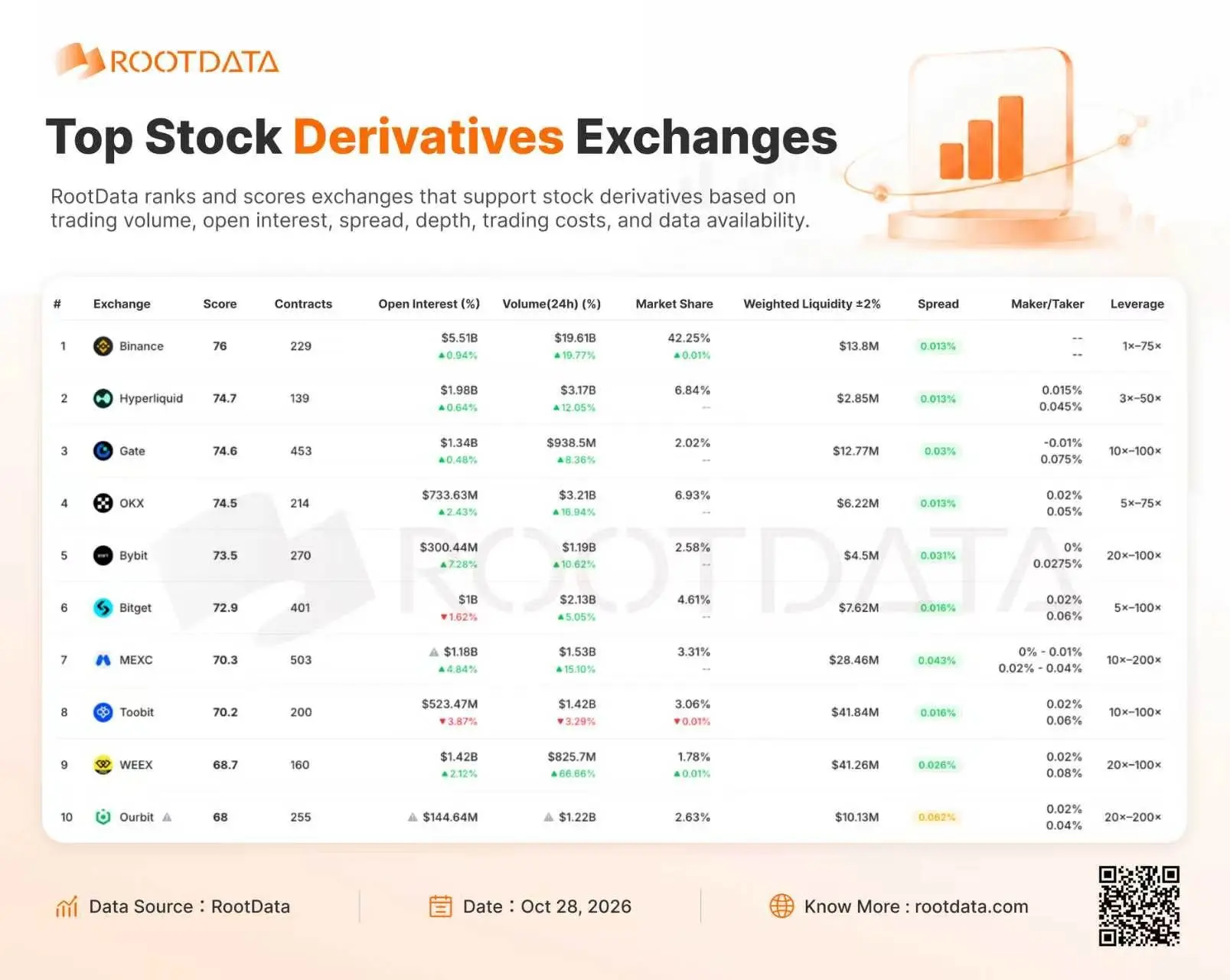
Through systematic data integration, these capabilities can support not only user-facing information disclosure but also institutional services, project research, and business development. This enables platforms to present and assess tokenized assets with greater depth and context.
This development also highlights the need for data infrastructure to evolve alongside asset and trading infrastructure as tokenization expands. Competition among platforms will increasingly extend beyond asset coverage, liquidity, and trading experience to include how effectively they organize information, deliver transparency, and integrate data into their products and services.
RootData's Tokenized Data Expansion Could Shift Competition Toward the Data Layer
For RootData, the partnership further expands the reach of its data services across leading platforms and a wider range of business applications.
Previously, Binance Alpha deeply integrated RootData's team data, allowing users to more conveniently explore a project's core contributors and their industry influence before trading. This integration enhanced information transparency on the platform. Meanwhile, RootData's data capabilities have continued to expand into wallets, trading platforms, security firms, and investment research tools.
The partnership with Payward represents a further step in this expansion, extending RootData's data services into information disclosure, tokenized stocks, institutional services, and business development, and bringing its capabilities deeper into comprehensive financial infrastructure.
To date, RootData has served more than 260 API clients, including prominent organizations and platforms such as Ethereum Foundation, Binance, OKX Wallet, CertiK, Coinglass, and Coinone.
These collaborations demonstrate that RootData is evolving beyond a standalone project information database into a standardized data provider supporting multiple leading industry platforms. Through APIs and other integration methods, RootData's datasets are increasingly embedded into products and operational workflows, positioning its data capabilities as foundational infrastructure across a wide range of use cases.
From Binance Alpha to Payward, RootData's partnerships are expanding from user-facing project information to tokenized finance and institutional services. Its data is no longer used solely to help users understand crypto projects; it is increasingly serving as foundational support for broader platform operations.
As RWA adoption and tokenization continue to progress, standardized, structured data will become an increasingly important foundation for information disclosure and cross-business collaboration. The partnership is expected to further extend RootData's capabilities into tokenization and institutional service applications, while supporting the industry's expansion into emerging financial segments such as tokenized assets. Ultimately, this evolution could accelerate a broader shift in tokenization competition: from a focus on assets and user traffic toward differentiation through data capabilities and information infrastructure.
 Risk warning Risk warning


Popular articles