Investors not buying it? OpenAI lowers valuation target to $1.25 trillion, plans to complete $30 billion financing before IPO
 Core Viewpoint


 OpenAI has lowered the valuation for this round of financing from $1.4 trillion to $1.25 trillion, with a target financing of up to $30 billion. This financing is positioned as a transitional arrangement before the IPO, led jointly by Coatue and the UAE Sovereign Fund, with a participation deadline of October 30. The valuation downgrade is due to weak investor demand, with some institutions experiencing "capital fatigue" after heavily participating in previous rounds.
OpenAI is lowering the valuation of this round of financing from the previous $1.4 trillion to $1.25 trillion to address some investors' reluctance while striving to complete up to $30 billion in financing before the IPO.
On October 22, according to CNBC citing informed sources, this round of financing is co-led by the American investment group Coatue and the sovereign fund of the United Arab Emirates, and OpenAI has notified potential investors that they must make participation decisions by October 30.
The valuation for this financing is a pre-investment valuation, which is about 47% higher than OpenAI's current valuation of $85.2 billion, but lower than the $1.4 trillion pricing floated to the market earlier this month.
While advancing the financing, OpenAI is also negotiating a supporting commercial agreement to secure priority procurement rights for newly built computing power from its UAE partners, which will provide substantial infrastructure support for its AI business expansion.
This financing is positioned as a "transitional" arrangement before the company's IPO—Chief Financial Officer Sarah Friar had previously informed employees that the window for going public is expected in 2027, but the specific date has not yet been determined.
High Pricing Faces Weak Demand
According to the Financial Times, Morgan Stanley and San Francisco tech fund Dragoneer previously promoted OpenAI to the bank's private wealth clients using the $1.4 trillion pre-investment valuation pricing.
However, several individuals familiar with the fundraising process led by Morgan Stanley revealed that client demand is significantly weaker than before. One individual stated:
No one is scrambling; previously, every time (OpenAI raised funds) it was a rush, but this time the response is tepid.
Some investors have reported signs of "indigestion"—having previously participated heavily in OpenAI's funding rounds, they are now facing funding fatigue.
OpenAI completed a $40 billion financing in March 2025 and subsequently achieved a record $122 billion financing in the same year. Competitor Anthropic's financing scale this year is also close to $100 billion.
Additionally, some investors indicated a preference to wait for Anthropic to complete its anticipated IPO later this year before deciding whether to follow up with investments in its competitor.
Market Turbulence Intensifies Financing Pressure
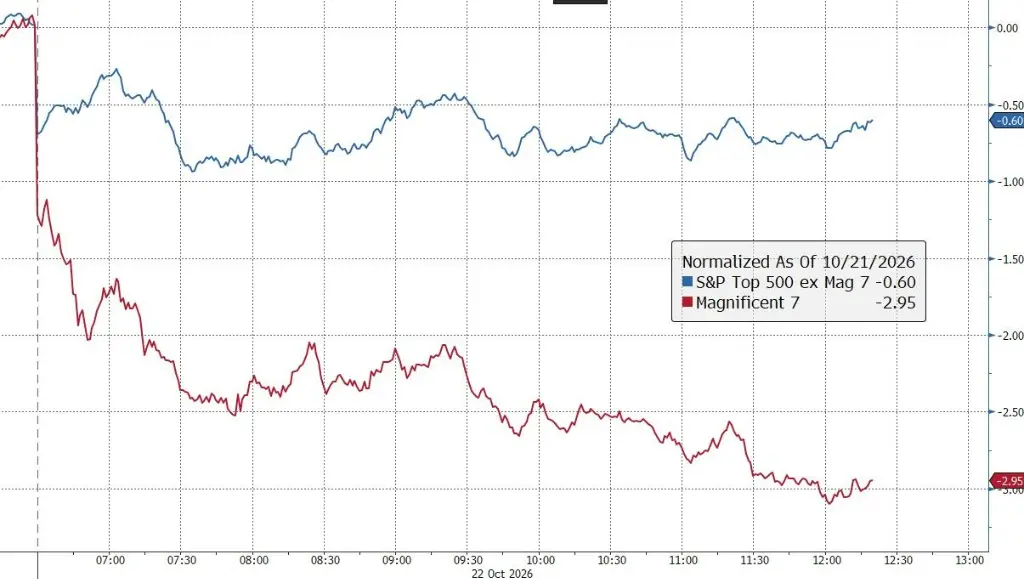
This valuation adjustment occurs against the backdrop of a significant pullback in U.S. tech stocks, with investors wary of whether the debt-driven AI infrastructure boom can be sustained.
On Thursday, major U.S. tech stocks generally fell, with the Wind Information U.S. Tech Seven Giants Index dropping 2.80% in a single day, including Meta down nearly 7%, Amazon and Nvidia down over 4%, and Tesla and Google down over 3%.
The Rockefeller family office holds positions in both OpenAI and Anthropic, and its Chief Investment Officer Jimmy Chang stated that the uncertainty surrounding the IPO prospects of both companies is exerting pressure on the overall U.S. stock market. Chang said:
The market needs to see a successful IPO; these companies need funding.
OpenAI stated that the final financing scale will depend on investor participation, and the actual amount may be lower than the $30 billion target. The company has declined to comment on this financing, and Coatue has also not responded to related inquiries.
For investors, this round of financing provides an opportunity to lock in leading AI assets before the public market, but the weak initial demand indicates that under the dual pressure of persistently high valuations and macro uncertainty, enthusiasm for AI investments in the private market is cooling.
Risk Warning and Disclaimer
The market has risks, and investment requires caution. This article does not constitute personal investment advice and does not consider individual users' specific investment goals, financial situations, or needs. Users should consider whether any opinions, views, or conclusions in this article align with their specific circumstances. Investing based on this is at your own risk.
 Risk warning