Micron's Earnings Report Preview: As Fiscal Year 2026 Q4 Approaches, Can HBM, SCA, and the Buyback Plan Propel Micron into a New Era of "Decoupling"?

On September 30, Eastern Time (this Wednesday), Micron Technology is set to release its financial report for the fourth quarter of fiscal year 2026 (June to August 2026). Based on the upward revisions from a densely packed sell-side expectation, it is highly likely that this quarter will once again deliver record-breaking performance. However, in the face of a trillion-dollar market capitalization and a high concentration of profit-taking, the marginal significance of the financial data itself has become relatively limited. The market is more concerned with whether Micron can break free from its designation as a "cyclical stock" and transition to a growth-oriented company with more resilient and predictable earnings.
Top investment banks like Goldman Sachs and UBS have focused on three core signals that management is about to release—Can the SCA strategic agreement continue to break through the revenue growth ceiling within the contract? Can the high premium of HBM remain strong beyond 2027? And after the lifting of restrictions under the CHIPS Act on December 9, will the stock buyback plan yield real cash? As we approach the release of the fourth-quarter financial report, how should we view these three key variables that reshape the storage industry landscape?
1. Review: Why did last quarter's financial report drive a single-day stock price increase of about 16%?
Looking back at June 24 when Micron released its FY26 Q3 (March to May 2026) financial report, the stock price surged about 16% in after-hours trading and closed up 15.7% the next day. The fundamental driver was the significant extent to which performance exceeded expectations:
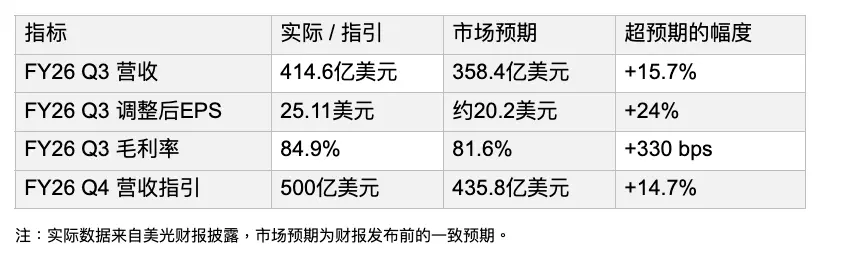
The significantly better-than-expected financial performance was one of the key factors driving the stock price increase: Micron's third-quarter revenue and guidance for the next quarter both exceeded market expectations by about 15%; more critically, the marginal gross margin corresponding to the new revenue in the third quarter reached 98%, meaning that most of the incremental revenue was converted into profit, reflecting Micron's strong pricing power and cost pass-through ability during the industry's upturn.
The commercial realization of the SCA long-term agreements changed the market's perception of the company's business model: the signing of 16 strategic customer agreements locked in approximately $100 billion in guaranteed contract revenue under 14 agreements, bringing in $22 billion in advance payments and deposits, of which cash amounted to $18 billion. This signifies that Micron's attempt to "de-cyclicalize" is no longer just a conceptual level but has transformed into cash assets on the balance sheet that are executable and highly certain.
Management's optimistic outlook on the mid-term supply-demand landscape extended the market's expectations for this economic cycle: Micron raised its server shipment growth forecast from about 10% to nearly 20% and clearly stated that the tight supply-demand situation would continue into 2027 and beyond. The triple combination of exceeding expectations, long-term agreements being realized, and an extended cycle supported the 16% increase in stock price on the day following the third-quarter financial report release.
2. Micron's fourth-quarter performance expectations have become consensus: Can the market price in advance, and can perfect expectations still be revised upward?
Sell-side institutions have generally predicted Micron's FY26 Q4 to be above the company's guidance median, and they are still revising upward before the financial report, making "exceeding guidance" itself difficult to serve as a significant catalyst for the stock price.
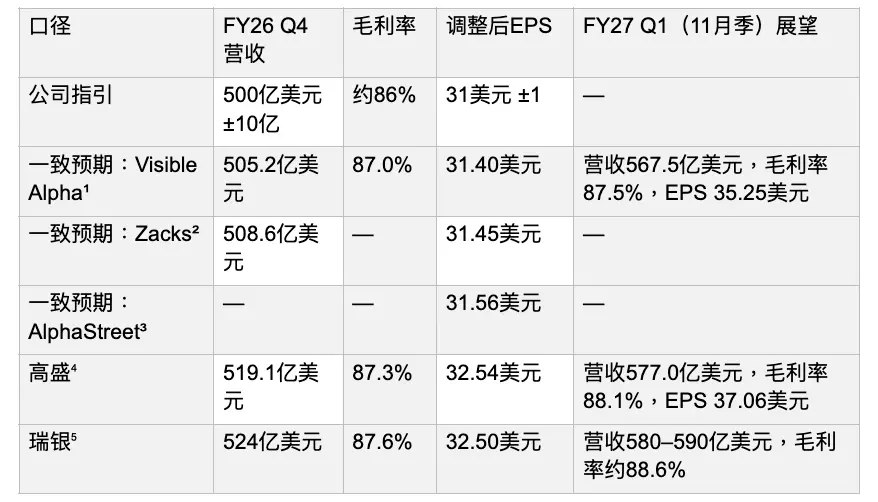
Note: ¹ Visible Alpha is a financial data platform under S&P Global, data as of September 11, 2026. ² Zacks consensus expectations as of September 25, 2026. ³ AlphaStreet earnings preview, published in late September 2026, only discloses EPS expectations. ⁴ Goldman Sachs earnings preview report as of September 11, 2026. ⁵ UBS research report in late September 2026, as cited by Zhitong Finance on September 26, 2026; UBS stated that its forecast exceeds consensus expectations by 3.9% (revenue) and 4.3% (EPS), based on which the consensus expectation it used was approximately $50.4 billion in revenue and $31.16 in EPS, which is basically close to Visible Alpha data. "---" indicates that the source did not disclose. The consensus expectations from various institutions may differ due to different data providers, covering brokers, and statistical timing.
Multiple indicators show that the market has formed a high consensus on exceeding expectations this quarter. The market's consensus expectation is not only above the company's guidance median but has also continued to be revised upward before the financial report: Visible Alpha's revenue expectation was $50.52 billion (as of September 11), and by September 25, Zacks' estimate had risen to $50.86 billion, with EPS expectations adjusted upward by $0.06 that week. Secondly, mainstream brokerage predictions generally exceed consensus expectations by 2% to 4%, with Citigroup also publicly predicting that Micron will exceed guidance, citing significant price increases in DRAM and NAND during the quarter. Most analysts covering Micron have given bullish ratings.
The apparent narrowing of the exceeding expectations space means that the possibility of replicating last quarter's significant surge this quarter has decreased. Last quarter's financial report showed Micron's revenue was nearly 16% above market expectations; however, this quarter, mainstream institutions' exceeding expectations range has narrowed to 2% to 4%, with revenue falling within the $51 billion to $52.5 billion range, which is entirely within market expectations. More concerning is the subsequent trend from the last quarter: after a significant surge, the stock price retraced about 20% in the following week, with a maximum drawdown of about 32% within 30 days. Even if performance significantly exceeds expectations, profit-taking after good news may still impact short-term trends.
Under high pricing, the stock price is more sensitive to any marginal slowdown signals. Micron's stock price has risen about 277% this year, closing around $1,080 on September 24, with a market capitalization exceeding $1 trillion; Goldman Sachs' target price of $1,100 is now close to the current price. This means that the biggest potential risk of this financial report is not underperformance but rather that exceeding expectations has already been fully priced in, and there is a lack of further upward revision space after good news is realized.
3. Valuation Discrepancy: Goldman Sachs $1,100 vs. UBS $1,625, where is the divergence?
Goldman Sachs and UBS have a 48% discrepancy in their target prices for Micron: although both institutions predict that Micron's performance this quarter will exceed market expectations and neither directly uses the peak earnings of this cycle for valuation, Goldman Sachs only assigns a "neutral" rating and a target price of $1,100, while UBS maintains a "buy" rating and a target price of $1,625.
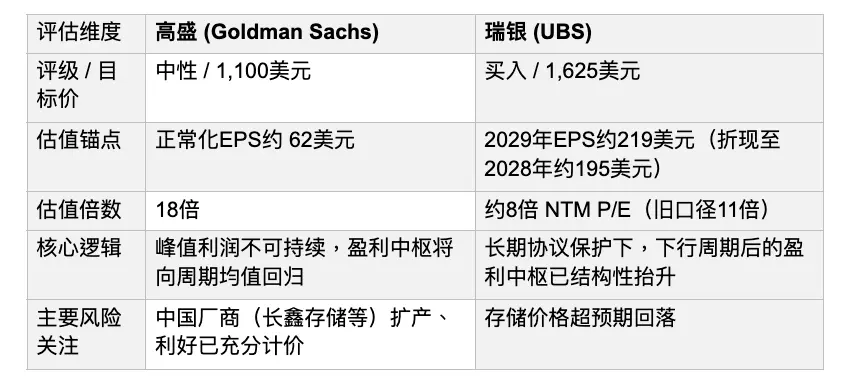
Goldman Sachs' valuation framework is based on a reasonable multiple of "normalized earnings," essentially still viewing Micron as a cyclical stock: Goldman Sachs derives a target price of $1,100 by multiplying a normalized EPS of about $62 by an 18 times price-to-earnings ratio. This EPS base is only slightly more than 30% of its 2027 EPS forecast (170.70), implying that current profits are at a cyclical peak and should not be viewed as a long-term sustainable level. Therefore, the low price-to-earnings ratio calculated based on peak earnings for Micron is not a signal of undervaluation but a typical characteristic of cyclical stocks at the peak of the cycle. Within this framework, Goldman Sachs believes that good news has been fully priced in: investors' positions are "tilted towards optimism," and market expectations before the financial report "remain high." Additionally, Goldman Sachs lists the continuous market share capture by Longsys and price suppression as major downside risks, believing that the long-term expansion of Chinese manufacturers remains a key variable suppressing industry valuations; as long as this uncertainty is not resolved, the market will find it difficult to grant Micron a higher valuation for peak earnings.
UBS's assessment logic, on the other hand, crosses the peak of the cycle and directly anchors the profit base after the downturn: according to UBS's publicly disclosed valuation model, UBS predicts Micron's non-GAAP EPS in 2029 to be about $219, discounted to about $195 for 2028 at a cost of equity of 12.2%, and then assigned an approximately 8 times forward price-to-earnings ratio (NTM P/E), resulting in a target price of $1,625. UBS chose 2029 as the valuation benchmark because by then, the industry is expected to have fully experienced a mild downturn, and the profit level in that year can more objectively reflect Micron's cross-cycle profitability under the support of SCA long-term agreements, which aligns with its industry judgment that "storage prices will start to decline in the second half of 2028."
Micron's recent stock price rebound may be driven by factors such as capital sentiment and catalyst expectations: after the release of last quarter's financial report, Micron's stock price continuously retraced from a 52-week high of $1,254.81, dipping to around $900 in early September; it has recently rebounded to around $1,080 over the past two weeks, during which market attention to capital positioning before the financial report has increased. On one hand, sell-side institutions like UBS have publicly reiterated their bullish stance; on the other hand, SK Hynix and Samsung have successively launched substantial shareholder return plans, prompting the market to bet that Micron will follow up with buybacks after the restrictions are lifted.
4. Storage Market Differentiation: Slow Rise of DRAM and HBM Premium, Where Does Profit Elasticity Come From?
The positioning of DRAM and HBM is fundamental to understanding the current supply-demand differentiation in the storage industry and Micron's revenue structure. DRAM, or dynamic random-access memory, is responsible for temporarily storing data during computation and is widely used in servers, smartphones, and personal computers. HBM, or high-bandwidth memory, is essentially based on DRAM architecture but vertically stacks multiple layers of DRAM chips using TSV (through-silicon via) technology and closely packages them with GPUs on the same substrate, offering data throughput capabilities far exceeding traditional memory, making it an irreplaceable core component for AI accelerators. In terms of revenue structure, DRAM is Micron's primary source of income: according to Goldman Sachs' forecast, about 75% of Micron's revenue in the fourth quarter of fiscal year 2026 will come from DRAM (including HBM), while the remaining approximately 25% will come from NAND flash memory.
The core feature of this storage cycle is the high differentiation in price structure, with HBM premiums replacing the traditional broad price increases of DRAM, becoming the main source of profit elasticity. The prices of traditional DRAM and NAND are constrained by long-term contract ceilings and weak consumer demand, having shifted from explosive increases to a slow rise; HBM, on the other hand, continues to expand its premium due to extremely high technical barriers and a highly concentrated capacity structure. This differentiation means that the profit drivers for Micron in this cycle are shifting from the industry-wide price increases of ordinary DRAM to the high marginal premiums brought by HBM.
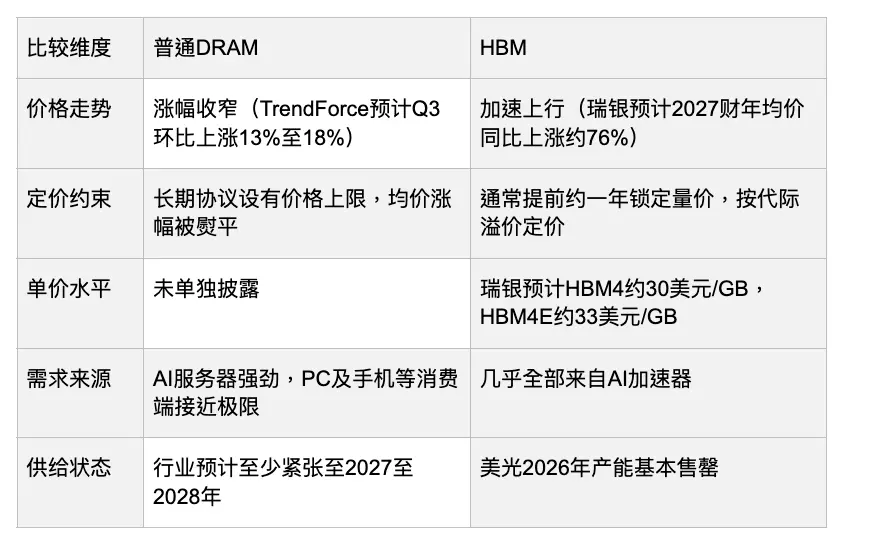
Quantitative comparisons further highlight HBM's pricing power, with its profit elasticity primarily coming from price rather than shipment volume. Entering the third quarter of 2026, TrendForce expects the quarter-on-quarter increase in standard DRAM contract prices to narrow to 13% to 18%. In contrast, UBS predicts that Micron's blended HBM average price in fiscal year 2027 will increase by about 76% year-on-year, with HBM4 priced at about $30/GB and HBM4E at about $33/GB, demonstrating pricing power far exceeding that of ordinary storage products. Micron currently holds about 20% of the global HBM market, with cumulative revenue from HBM4 exceeding $1 billion; however, under the condition of nearly sold-out capacity, its bit shipments are constrained by actual capacity limits, making it difficult to significantly increase volume. Although the market has concerns about NVIDIA's reduction of HBM configurations for the new generation of GPUs, since the current bottleneck is on the supply side rather than the demand side, a decrease in single-card configurations can actually allow limited HBM supply to match more GPU shipments, alleviating overall delivery pressure. Therefore, under the constraint of limited shipment volume growth, the approximately 76% increase in average price and its corresponding high marginal gross margin may constitute an important source of growth elasticity for Micron's future revenue and profits.
On the supply side, the squeeze of wafer capacity by HBM is the key mechanism supporting the "slow and continuous rise" of ordinary DRAM prices, while the expansion pace of Chinese manufacturers is the biggest uncertainty. Producing HBM of the same bit requires about 3 to 4 times the wafer capacity of ordinary DRAM. The three major manufacturers, SK Hynix, Samsung, and Micron, have prioritized new wafer allocations for HBM, significantly compressing the effective supply of ordinary DRAM. TrendForce predicts that the proportion of HBM in global DRAM wafer investment will rise from 18% in 2025 to 30% by the end of 2027, but its bit output share will only increase from 8% to 13%, clearly showing the huge gap between capacity consumption and bit output. Since new wafer fabs typically take over two years from construction to mass production, this squeezing effect will maintain a tight supply-demand relationship for ordinary DRAM for a long time. Micron's management believes that the supply-demand tightness will continue beyond the calendar year 2027, and UBS also believes that the DRAM industry will remain in short supply until the second quarter of 2028. Disagreements focus on Changxin Memory Technologies (CXMT): Goldman Sachs lists its market share expansion as a major downside risk, while UBS believes its expansion is constrained by the acquisition of advanced equipment and process yield, and market concerns about its impact on prices are somewhat excessive.
The structural imbalance on the demand side is intensifying: AI-related demand continues to concentrate on HBM and server memory, while consumer electronics are approaching their price tolerance limits. According to TrendForce's estimates, AI applications will consume about 20% of global DRAM wafer capacity by 2026, while global DRAM capacity is only growing at about 10% to 15% annually, indicating that the expansion of AI demand is clearly outpacing supply. AI training and inference servers have extremely high requirements for memory capacity and bandwidth, and the explosion of inference demand has also driven shipments of high-capacity enterprise SSDs; cloud service providers are signing multi-year long-term agreements to secure capacity. In stark contrast, consumer terminals such as PCs and smartphones are showing increasingly obvious signs of weakening demand in the face of record contract prices. From the perspective of supply-demand balance, the possibility of easing in the short term is limited: most new capacity is prioritized for HBM, and the expansion pace of ordinary DRAM is relatively restrained. Notably, TrendForce points out that at the beginning of 2026, the revenue per wafer for HBM briefly fell below that of DDR5 64GB server memory modules, indicating that HBM's relative profitability was once lower than that of ordinary DRAM. This also explains why manufacturers significantly raised HBM prices in 2027: only by maintaining a sufficiently high premium can manufacturers be motivated to continue allocating capacity to HBM.
The core differences between the two product categories are as follows:
V. What does Micron's SCA long-term agreement lock in? Can it help Micron shed the "cyclical" label?
Memory chips are a typical cyclical industry, and this cyclicality is the root cause of Micron's long-term low valuation: memory chips are highly homogeneous standard commodities, with prices almost entirely determined by supply and demand: when supply is insufficient, prices rise sharply, and manufacturers rush to expand production; one to two years later, new capacity is released, the market turns to surplus, prices fall sharply, manufacturers incur losses, and are forced to cut production. This cycle of "prosperity—expansion—surplus—clearing" is similar to cyclical industries such as steel, shipping, and LCD panels. The cost is volatile profits and a lack of predictability in operations; Micron experienced significant losses in fiscal year 2023. For this reason, the capital market exhibits an "inverted pricing" for cyclical stocks: Micron's projected price-to-earnings ratio for 2027 is only about 6 times, SK Hynix about 4 times, while the weighted average for comparable semiconductor companies is about 16 times.
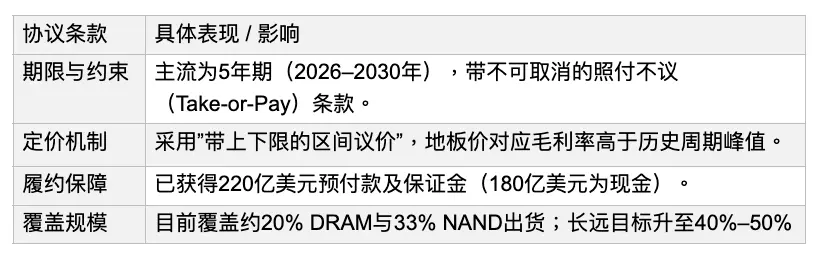
The essence of the SCA strategic customer agreement is to exchange some price upside flexibility for long-term volume and price certainty: this agreement is mainly aimed at large cloud service providers. According to data disclosed by Micron in the previous quarter, the company has signed 16 SCA agreements, with 14 corresponding to a minimum contract revenue of about $100 billion, and has received about $22 billion in advance payments and performance guarantees, of which about $18 billion is cash.
The first batch of SCAs officially entered the execution phase in 2026, but the current coverage of actual shipments by the contracts is still relatively limited: according to publicly available market information, the signed agreements currently cover about 20% of Micron's DRAM shipments and one-third of NAND shipments. Management expects that once all planned agreements are signed and implemented, fixed-price or price-capped revenue will account for about 40% of total revenue, and the final coverage ratio may even exceed half. This means that at the current stage, about 80% of Micron's DRAM shipments are still mainly sold at market prices, allowing it to fully enjoy the price increases brought about by industry prosperity.
Micron has not disclosed specific price ranges for the agreements, but its floor price mechanism shows strong anti-cyclical downward capability: Micron stated that the gross margin corresponding to the agreement's floor price "far exceeds any quarterly peak gross margin in previous cycles"; as a reference, Micron's peak gross margin in the last cycle was about 62%. Regarding the ceiling price, based on publicly available industry information, the price cap for the first batch of agreements is roughly based on market prices in the second quarter of 2026. Subsequently, as market prices continued to rise, SCA customers effectively received a certain discount.
The gradual effectiveness of long-term agreements has flattened the increase in Micron's blended average selling price (ASP), which is a structural reason for the sequential slowdown in its revenue growth: Micron's revenue in the last quarter (FY26 Q3) grew significantly by 74% sequentially; according to Goldman Sachs' forecast, the sequential growth rate for FY26 Q4 is expected to drop to about 25%, and further decline to about 11% in November. This slowdown in growth is not due to weakening fundamentals or industry downturns, but rather a natural result of the increasing share of SCA revenue during the price rise period. Conversely, once the industry enters a downturn cycle, the floor price in the agreements and the "take-or-pay" minimum purchase volume will play a stabilizing role, which is also the core reason the market is willing to pay a valuation premium for Micron's "de-cyclical" logic.
Core terms design framework of SCA
VI. Share Buybacks: What experience does SK Hynix have with the CHIPS Act restrictions being lifted on December 9?
The buyback restrictions of the CHIPS Act will be lifted on December 9, 2026, and this financial report is the last formal conference call before the restrictions are lifted, making the capital return statement as important as the quarterly performance. The U.S. Chips and Science Act provides subsidies for domestic wafer fab construction, with one of the conditions being that subsidized companies cannot conduct large-scale buybacks or dividends for a certain period. Micron signed a subsidy agreement of about $6.1 billion with the U.S. Department of Commerce in December 2024, and can only conduct small-scale buybacks over the next two years to offset dilution from employee equity incentives. The two-year agreement will end on December 9, 2026. Goldman Sachs also listed the buyback plan as one of the most anticipated topics in the conference call preview.
Stock buybacks may support shareholder value through factors such as increased earnings per share, potential buying support, and management signals. First, with profits unchanged, a reduction in circulating shares will directly raise earnings per share; based on Micron's current share capital of about 1.1 billion shares, a buyback of $20 billion per quarter could recover about 1.6% of circulating shares. Second, regular buybacks may provide additional market demand during stock price corrections and alleviate selling pressure to some extent. Third, buybacks are a public endorsement of management's cash flow sustainability: memory manufacturers typically expand production significantly at peak market conditions, which has historically been a signal of market peaks; prioritizing cash for shareholder returns rather than capacity expansion, along with SCA long-term agreements, forms the second pillar of Micron's "de-cyclical" narrative.
From the currently disclosed financial data, Micron has strong buyback capability, and the market is focused on the scale and pace. Micron's free cash flow for FY26 Q3 reached a record $18.3 billion, with net cash of about $25 billion. Chief Financial Officer Mark Murphy stated that after the restrictions are lifted, the company will increase capital returns, with a long-term goal of returning 100% of excess cash to shareholders, but did not provide specific scale or timetable. According to UBS research reported by Zhitong Finance, UBS expects Micron to initiate buybacks in the second quarter of fiscal year 2027 (from December 2026 to February 2027), with an initial scale of about $20 billion per quarter, and is expected to gradually increase thereafter.
Management's consistent cautious style means that the buyback information in this conference call may not exceed expectations. UBS judges that Micron will not release aggressive buyback signals in advance. Combined with past statements, management is more likely to reiterate the direction of "increasing capital returns after the restrictions are lifted" rather than announce specific authorized amounts. In the context of the market having high expectations for buybacks, if only qualitative statements are provided this time, it may be difficult to serve as a catalyst for stock price growth in the short term.
SK Hynix's buyback in August provides a useful reference: buybacks may boost market sentiment in the short term, but they may not change the overall pricing logic of the industry. On August 19, SK Hynix announced a stock buyback and cancellation plan of 40 trillion Korean won (about $28.6 billion), accounting for about 3.3% of total share capital, with an execution period from August 20 to November 19, and all repurchased shares to be canceled; at the same time, the company raised its shareholder return target for 2025 to 2027 from "within 50% of cumulative free cash flow" to "over 50%." The board's reasoning was that the company's intrinsic value was not fully reflected in the current stock price. Before the announcement, its stock price had fallen nearly 50% from the June peak, and on the day before the announcement, it plummeted over 9%; the first trading day after the announcement saw a rise of 12.73%, fully recovering lost ground, showing that the market reacted directly and quickly to "real cash" shareholder returns. However, afterward, its stock price remained about 16% lower than the 50-day moving average, with market concerns about the sustainability of AI capital expenditures and rising global bond yields, which buybacks cannot resolve. Another noteworthy detail is that SK Hynix's stock price fell 4.9% when it announced a 54.3 trillion Korean won expansion investment plan a week before the buyback announcement, reflecting the market's clear preference for "returning to shareholders" rather than "expanding capacity."
From Hynix's case, the buyback that Micron is about to initiate may support long-term per-share value more than it affects short-term stock prices; it is more like a "ballast" for long-term value rather than an independent driver of short-term stock prices. Hynix's experience indicates that buyback announcements can boost sentiment and strengthen market recognition of capital discipline, but the mid-term direction of stock prices still depends on the sustainability of memory price cycles and AI demand. The deeper significance of Micron's buyback lies in the long term: continuously reducing share capital at peak market conditions will determine the extent to which the company's earnings per share and stock price can be supported during the next downturn cycle. Therefore, what is truly worth paying attention to in this conference call is whether management can provide a quantifiable capital return framework, including the scale of buyback authorization, execution pace, and the trade-offs between capital expenditures and shareholder returns.
Disclaimer
This article is compiled and written by this platform based on publicly available information. The market data, institutional views, and news reports cited mainly come from research reports by Goldman Sachs, UBS, and other brokerages, data agencies such as Visible Alpha, Zacks, FactSet, TrendForce, as well as company announcements and financial reports from Micron Technology and SK Hynix, and public disclosures from major financial media. This platform has made every effort to verify its accuracy but makes no express or implied guarantees regarding the completeness, timeliness, and accuracy of the relevant information.
The views, forecasts, and valuation data from UBS mentioned in this article are derived from reports by media such as Zhitong Finance. This platform has not obtained the original research report, and there may be discrepancies with the original text; Micron has not disclosed the specific price range of the SCA strategic customer agreement, and the related comparisons in this article are based on publicly available market information. The figures for HBM revenue share, share buyback ratio, etc., are also estimates and not official company data. Readers are advised to exercise caution.
The analyses, judgments, and expectations contained in this article only represent the views at the time of writing (late September 2026). Consensus expectations, institutional forecasts, and market prices may change around the time of financial report releases, and this platform does not assume any obligation to update.
The content of this article is for reference and communication purposes only and does not constitute any investment advice, offer, or invitation to offer, nor does it constitute a recommendation for any securities, financial products, or derivatives. Investing in stocks and the semiconductor industry carries significant volatility risks, and past performance does not guarantee future returns. Investors should operate based on their own financial situation and risk tolerance and consult qualified professionals before making any investment decisions.
 Risk warning