The rise of giant platforms and micro software companies creates a dangerous situation for medium-sized single-point solutions
 Core Viewpoint
 537 American unicorns still carry the old valuations from 2021-22, and "AI native" is shifting from a bonus to a risk point being exposed. Investors are starting to ask: What is left after you remove your AI label?
Original Author: Venture Curator
Original Compilation: Deep Tide TechFlow
Deep Tide Guide: 537 American unicorns are still carrying the old valuations from the 2021 bubble period, and the label "AI Native" is shifting from a bonus to a risk point. For practitioners who are currently raising funds or holding options, this article helps you distinguish which valuations are real and which are just unchallenged paper numbers.
537 American unicorns are still carrying valuations from the 2021-22 bubble period. Are they still real?
Founders and early employees are often taught to treat the last round's valuation as a scoreboard. That is the number on the equity structure table, the number in press releases, and the number everyone uses to estimate their equity value.
However, new data from PitchBook's Q3 2026 quantitative outlook report shows that for most American unicorns, this number has not been truly tested by the market for several years.
PitchBook studied all active American unicorns, categorizing them by the year they last completed a priced financing round.
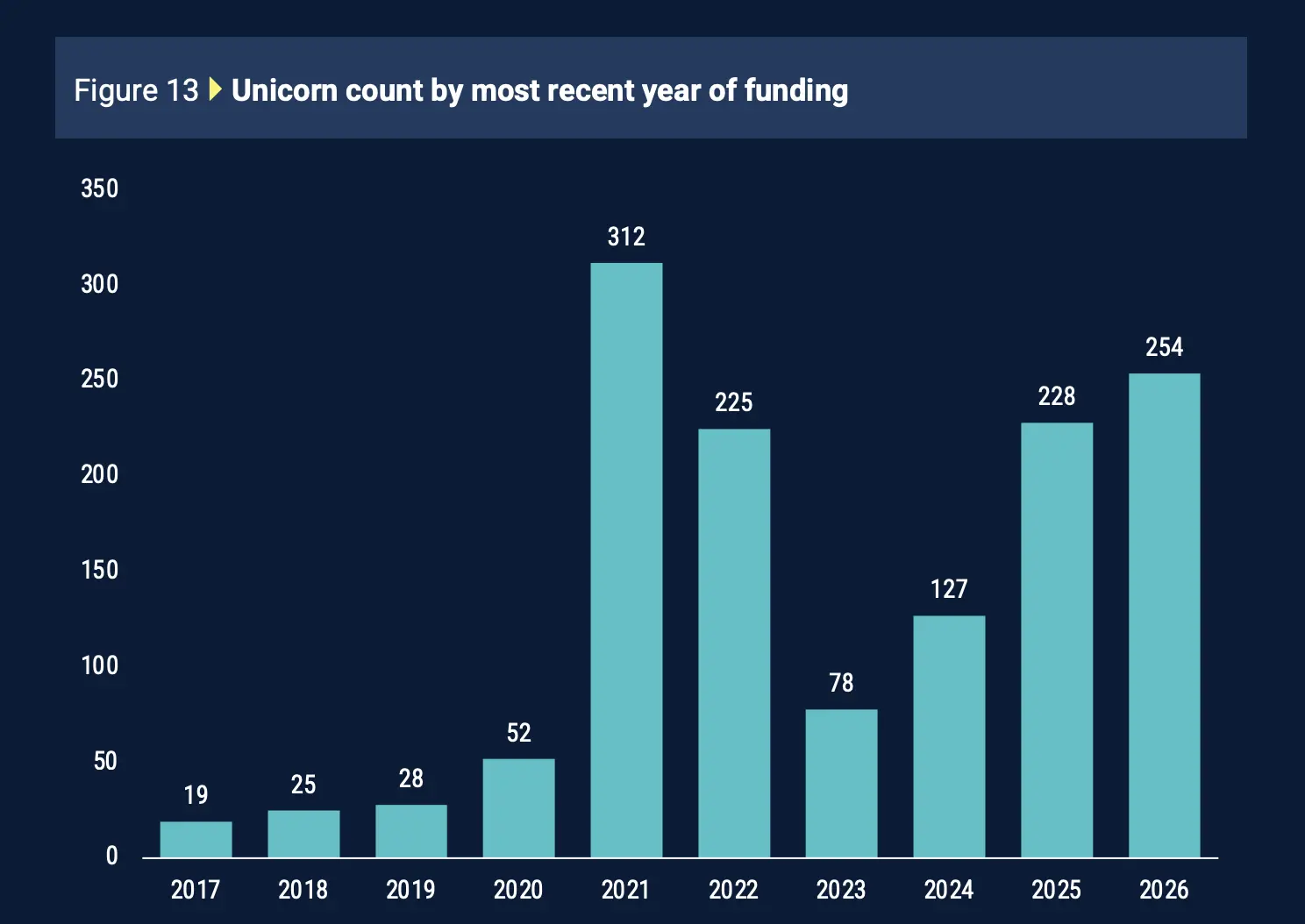
Among the 964 active American unicorns, 312 last raised funds in 2021, and another 225 in 2022. This means that 537 companies (about 56% of the entire unicorn group) are still carrying valuations set during the most expensive financing period in venture capital history.
Cash will no longer return to match those numbers. The allocation of venture capital funds accounts for only 7.9% of net asset value, nearly half of the long-term average of 14.5%. PitchBook points out that fund returns have been directly dragged down by the inflated valuations from 2020 to 2022.
When these companies actually go to test prices, they often cannot hold up. Public market investors refuse to pay private market prices. Chime's valuation at IPO significantly shrank from its private market peak, and secondary market buyers offer discounts far greater for companies that completed their last round of financing many years ago compared to those that recently completed financing.
There is also a second trend behind this. Many of these companies are not stagnating because they cannot continue, but are actively choosing not to raise funds or go public, as any new pricing event could force them to face a lower number. Staying private and silent allows the 2021 valuation to remain on paper. This is why the market can simultaneously have record paper values and record trapped values.
So is the unicorn craze real, or is it just an unverified number?
For many companies, both statements may hold true. Some companies have indeed matured to the valuations of 2021 and can easily sustain them today. But the market has no way to confirm which companies belong to this category, as they have not raised funds or sold at real prices since then. A valuation from four years ago is not a lie; it is simply unverified.
This is precisely the part that founders and employees need to be cautious about.
If your company's last financing was in 2021 or 2022, the valuation on the equity structure table is the most optimistic number you have ever owned, which does not necessarily equal today's actual value. This affects how you negotiate the next round, how you consider exercising options, and how you explain to the team what their options mean. The same goes for investors: if a fund shows strong unrealized gains for these companies, it is just reporting paper numbers, not real cash.
The real risk is not that the valuation may be lower than it appears, but that when making financing, hiring, or exercising decisions, you treat the number set in 2021 as the price the market is still willing to pay you today.
Calling startups "AI Native" may actually harm your valuation?
Identifying as an AI company can still fetch a valuation premium. But investors are increasingly asking a second question: how much of this company is truly defensible because of AI?
The data in this analysis indicates that the market is beginning to categorize companies with the same "AI Native" label into entirely different baskets.
The AI premium still exists: data from Carta for the first half of 2026 shows that AI startups raise about the same amount of money in seed rounds as non-AI companies, but their valuations are about 50% higher.
However, not every AI company receives the same premium: analysis places commoditized AI shell companies at 3 to 8 times revenue, vertical AI products with sticky proprietary data at 10 to 20 times, and companies that truly own intellectual property and proprietary data at 25 to 40 times.
The more mature the company, the stricter the scrutiny: in seed rounds, companies without protectable intellectual property face a 20% to 30% discount compared to more defensible peers. By Series A, this gap widens to 30% to 40%.
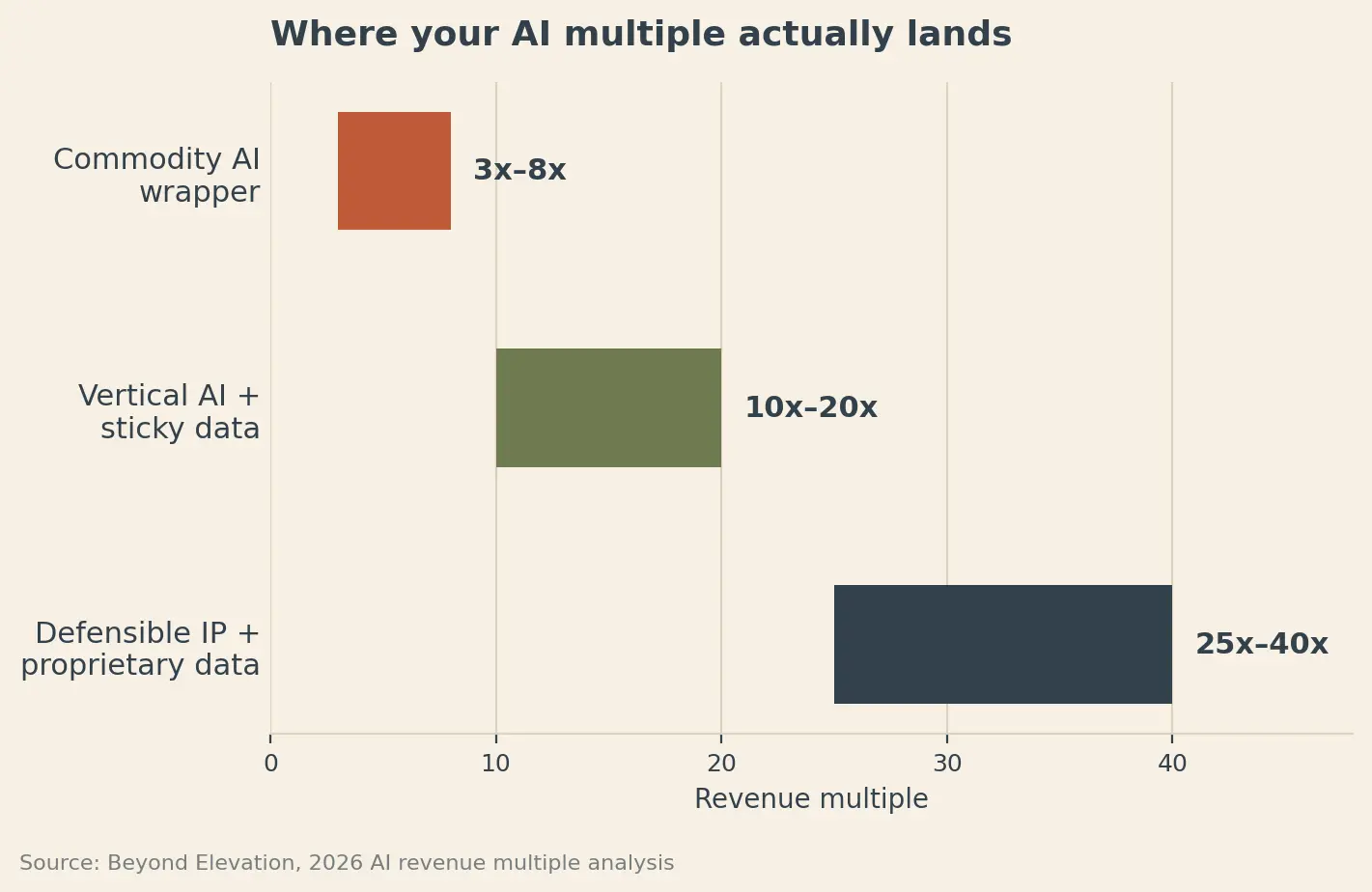
This explains why simply adding AI to a product is becoming increasingly meaningless.
Investors want to know more and more what remains when you remove the AI label.
Can another startup create a product by calling the same foundational model API? Does each new customer generate proprietary data that measurably improves the product over time, such as accuracy, resolution time, or matching quality? Is the software embedded deeply enough in the workflow that replacing it would be painful? After the inference volume increases tenfold, does the unit economic model still hold?
These questions point to four directions founders should examine before the next round of financing: technological differentiation, proprietary data, workflow lock-in, and unit economic models under scale.
The actual test of technological differentiation is surprisingly simple: switch out the underlying model. If changing your main model supplier to another model of comparable level results in little change to the product, investors may not see where the technological moat lies.
For proprietary data, just having user numbers is not enough. A stronger signal is whether increased usage generates data that measurably improves the product over time, such as improvements in accuracy, resolution time, or matching quality.
Workflow depth is another clue. If customers who integrate the product more deeply consistently show better retention and expansion, founders have tangible evidence of switching costs, rather than just claiming strong product stickiness.
Then there is the economic model. An AI product may have good margins at current usage levels, but that could completely change if the inference volume expands tenfold. Clarifying these calculations before investors can reveal whether the business truly becomes stronger as it scales.
This makes the evolution of the "AI Native" premium very interesting.
Eighteen months ago, just being associated with AI could significantly strengthen the financing narrative. As more and more startups use the same rhetoric, investors have more reasons to look beneath the surface.
The AI label can get you into the conversation. The increasingly valuable part is proving why what you have built becomes harder to replicate as it grows.
The barbell effect of software: AI is about to kill the middle layer of the software market.
AI is making software development significantly cheaper and faster. This sounds good for startups, but it may also weaken some of the moats that have protected software companies for decades.
Mike Vernal from Conviction made an interesting comparison: software may be heading towards a similar "barbell" structure that emerged in the newspaper industry after the internet changed it.

Before the internet, regional newspapers benefited from high distribution costs. Once distribution became almost free, most of the middle layer disappeared. A few global publications became much larger, while thousands of independent and niche publications emerged.
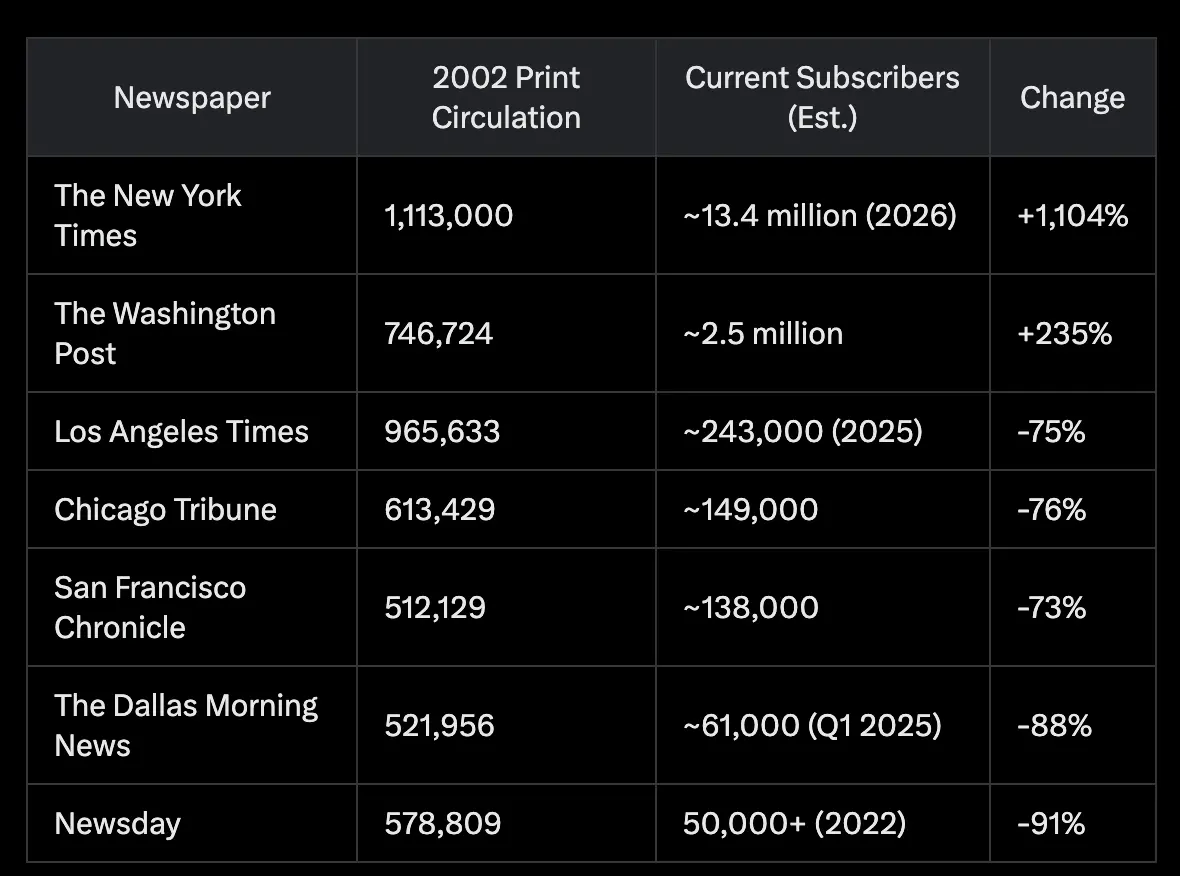
Vernal believes AI could create a similar structure in the software space.
Traditional software moats usually come from three things:
Building products is expensive
Switching systems is painful
Integration creates strong ecosystems.
AI weakens all three. Competitors can replicate features faster, migration can become more automated, and AI can make integration significantly easier.
The possible outcome is a market that is extremely strong at both ends:
Giant platforms: A few companies may dominate entire categories of procurement, such as sales, marketing, finance, human resources, legal, or healthcare. They do not just sell a narrow tool but continuously expand until they become the system that customers use for almost everything.
Micro software businesses: On the other end, AI programming tools may enable millions to build highly specific software for themselves, their companies, or small groups of customers. Some of these may grow into profitable niche businesses.
An uncomfortable middle layer: Medium-sized point solutions may face the greatest pressure. If large platforms can continuously add their functionalities and small teams can cheaply rebuild narrow products, then defending as independent tools becomes more difficult.
The analogy with Amazon explains what new moats might look like. Amazon started with something relatively easy to replicate: selling books online. Its defensiveness comes from decades of continuous reinvestment in logistics, infrastructure, technology, and distribution.
AI may drive software companies toward the same strategy: building faster, continuously expanding, reinvesting, making the overall product increasingly difficult to replicate.
For venture-backed software startups, this creates an interesting strategic question: if building software is almost free, is your moat still a good product, or everything you can build around it?
How is your seed round valuation actually determined? (It has almost nothing to do with your company).
Founders often assume that valuation is mainly related to traction, market size, or how well they pitch.
But there is another constraint that most founders hardly see: the economic model of the VC fund sitting across from them.
Imagine you are pitching to a $28 million seed fund. It typically writes checks of around $600,000 and wants about 6% to 8% equity.
At 7% equity, a $600,000 investment implies a post-money valuation of about $8.6 million. At 6%, it means $10 million. So if you raise funds at an $18 million valuation, that fund may not even be able to make that investment in its portfolio model.
This creates a simple chain:
Fund size → Check size → Target ownership → Feasible valuation ceiling
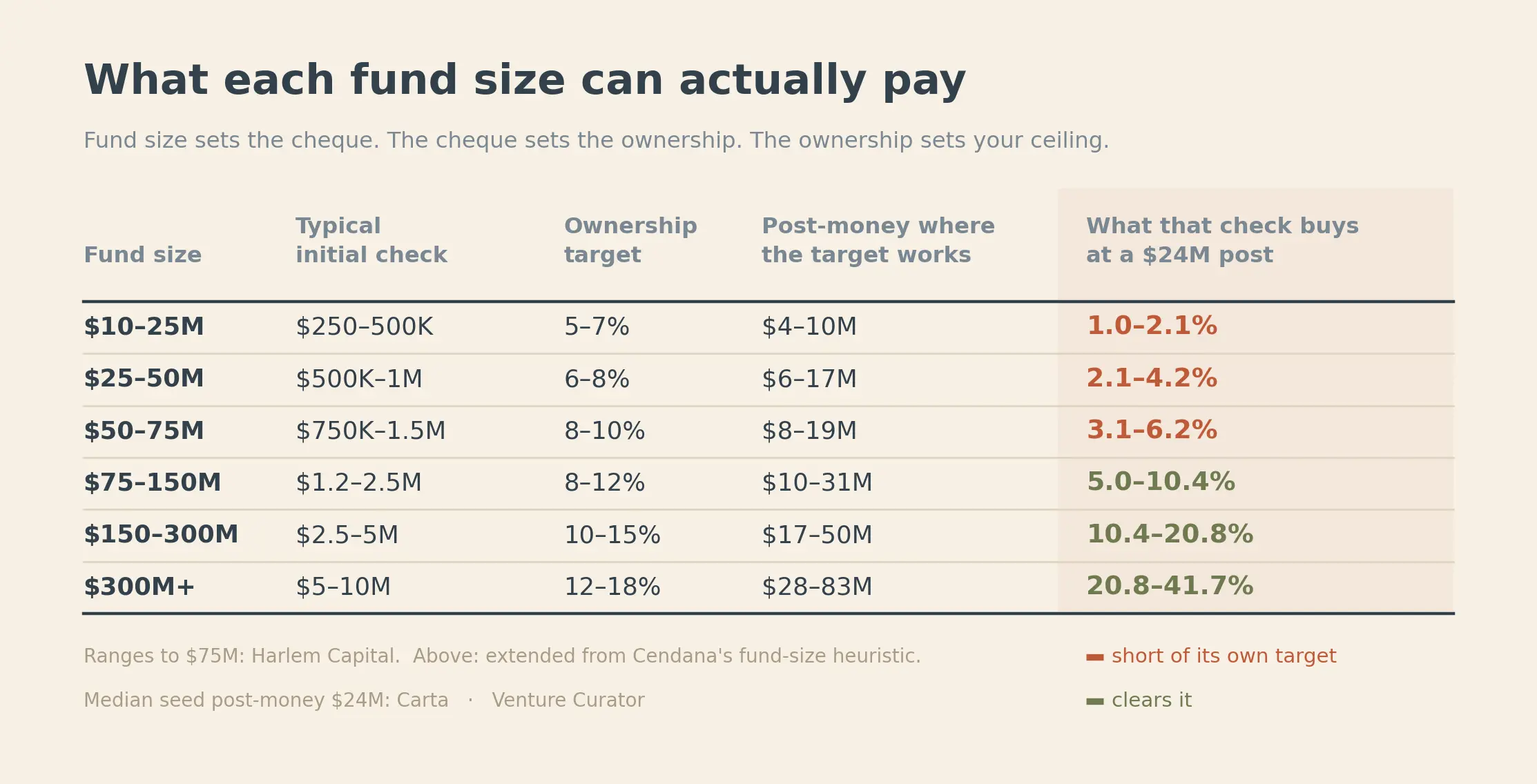
This is more important today because seed round valuations have risen. The median post-money valuation for seed rounds cited in the analysis from Carta is $24 million. A $50 million fund investing $1.5 million at this valuation can only acquire 6.2% equity, which may be below its target.
This also changes how founders think about round sizes.
If you tell a fund that you want to raise $3 million and the lead investor wants 15%, you have implicitly established a post-money valuation of $20 million before anyone explicitly discusses valuation.
A more useful sequence is:
Calculate how much funding you need to reach the next milestone with an 18 to 24-month runway.
Add a buffer.
That is your round size.
Divide it by the dilution percentage you are willing to accept.
Then go find funds whose check size and ownership model can support this valuation.
There is another number that founders often overlook: the option pool. The lead investor may require the establishment of a 10% to 15% option pool before the investment, which will dilute existing shareholders before the investment is finalized. Analysis suggests that negotiating the option pool based on actual hiring plans can sometimes have a greater impact on founder ownership than arguing for an additional $1 million or $2 million on the headline valuation.
To avoid wasting weeks on the wrong funds, the simplest way is to ask this question during the first call:
"What is the typical first check size for this fund, and how much equity do you usually want?"
These two numbers can quickly help you estimate whether the fund's economic model supports your financing round.
So, do not take all valuation resistance as a denial of your startup. Sometimes your company is fine. It’s just that your financing round does not align with the fund's mathematical logic.
If ChatGPT can do what your app does for free, why would anyone pay?
This is becoming one of the biggest challenges faced by consumer app founders.
If users can open ChatGPT, Claude, or Gemini and get roughly the same results in seconds, why would they spend $10 or $20 a month to use a standalone app?
Daphne Tideman from RevenueCat believes the answer is not simply "add more AI." AI-driven apps have monetized well, with each paying user generating 41% more revenue than non-AI apps, and a 52% higher trial conversion rate. However, their 12-month retention rate is only 21.1%, compared to 30.7% for non-AI apps.
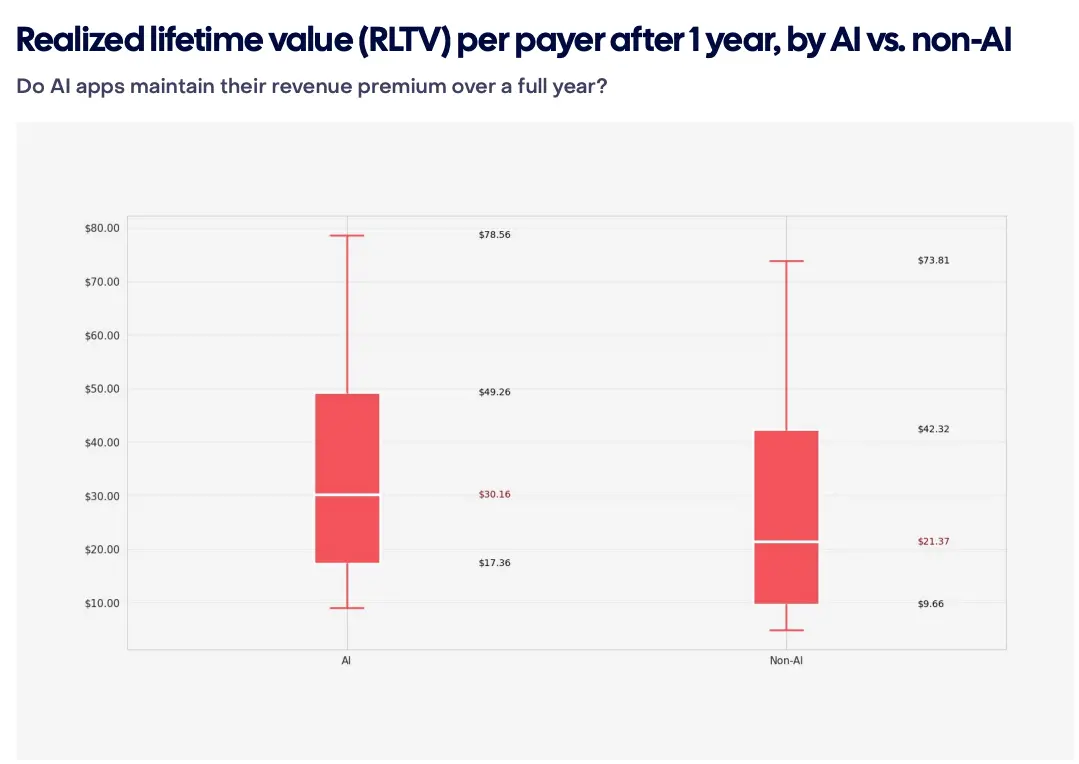
In other words: AI can bring people in the door. But it may not provide a reason for them to stay.
Look at the comparison between Chegg and Duolingo.
The difference lies in what else is offered beyond the answers.
RevenueCat suggests that apps can build six things that are harder to replicate with a blank LLM chat:
Structure: Turn an answer into a complete workflow or experience.
Memory: Understand users over time, making the app more useful.
Habit: Bring users back with continuous check-ins, reminders, supervision, and gamification.
Precision: Master specialized data or expertise to produce better outcomes.
Connection: Build community, identity, personality, or emotional attachment.
Combination of physical and digital: Integrate software with sensors, devices, or real-world data.
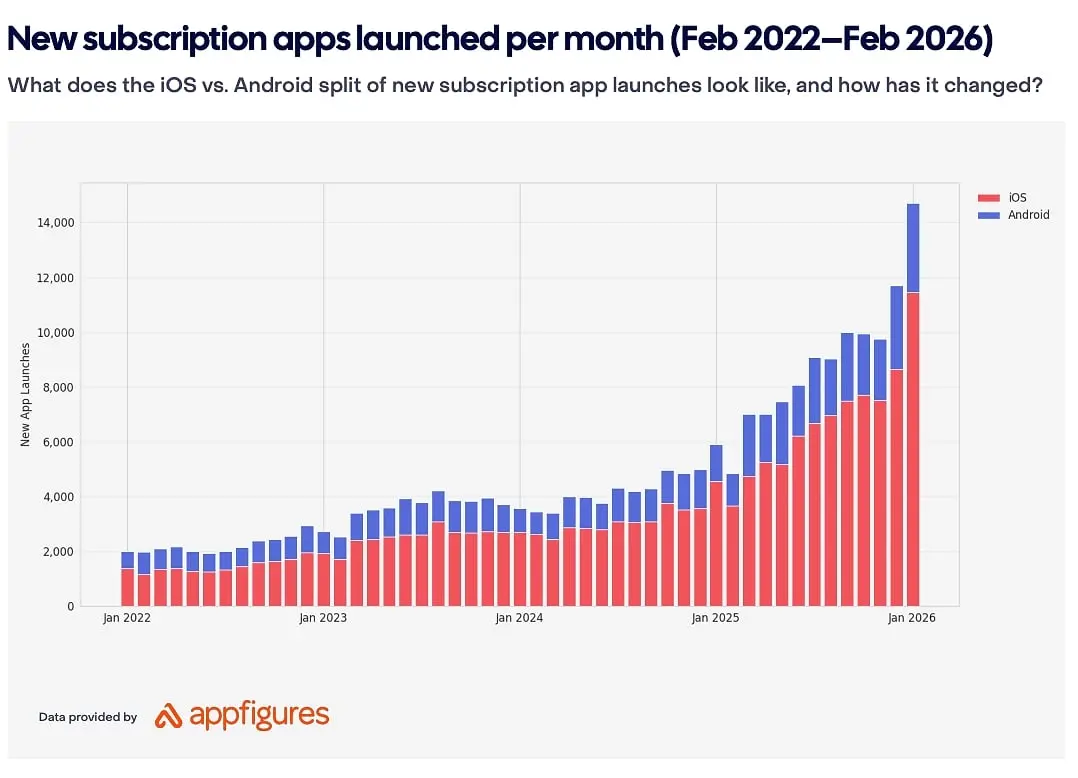
Duolingo is a great example, as it combines several of these elements. ChatGPT can teach languages, but Duolingo has spent years building continuous check-ins, leaderboards, progress systems, reminders, and gamification. Reportedly, after introducing leaderboards, Duolingo saw a 17% increase in learning time and a threefold increase in highly engaged learners.
Another simple test founders can do is the blank dialogue box test.
Open ChatGPT or another LLM, accurately describe the problem your users come to your app to solve, and then compare its response to what your product delivers. If most of your product's value can be replicated with a single prompt and response, you have a differentiation problem. If your app incorporates structure, accumulates data, builds habits, precision, connections, or real-world components, that may be where your moat lies.
So, AI itself may not be the moat. The more critical question for founders is: what does your product provide users that a blank dialogue box cannot? RevenueCat's perspective is that winners will use AI at the core of their product while competing on the experiences built around it.
 Risk warning