Bitget UEX Daily Report|Trump claims Hamas agrees to disarm and Israel will withdraw troops; Amazon surges 9% after earnings and raises capital expenditure; Microsoft jumps over 15% driving a tech rebound (July 31, 2026)

 Bitget UEX Daily Report
# 1. Hot News
Federal Reserve Dynamics
Waller focuses on broader inflation indicators, near-term rate hike probability under assessment
- Citigroup economists point out that Waller hinted that other inflation indicators besides PCE will play a larger role, which may reduce the likelihood of a near-term rate hike. The core PCE in June fell to 3.3%, while the core CPI was at 2.6%.
- CME data shows that the probability of maintaining interest rates in September is about 36.6%, while the cumulative probability of a 25 basis point rate hike is about 63.4%.
- The market is still digesting Waller's previous firm reiteration of the 2% target and his comments downplaying forward guidance. Market impact: Uncertainty remains in the policy path; if broader inflation indicators are mild, it may ease near-term rate hike bets and provide marginal support for risk assets.
International Commodities
Trump claims Hamas agrees to disarm, Israel will withdraw troops
- Trump announced on social media that the peace committee reached a historic agreement to fully disarm Hamas and all armed groups in Gaza. The agreement is an important step towards Gaza being governed by a new Palestinian government, with Israel receiving security guarantees and Gaza no longer being used as a base for attacks.
- This is a significant milestone in the implementation of Trump's 20-point plan, which will be advanced in phases, with Israeli troops withdrawing after disarmament is completed, and international stabilization forces cooperating with the new Palestinian police force.
- The Iranian military simultaneously claimed to have used drones to attack the U.S. military at the Sheikh Isa Air Base in Bahrain, claiming significant damage. Market impact: Signs of easing in the Middle East situation help reduce some geopolitical risk premiums; however, Iran's statements regarding attacks on U.S. bases keep the oil market sensitive, with short-term oil price fluctuations influenced by multiple factors.
Macroeconomic Policy
Korea-Japan currency market intervention raises concerns
- South Korea's rare dollar sell-off and Japan's yen-buying intervention in the currency market have led to market skepticism about coordinated actions between Korea and Japan; the Korean won and yen have significantly appreciated.
- South Korea plans to inject about $14 billion into its sovereign wealth fund to invest in artificial intelligence and other fields. Market impact: Communication between China and the U.S. helps stabilize expectations; currency market interventions show that Asian monetary authorities are concerned about exchange rate fluctuations, while AI-related investment plans reflect long-term industrial layouts.
# 2. Market Review
Commodity & Forex Performance
- Spot Gold: Approximately $4,092/ounce, -0.24%
- Spot Silver: Approximately $58.0/ounce, -0.49%
- WTI Crude Oil: Approximately $82/barrel, -1%
- Brent Crude Oil: Approximately $80.94/barrel, -0.97%
- Dollar Index (DXY): Approximately 100.13, +0.15%
Driving Factors Analysis: The disarmament agreement with Hamas brings expectations of easing in the Middle East, partially suppressing oil risk premiums, leading to a pullback in oil prices from high levels. Gold and silver show divergent performance, influenced by dollar trends and changes in risk appetite. The dollar index remains relatively stable. The asset linkage logic is reflected as: geopolitical easing signals → oil prices under pressure → marginal cooling of inflation expectations, while a rebound in tech stocks boosts risk appetite, leading to a decrease in safe-haven demand for precious metals. Short-term attention is still needed on Iranian statements and actual developments.
Cryptocurrency Performance
- BTC: Approximately $65,118, +2.14%
- ETH: Approximately $1,928, +1.31%
- Total Cryptocurrency Market Cap: Approximately $2.28 trillion, -0.1%
- Market Liquidation Situation: Total liquidation in 24 hours approximately $195 million, with $160 million in short liquidations.
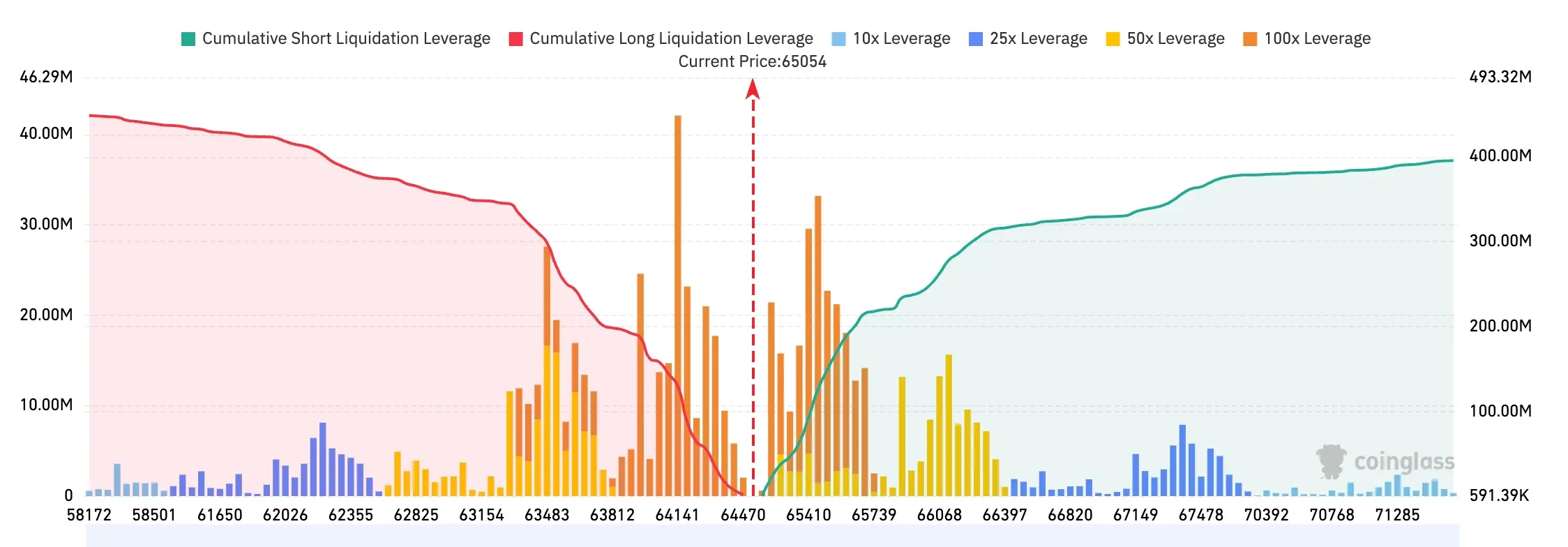
- Bitget BTC/USDT Liquidation Map: The current price (65,054) has a large number of 50x and 100x short liquidation orders concentrated in the $65,400--$66,000 range. If it breaks through $65,500, it may trigger continuous short liquidations and amplify the rise. The cumulative short liquidation scale above is approximately $400 million, lower than the $420 million in long positions below, indicating that overall liquidation pressure between longs and shorts is relatively close, with a focus on the high-leverage liquidation zone of $65,400--$66,000 in the short term.
- Spot ETF Net Inflow/Outflow: BTC spot ETF saw a net inflow of $32 million yesterday, with a dynamic net inflow of $49.7 million today.
Driving Factors Analysis: The rebound in U.S. tech stocks has boosted risk appetite, stabilizing the overall cryptocurrency market. The scale of leveraged liquidations has decreased, with long and short forces tending to balance. ETF fund flows show signs of improvement, indicating a marginally positive institutional attitude. Geopolitical easing and tech stock performance provide support, but macro policy uncertainty remains, and the short term may maintain a volatile pattern, with attention on subsequent earnings reports and geopolitical developments.
U.S. Stock Index Performance
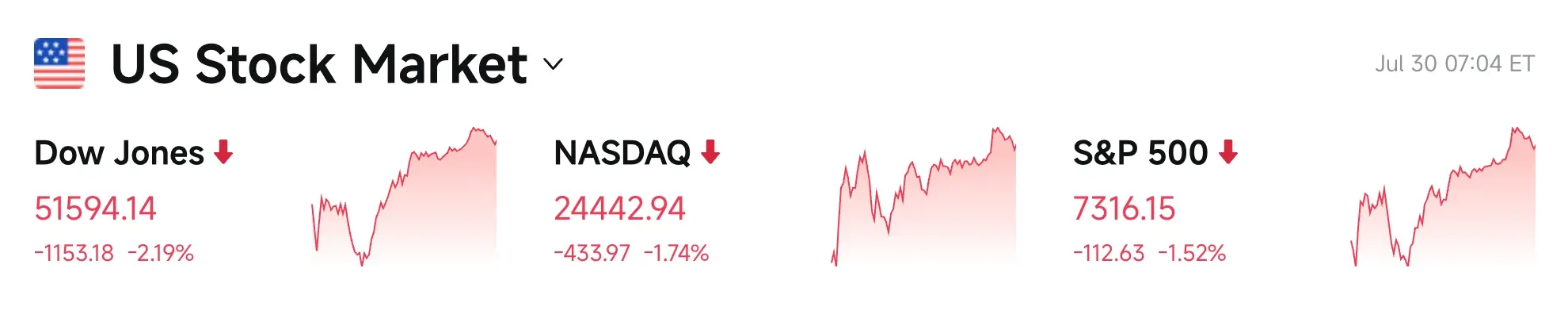
- Dow Jones: Closed at approximately 52,208 points (+1.19%), significantly rebounding.
- S&P 500: Closed at approximately 7,438 points (+1.7%), recovering some losses.
- Nasdaq: Closed at approximately 25,122 points (+2.8%), driven by a surge in tech stocks.
Tech Giants Dynamics
- NVDA: Approximately $195.04 (+2.65%)
- AAPL: Approximately $333.43 (-1.41%)
- MSFT: Approximately $451.10 (+15.51%)
- GOOGL: Approximately $333.68 (-0.62%)
- AMZN: Approximately $235.50 (+3.90%)
- META: Approximately $535.47 (-8.58%)
- TSLA: Approximately $306.60 (+2.8%)
Performance Summary and Driving Analysis: The tech sector rebounded significantly. Microsoft surged over 15% due to better-than-expected cloud business performance, marking the largest single-day increase in years, boosting the Nasdaq and semiconductor sectors; Amazon's stock rose about 9% after raising capital expenditure guidance. Apple faced relative pressure, while Meta's stock declined due to concerns over future spending commitments nearing $700 billion. Overall, driven by "performance realization," the differentiation between hardware and software has eased, and market confidence in AI investment returns has partially recovered.
Sector Movement Observation
Optical Communication / Compound Semiconductor Materials
- Representative Stocks:
- AXT Inc (AXTI): +20% to +27%
- Applied Optoelectronics (AAOI): Around +17%
- Coherent (COHR): Following the rebound
- Lumentum (LITE): Following the rebound
- Credo (CRDO): Related to optical interconnects, sentiment recovery in sync
- Driving Factors: Microsoft's cloud business exceeding expectations significantly boosted market confidence in AI data center optical modules and high-speed interconnect demand. The optical communication sector saw strong recovery after a general decline the previous day, with upstream compound semiconductor substrates (AXTI) showing particularly notable resilience.
Storage Concept
- Representative Stocks:
- SanDisk (SNDK): +17% to +24%
- SK Hynix (SKHY ADR): Following the rebound in the storage sector
- Micron (MU): Significant rebound
- Seagate (STX): Relatively resilient and following the recovery
- Driving Factors: The rebound in tech risk appetite and Microsoft's cloud business exceeding expectations alleviated market concerns about AI capital expenditure returns. SK Hynix, a major global supplier of HBM and advanced storage, had previously faced pressure due to "high growth but below expectations" and concerns about the storage cycle, but rebounded today with the sector's sentiment recovery.
Cloud Computing
- Representative Stocks:
- Microsoft (MSFT): +15.51%
- Amazon (AMZN): Surged about +9% after earnings
- Google (GOOGL): Relatively stable
- Meta (META): Adjusted down due to capital expenditure concerns
- Driving Factors: Microsoft's cloud business (Azure) exceeding expectations became a core catalyst, significantly boosting market confidence in returns from cloud and AI infrastructure investments; Amazon's capital expenditure increase and recognition from funds led to noticeable differentiation within the sector, with performance realizers leading the charge, while those with high long-term expenditure commitments faced pressure.
# 3. In-Depth Analysis of U.S. Stocks
1. Microsoft (MSFT) - Cloud business exceeds expectations, surges over 15%
Event Overview: Microsoft's stock price surged about 15.5% to $451.10, marking the largest single-day increase since 2008, with a market cap increase of about $450 billion in one day, setting a record for single-day market cap growth in U.S. stocks. Azure cloud business revenue growth exceeded expectations, free cash flow performance was robust, and the company provided relatively restrained capital expenditure guidance, alleviating market concerns about "over-investment and uncertain returns."
Market Interpretation: Against the backdrop of ongoing doubts about AI capital expenditure returns and significant corrections in chip and storage stocks, Microsoft demonstrated through actual performance that large-scale investments in AI infrastructure have begun to translate into quantifiable revenue growth. This sharply contrasts with hardware stocks that rely solely on forward demand narratives, prompting the market to quickly assign a premium to "performance realizers." This surge not only boosted overall sentiment in the tech sector but also re-anchored investor confidence in the commercialization path of cloud and AI.
Investment Insight: The progress in cloud and AI commercialization has been validated in stages; future focus should be on tracking the alignment of capital expenditure rhythm with cloud business growth rates to assess the sustainability of valuation recovery.
2. Amazon (AMZN) - Raises capital expenditure, surges about 9% after earnings
Event Overview: Amazon raised its full-year capital expenditure guidance to $220 billion, demonstrating strong confidence in long-term demand for AI and cloud computing. The stock price surged about 9% after earnings, with the market also focusing on its AWS cloud business growth and retail business resilience.
Market Interpretation: The capital expenditure increase could have raised concerns about "over-spending," but the strong stock price reaction indicates that investors prioritize growth prospects and long-term positioning over short-term free cash flow pressures. In contrast to Meta, which faced pressure due to long-term spending commitments, Amazon's revision was interpreted as a positive response to visible demand rather than blind expansion. This led to noticeable differentiation within the sector: companies that can demonstrate demand visibility attracted capital.
Investment Insight: The alignment between capital expenditure increases and actual growth guidance will determine future valuation space; it is necessary to observe whether AWS growth can continue to absorb higher investments.
3. Meta (META) - Future spending commitments nearing $700 billion, stock price under pressure
Event Overview: Meta disclosed future spending commitments nearing $700 billion, raising market concerns about the scale and return cycle of long-term AI-related investments, with the stock price significantly adjusting down about 8.6% to around $535.
Market Interpretation: In stark contrast to Microsoft's "realized revenue growth," Meta's large future spending commitments have intensified market doubts about the lengthy return cycle of AI investments. Investors currently prefer investment paths that can quickly translate into revenue and profits, remaining cautious about long-term, highly uncertain capital expenditures. This has led to a differentiation pattern within the tech sector where "realizers lead, while long-term committers face pressure."
Investment Insight: Capital expenditure discipline and AI monetization efficiency are core pricing factors; it is essential to continuously observe the contribution of advertising business profit margins, user growth, and the implementation of AI functions to revenue.
4. Apple (AAPL) - Relatively pressured, awaiting earnings verification
Event Overview: Apple's stock price fell about 1.41% to $333.43, lagging behind the tech rebound led by Microsoft and Amazon. The market is awaiting its upcoming earnings report to verify iPhone demand, service business growth, and AI function implementation progress.
Market Interpretation: Apple has long enjoyed a "certainty premium" due to its robust cash flow and service business. However, in the current phase where funds are chasing "performance realizers" in cloud and AI infrastructure, its relatively defensive attributes have become a reason for short-term underperformance. The market needs to see stabilization in device demand and substantial contributions from AI functions like Apple Intelligence to upgrade and services to regain a higher growth premium.
Investment Insight: Earnings results will determine its relative attractiveness within the "certainty vs growth" framework, with service business and AI implementation progress being key observation points.
5. Nvidia (NVDA) - Follows tech rebound, rises over 2.5%
Event Overview: Nvidia's stock price rose 2.65% to $195.04, benefiting from the rebound in tech risk appetite driven by Microsoft's performance, ending a previous adjustment trend due to concerns over AI infrastructure costs and competition.
Market Interpretation: As a core supplier of AI computing power, Nvidia's stock price is highly sensitive to downstream cloud providers' willingness to invest capital and their return expectations. Microsoft's cloud business exceeding expectations provided significant emotional support, but the market remains cautious about the capital expenditure return cycle in the hardware chain. Compared to Microsoft, Amazon, and other "application and cloud service" stocks, Nvidia relies more on major clients continuing to ramp up capital expenditures, thus its rebound strength is relatively restrained.
Investment Insight: The long-term logic of AI computing power demand remains unchanged, but short-term volatility still depends on major clients' capital expenditure guidance and the evolution of competitive dynamics, necessitating caution against profit-taking after emotional recovery.
6. SK Hynix (SKHY ADR / 000660.KR) - Significant rebound after disappointing earnings
Event Overview: In the second quarter, operating profit surged 557% year-on-year to 60.54 trillion won, and revenue increased 257% year-on-year to 79.32 trillion won, both setting historical highs, but both figures fell short of market expectations. Following the earnings report, Korean stocks and ADRs fell sharply. On July 31, the Korean market rebounded strongly, with the Korean Composite Index rising about 15%-16%, and SK Hynix's stock price skyrocketed about 24%-25% (to 1,640,000 won), with Samsung Electronics also rising over 25%. Catalysts include: SK Group Chairman Choi Tae-won personally increasing his stake in the company (buying at the bottom before the reporting deadline), the Korean government promoting an AI-related investment plan of about 20 trillion won, and market sentiment recovering after consecutive declines.
Market Interpretation: The previous decline was primarily due to the expectation gap caused by "high growth but below expectations," compounded by market concerns about the AI storage cycle and capital expenditure returns. Today's significant rebound is more driven by sentiment and liquidity—major shareholder increases convey confidence, government AI investment plans provide policy support, and technical recovery after overselling. This reflects the current storage sector's high sensitivity to sentiment and policy signals, with fundamentals and stock prices potentially diverging in the short term.
Investment Insight: The long-term logic of HBM and advanced storage demand remains, but short-term volatility is severe. It is necessary to observe subsequent actual shipments, customer demand absorption capacity for expansion, and whether the market's pricing of AI capital expenditure sustainability stabilizes.
# 4. Market & Project Dynamics
Strategy reported a net loss of $8.2 billion in the second quarter, compared to a net profit of $10 billion in the same period last year, with losses almost entirely attributed to unrealized losses from Bitcoin holdings. The company's Bitcoin holdings increased by 11% to a peak of 846,000 BTC in the second quarter, after which it began to reduce some assets. Bitcoin prices fell over 40% compared to Q2 2025. The company has suspended Bitcoin purchases for five consecutive weeks, prioritizing the establishment of dollar cash reserves, and has sold approximately $218 million in Bitcoin for preferred stock dividends this year. CEO Phong Le stated that the company has reduced convertible debt by 18% to $6.7 billion, with dollar reserves increasing by 12% to $2.4 billion.
Apple announced its third-quarter financial results on July 30 local time. Data shows that the company achieved total net revenue of $109.417 billion in the quarter, a year-on-year increase of about 16.4% compared to $94.036 billion in the same period last year. Profitability significantly improved, with net profit reaching $29.789 billion, a year-on-year increase of about 27.1% compared to $23.434 billion in the same period last year; diluted earnings per share (EPS) were $2.02, up about 28.7% from $1.57 in the same period last year.
Amazon's cloud computing business revenue exceeded analyst expectations, with strong demand for artificial intelligence services driving sales acceleration for the fifth consecutive quarter. Amazon stated on Thursday that for the quarter ending June 30, its cloud computing business, Amazon Web Services (AWS), saw revenue growth of 37% to $42.2 billion. This is the fastest growth rate since the fourth quarter of 2021.
Meta announced that it has committed nearly $700 billion in future spending through long-term and short-term agreements, covering areas such as AI data centers and cloud computing. In a regulatory filing on Thursday, Meta stated that it has $349.3 billion in irrevocable contract commitments, primarily related to third-party cloud service agreements, servers, and network infrastructure.
Six companies at the core of AI data centers saw their stock prices soar on Thursday, including IREN, which rose 30.54%, Bitdeer up 24.72%, Riot Platforms up 21.27%, CleanSpark up 21.07%, and HIVE Digital up 18.34%.
The Block analysis indicates that this surge is related to the forced liquidation of a public stock portfolio by the hedge fund Situational Awareness, led by former OpenAI researcher Leopold Aschenbrenner. The fund liquidated its holdings to meet margin requirements, with Citadel, owned by Ken Griffin, taking over most of the stocks. After the liquidation news broke, the stock prices of mining companies that had seen massive sell-offs in previous weeks rebounded.
# 5. Today's Market Calendar
Data Release Schedule
|----|----|--------|------| | After Hours | Japan | Kioxia Earnings Report | ⭐⭐⭐⭐ | | This Week | U.S. | Relevant Economic Data | ⭐⭐⭐ |
Important Event Forecast
July 31 (Friday)
- ★★★★ Kioxia releases earnings report (completion of the three major storage companies in Japan and Korea)
- U.S. releases July Chicago PMI and final Michigan Consumer Confidence Index
Institutional Views:
Analysts generally believe that Trump's announcement of the Hamas disarmament agreement brings expectations of easing in the Middle East, helping to reduce some geopolitical risk premiums. Microsoft's cloud business exceeding expectations and Amazon raising capital expenditure and surging significantly boosted market confidence in AI investment returns, driving a rebound in the tech sector. Meta's long-term spending commitments remind investors to pay attention to return cycles. The cryptocurrency market stabilizes alongside risk appetite. The overall consensus is that performance realization becomes the main line in the short term, while geopolitical and policy uncertainties remain, necessitating close tracking of subsequent developments.
Disclaimer: The above content is compiled by AI search, with human verification for publication, and should not be considered as any investment advice. The data in the text may inevitably have deviations; please refer to real-time market data.
 Risk warning