The Rise and Silent Death of New Banks
 Core Viewpoint

 Global new banks have served nearly 1.5 billion people, but among the 368 companies still in operation, only 127 hold a full banking license. Behind the prosperity lies highly concentrated infrastructure, disappearing brands, and a systemic risk that customers are almost completely unaware of.
Author: Francesco Andreoli, Head of Developer Relations at Consensys & MetaMask
Compiled by: Jiahua, ChainCatcher
Everyone is counting funding rounds, but no one is counting funerals. So I counted both sides.
Six months ago, I started tallying new banks (neobanks) because I found that no one could tell me how many companies were in this industry. Analysts selling PDFs for $4,000 didn’t know, VCs investing didn’t know, and founders competing against each other didn’t know either.
The answer is, as of July 2026: 368 verified, operational neobanks. I track each of these on neobankbeat.com, and all the data is open.
But the number that truly changed my view of this industry is not 368, but how many I deleted to arrive at that number.
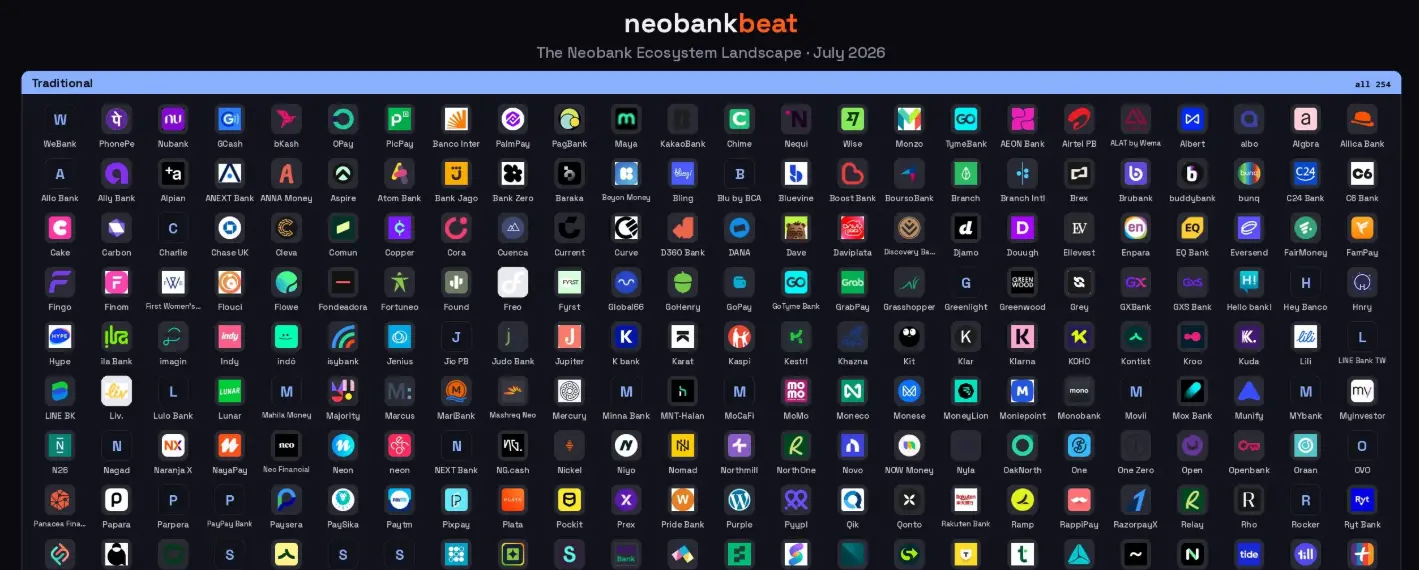
368 verified operational neobanks
The rise is real. Let’s start with that.
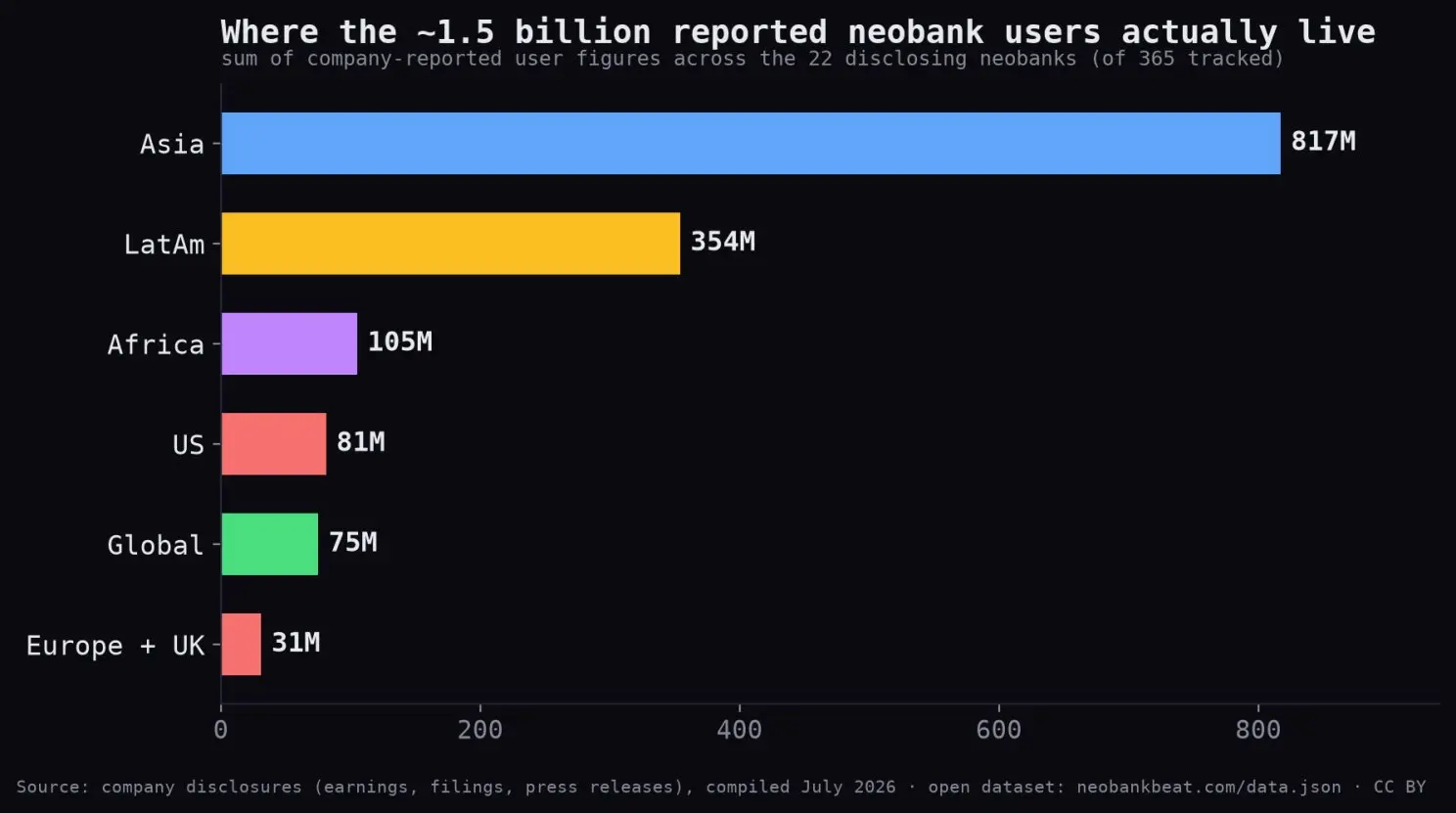
Summing up the user numbers disclosed by all companies in the dataset, the neobanks we track serve approximately 1.46 billion people. This is not a prediction or a number from a TAM chart, but the actual customer counts reported by each company.
And the geographical distribution would surprise anyone used to Western fintech media:
Of these, 817 million users are in Asia. Just WeBank alone serves over 400 million people, more than all the neobanks in the US and Europe combined.
Nubank has 131 million customers, more than the total of all neobanks in the US.
Europe's star, Revolut, has over 50 million users. This achievement is impressive, but still just a fraction compared to the numbers in Asia.
The marginal momentum of the industry is also shifting. Among the neobanks established in the 2020s and still operational, 30% are web3 native self-custody applications, where users' balances are not held by any company. In the batch from the 2010s, this ratio was 4%. Regardless of how you view cryptocurrencies, builders have already voted with their feet.
So yes, the rise is real: 368 companies, three structurally completely different waves (254 traditional challenger banks, 58 fiat and crypto hybrid applications, 56 web3 native applications), supported by 106 infrastructure providers, backed by 219 investors. All of this is marked on the map.
Next is the part that no one would write into a BP.
Out of the 368, only 127 hold a full banking license.
Read that again. Two-thirds of those "banks" in your mobile app store are not banks. Their right to exist is rented, coming from a holding bank, an electronic money license, or some card issuer you’ve never heard of. And their customers almost never know which side of the line they stand on.
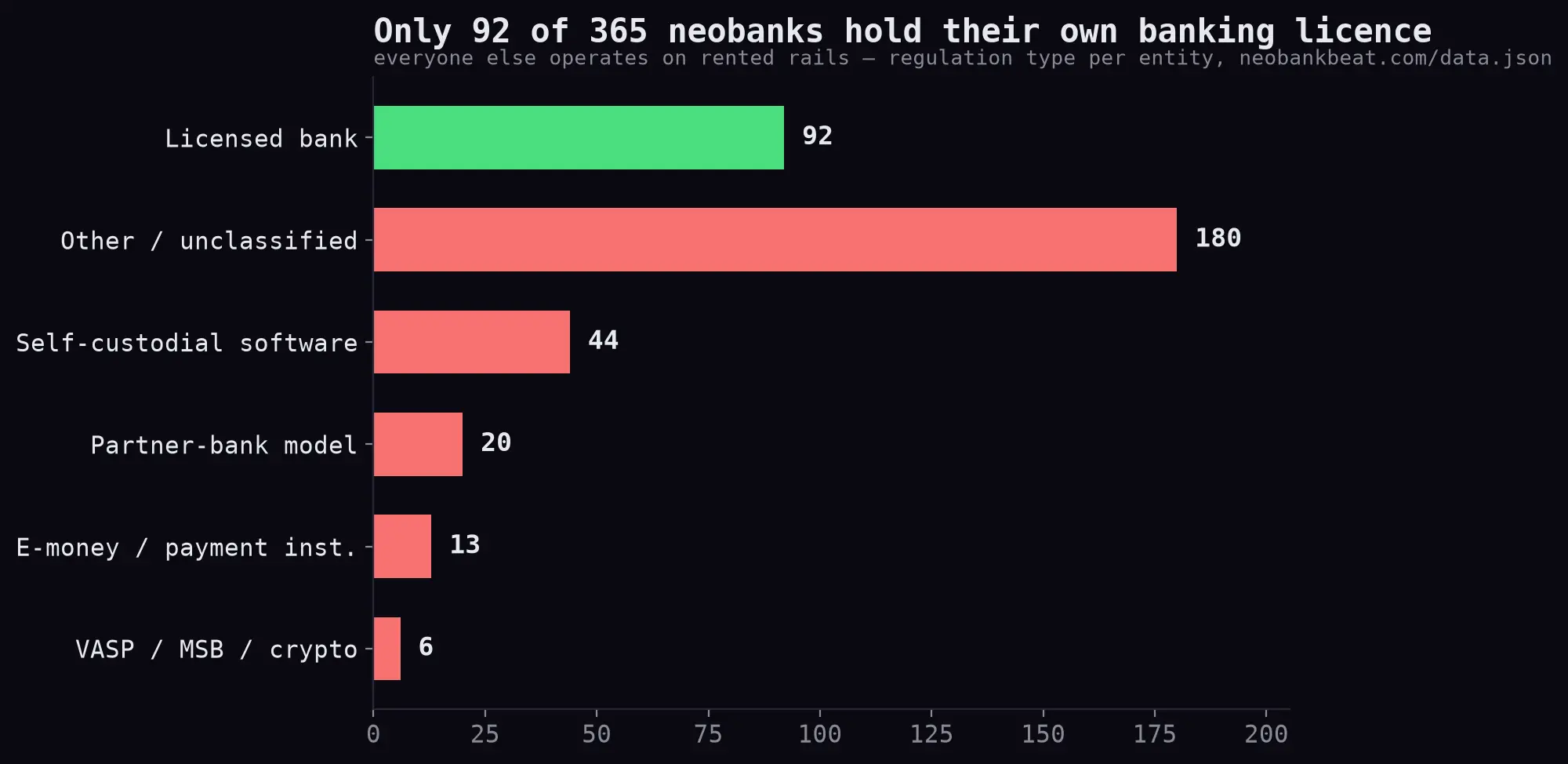
Bank Licenses
This is not a technical detail issue, but a core structural risk of the entire industry, and it has real-life consequences:
WaveCrest, 2018: Visa revoked the qualification of a card issuer, and dozens of crypto card projects died overnight.
Wirecard, 2020: A payment processor revealed a €1.9 billion hole, freezing funds for a batch of "banks" across Europe, their only fault being that they were built on it.
Synapse, 2024: A BaaS intermediary went bankrupt, and ordinary Americans discovered that "FDIC insured" did not mean what they thought, because the problem lay precisely with the ledger that recorded which money belonged to whom.
Ready, 2026: The same movie, with a new cast.
When a real bank goes bankrupt, deposit insurance pays out. When the infrastructure of a neobank has problems, customers receive a queue number in a bankruptcy proceeding.
The deaths in this industry are silent. This is the real scandal.
After maintaining this dataset, one thing I didn’t anticipate at the beginning was: the deletions never stopped.
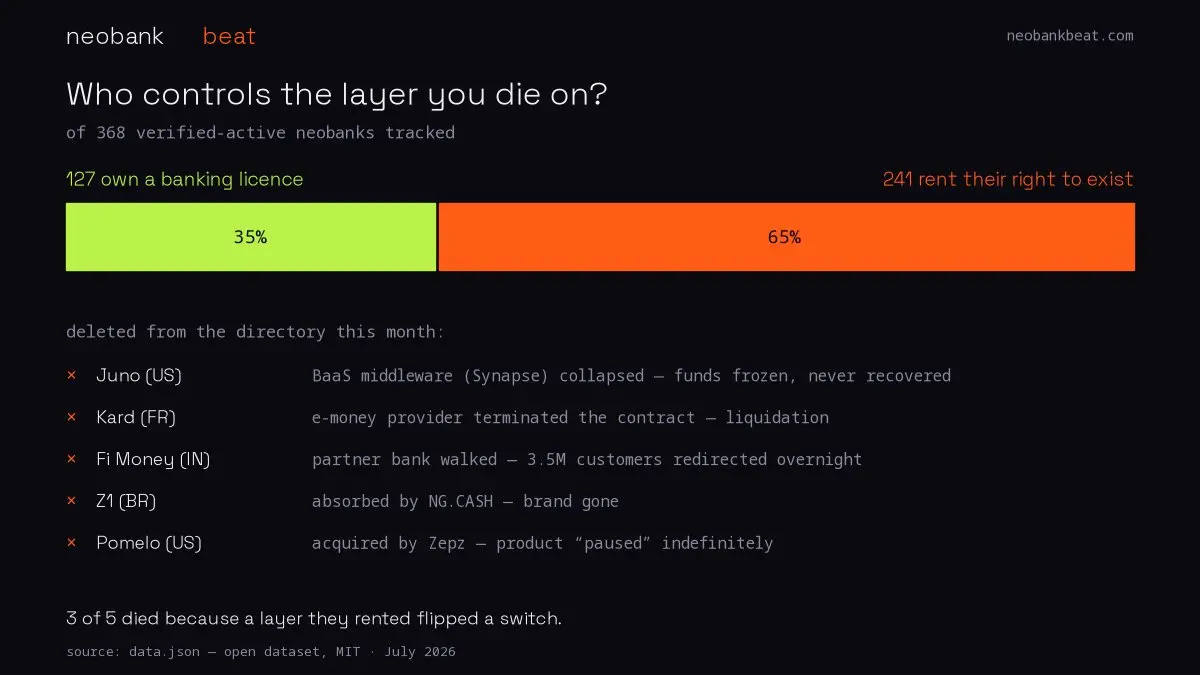
Who is in control?
Just this month, five entities disappeared from the list, either being liquidated, absorbed, or quietly transforming into something else. No press releases, no retrospectives. Neobanks don’t die with a bang like FTX.
Apps simply stop updating, customer service stops responding, and then one day the domain redirects to a landing page of a partner, with hundreds of thousands of customers either migrating or evaporating.
No one writes obituaries for neobanks. Fintech media reports on product launches and funding rounds because the advertising fees and interview opportunities are on that side. Thus, this graveyard remains invisible, and every new founder crashes into the same five traps, thinking they are the first to see through them.
This is why we record exits as carefully as we do entries. Failure data is more valuable than funding data. You learn nothing from press releases.
"But AI will solve the profitability model issue." Really?
Now every neobank BP mentions AI. So we reviewed the 368 one by one, cross-referencing financial reports, regulatory disclosures, and actual operational evidence, not marketing pages.
67 passed. 18%. The remaining 300+ are either still in pilot, "exploring," or claiming their partner's model as their own.
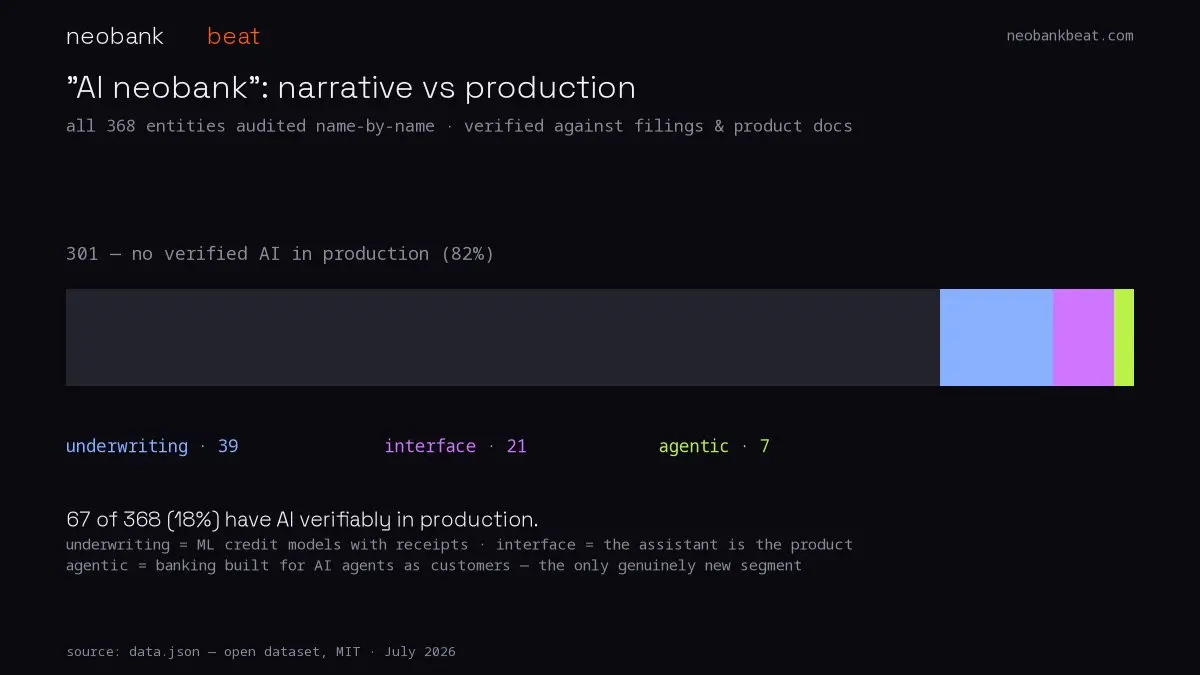
AI Neobanks?
The counterintuitive part is that the best AI implementations are often not from those well-known companies, but from emerging market lenders in Nigeria, the Philippines, Mexico, and Bangladesh. In these places, the credit system is virtually non-existent, and a model that can provide credit to credit invisibles is not a nice-to-have feature, but the entire reason this business can exist.
While the West talks about AI banks, the Global South is actually making it happen because they have no other choice.
What This Map Truly Shows
Looking at the infrastructure section of the map: 106 providers supporting 368 consumer-facing brands. In this box, a few holding banks, BaaS platforms, and card processing companies each carry dozens of logos above them. The concentration that is invisible from the consumer side is precisely what breeds the next Synapse.
This is the most honest picture of the industry in 2026: a spectacular, truly world-changing rise, with 1.5 billion people gaining banking services through one app, many of whom are doing so for the first time; and all of this is built on a load-bearing layer that the vast majority of customers have never heard of, with two-thirds of the companies unable to survive a bad quarter from their landlords.
Two things can be true at the same time. That’s what makes it interesting.
Three Predictions I’m Willing to Admit Might Be Wrong
The licensing gap will narrow from both ends. Strong unlicensed players will acquire or obtain licenses, while weak ones will become deletions in 2027. The middle ground will disappear.
The first AI credit explosion will happen within two credit cycles. Those 67 operational models mostly have not experienced a real downturn in their current form. Some are about to learn what is missing in their training data.
The next wave of customers will not be humans. Banking infrastructure serving AI agents, including wallets operated by agents, cards issued by agents, and machine-to-machine payments, is currently only being done by 7 companies. It looks like web3 native in 2021: small, strange, and structural.
 Risk warning