Coinbase's official silence, regulatory red lines remain unchanged: Is China really open for registration?
 Core Viewpoint

 Is this ice-breaking a test or the beginning of an era?
Author: Chloe, ChainCatcher
On July 14, 2026, multiple community users conducted tests and discovered that Coinbase, the largest compliant exchange in the United States, has opened registration for Chinese users, supporting KYC completion with a "second-generation ID card" paired with a +86 phone number. Some users passed the preliminary review within a minute. Wu confirmed the validity of this information with Coinbase employees, but the official has yet to release any formal announcement.
However, this door is only half open: accounts currently only support on-chain deposits, withdrawals, and trading, and do not support fiat currency deposits or withdrawals via bank cards. Users can only receive deposits of USDT and other stablecoins through on-chain addresses. This article compiles the details of the event and proposes a motivation hypothesis centered around Deribit, in contrast to the unyielding regulatory red lines in Beijing and the risk list that Chinese users must face.
Coinbase has yet to release any announcements
On July 14, Beijing time, screenshots of tests showing that Coinbase has opened registration for Chinese users began circulating on social media. Users can quickly complete KYC verification using a Chinese "second-generation ID card" along with a "+86 phone number." According to tests conducted by users in the X community, preliminary reviews can be completed within a minute, and no additional proof of overseas address is required during the initial review stage.
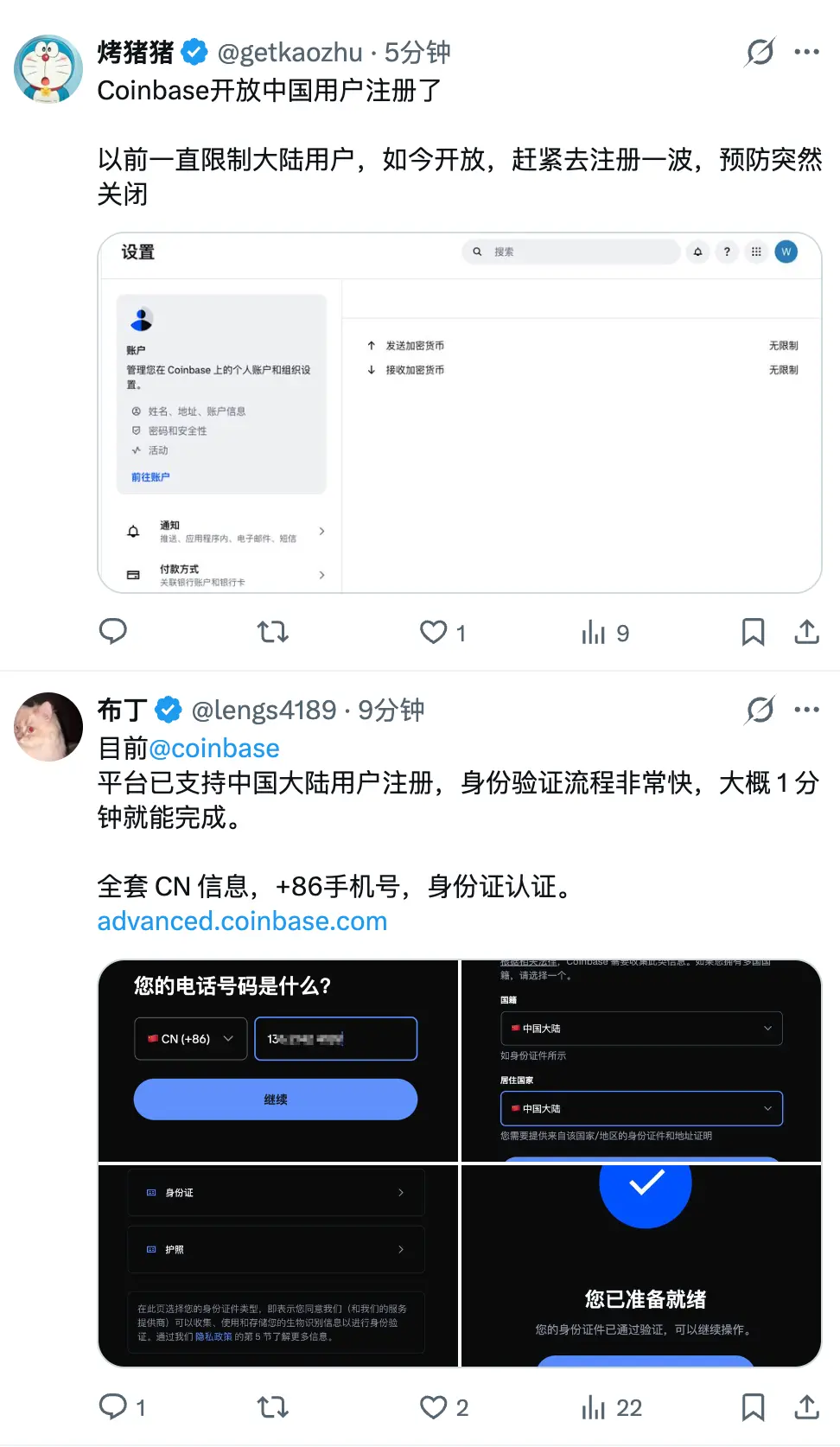
Feedback from the V2EX forum added more details: the entire process takes about five minutes, and registering with an ID card can waive the address proof requirement; if a passport is used instead, the system will require the upload of address proof documents. Some users confirmed that the platform indeed allows new user registrations, and identity verification is completed in about a minute.
Additionally, according to reports, Coinbase employees also confirmed that users can now use Chinese resident ID cards and complete identity verification with a mainland China address; previously, the process required registration and verification with a Chinese passport paired with a Hong Kong address. In other words, this is a substantial adjustment to the verification policy, rather than a front-end error.
However, Coinbase has yet to release any announcements or clarify which products will be available after registration. Its publicly available identity verification documents still only list passports as acceptable identification for China, without showing options for ID cards or Chinese addresses. This state of having the front-end already online, documents not synchronized, and a complete lack of announcements suggests that this move may be a gray area expansion or a deliberately low-profile limited opening.
Accounts that only allow deposits: What can and cannot be done
For Chinese users, the actual use of this account has clear boundaries. According to tests by V2EX users, Chinese users can currently only conduct on-chain deposits, withdrawals, and trading, and bank fiat currency deposits are not supported. This means that RMB cannot be deposited or withdrawn through bank cards or third-party payments on Coinbase; the only funding channel is through on-chain addresses: users transfer USDT, USDC, or other crypto assets to their Coinbase address from other wallets or platforms and then trade within the platform.
This aligns with Coinbase's compliance framework. Its support policy allows the company to restrict deposits, purchases, or other account functions when local regulations do not permit a certain service. Opening registration and identity verification does not automatically equate to opening all trading pairs, payment methods, and fiat currency services.
The verification process itself also has time limits. New registered accounts have limited functionality until identity verification is completed, and users need to upload government-issued identification through the official verification portal. The platform typically completes the review within 24 hours and will periodically require re-verification for record-keeping, compliance, and anti-fraud purposes. For Chinese users, this means that each re-verification is a point in time when the account status is reassessed.
Why now: Three clues point to Deribit
The following motivation analysis is primarily compiled from the views of X user Phyrex (@PhyrexNi). Why would an exchange known for compliance, which has long listed China as a restricted area, choose to break the ice at this time? These insights are conjectures rather than official statements from Coinbase, but three verifiable clues point to the same answer: Deribit.
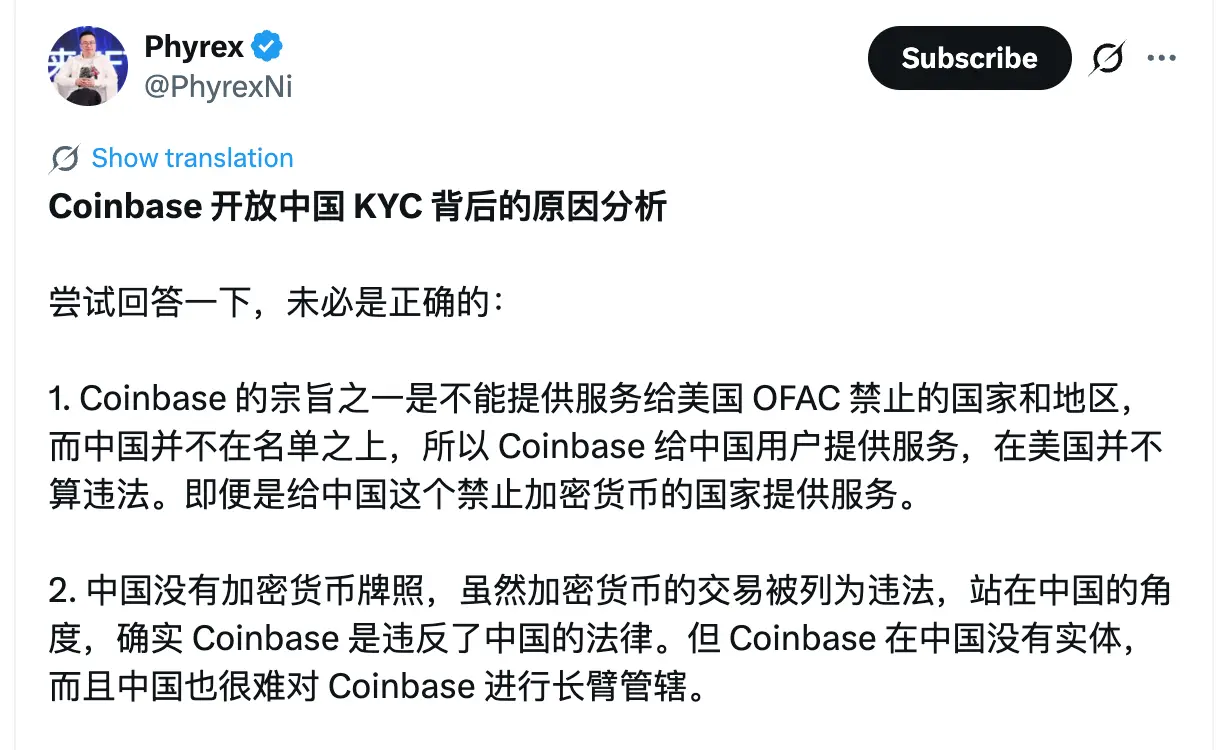
Clue One: U.S. law does not prohibit it, and China is difficult to regulate
One of Coinbase's compliance bottom lines is not to provide services to countries and regions sanctioned by the U.S. OFAC, and China is not on that list. Therefore, even if China itself prohibits cryptocurrency trading, providing account opening services to Chinese users does not violate U.S. law. Conversely, from China's perspective, Coinbase does indeed violate domestic prohibitions on foreign exchanges providing services to domestic residents; however, Coinbase has no physical presence in China, making enforcement difficult.
Comments from the Chinese community point out that China has previously penalized overseas brokers (like Tiger Brokers), and theoretically, the same logic could apply to Coinbase, but the difficulty of cross-border enforcement is evidently higher. This back-and-forth may have left Coinbase with room to attempt.
Clue Two: Deribit has written the value of the Chinese market into its financial reports
The real opportunity may be Deribit. Coinbase completed its acquisition of this crypto derivatives exchange on August 14, 2025. Deribit has historically had a high proportion of Asian and Chinese users, and although specific data has never been disclosed, the value of this user segment has been clearly quantified: in the 10-Q document submitted by Coinbase to the SEC, Deribit's "customer relationships" intangible assets were separately valued at approximately $1.059 billion, with an amortization period of 15 years.
In other words, Coinbase paid a book value in the billion-dollar range for Deribit's existing customer relationships, which include a large number of Chinese users. Opening registration for Chinese users may be a natural extension of this investment.
Clue Three: KYC integration makes Chinese users a part of the options entry
Coinbase has clearly advanced the integration of Deribit accounts with its own KYC system: customers of the Deribit international exchange do not need to complete KYC again during migration and can trade Deribit’s options products directly within the Coinbase app in the future.
Connecting this integration path with "opening KYC for Chinese users," the two matters form a line: opening accounts for Chinese users is essentially paving the way for Deribit's options business.
Currently, the crypto options exchange with the best liquidity depth remains Deribit. After integrating with Coinbase and promoting Coinbase options, it is essentially engaging in differentiated competition with rivals like Binance and OKX: first leveraging Deribit's advantage in options to attract Chinese users, and then guiding options users to the futures and spot markets through subsidies and activities.
In the first quarter of 2025, Deribit brought Coinbase over 80% market share in Bitcoin options and over 90% in Ethereum options. This level of monopolistic market depth is the foundation for its differentiated competition.
The regulatory wall is gradually rising, and the market background is also unfavorable for loosening restrictions
On the other side of Coinbase's opening is a regulatory wall that has only increased over the past five years. In September 2021, the People's Bank of China and ten other departments issued Document No. 237, clearly stating that activities related to virtual currencies are illegal financial activities, and that providing services to domestic residents through foreign exchanges online is also deemed illegal financial activity, implementing long-arm jurisdiction. This red line is the background for Coinbase's long-standing classification of China as a restricted area.
Moreover, this wall has just been raised again. On February 6, 2026, the People's Bank of China, the China Securities Regulatory Commission, and eight other departments jointly issued a notice reiterating that domestic virtual currency-related activities are illegal financial activities, prohibiting the tokenization of real-world assets (RWA) within the country, and explicitly stating that without consent, no domestic or foreign entities or individuals may issue stablecoins pegged to the RMB abroad.
The attitude of regulatory authorities has also been continuously expressed. Pan Gongsheng, governor of the People's Bank of China, stated that stablecoins currently cannot effectively meet the basic requirements for customer identification and anti-money laundering; Wang Xin, director of the research bureau, called in June 2026 at the Lujiazui Forum to closely monitor the impact of stablecoins on the international monetary system and cross-border payments.
The market background is also unfavorable for relaxing regulations. After Bitcoin hit a high of over $120,000 in October 2025, it briefly fell below $70,000 in February 2026, with official media emphasizing the risks of speculative trading.
In other words, this breaking of the ice is entirely a unilateral action by Coinbase. There are no signs of any easing of China's ban on cryptocurrency trading and foreign exchanges providing services to domestic residents.
Risk list: Four accounts users need to pay attention to
The first account is the risk of account existence. If the system later detects that the user's actual residence is in China, the account is very likely to face freezing or restrictions, and the fiat currency deposit and withdrawal functions will likely not work properly. In the absence of an official announcement, this registration channel itself may also be closed at any time, and users cannot claim any commitments based on it.
The second account is the risk of funding channels. The structure of only allowing deposits means that asset inflows and outflows rely entirely on on-chain transfers. If the account is restricted while holding positions, users may not only be unable to withdraw fiat currency, but on-chain withdrawals may also require additional verification.
Coinbase is known for its strict compliance reviews. Comments from the Chinese community remind that it may require users to submit proof of asset sources, bank statements, etc.; if unable to provide these, the platform may not allow withdrawals, and fees are relatively high compared to peers.
The third account is the risk of legal and rights protection. According to Document No. 237 and the notice from eight departments in February 2026, civil actions related to virtual currency trading by domestic residents are not protected by law, and providing services to domestic residents by foreign exchanges is considered illegal financial activity.
It is important to clarify a difference that is easily overlooked, which Phyrex specifically points out: Coinbase being compliant in the U.S. does not mean that Chinese users will be protected in China.
After the FTX incident, the lesson to be learned is that once a platform encounters problems, or users need to protect their rights, the difficulty of doing so is extremely high if the platform is not compliant in its home country. The claims process for FTX's Chinese users was exceptionally difficult. Compliance is an asset at the platform level but does not automatically translate into a claim right for individual Chinese users.
The fourth account is the risk of information asymmetry. Currently, all details come from user tests and informal confirmations from employees, and official documents even contradict the front-end processes. Until Coinbase releases a formal announcement, any judgments about the scope of opening, product permissions, and duration are merely speculation.
Three indicators worth paying attention to next are: whether the official releases an announcement and updates supporting documents, whether the ID card registration channel remains open, and whether the product permissions for restricted accounts gradually expand. The direction of these three indicators will determine whether this breaking of the ice is a test or the beginning of a new era.

 Risk warning



Popular articles