The second half of the nine sections of the exchange public chain: Is Kraken not supplementing the chain, but the market?

 A deep dive into how Kraken's public chain Ink leverages "tens of billions in RWA + hardcore DEX Nado" to create a real on-chain financial closed loop in the "bottom of the ninth" of the exchange L2 track.
Preface
"The bottom of the ninth," the most breathless moment in a baseball game.
The regular tactical probing has long ended, and the defenses on the field are tighter than ever. For the batter holding the bat at this moment, this is no longer a trial-and-error phase where mistakes are allowed; every swing must aim for a home run in this life-and-death showdown.
Placing this term in today's exchange public chain track is not only appropriate but also carries a certain cruel relevance.
Where is the exchange public chain now?
If we rewind time two or three years, exchanges creating chains was still a fresh concept.
Back then, the market looked at exchange public chains primarily through the lens of traffic. Whoever could bring users onto the chain faster, whoever could capture the hottest assets and speculative sentiment, would have a better chance of success. Then regulations changed, brands changed, and user structures changed. The market's expectations for exchange public chains also shifted: it was no longer just about speed or cost, but whether it could genuinely migrate a portion of users onto the chain using the original entry, distribution, and credit of the exchange.
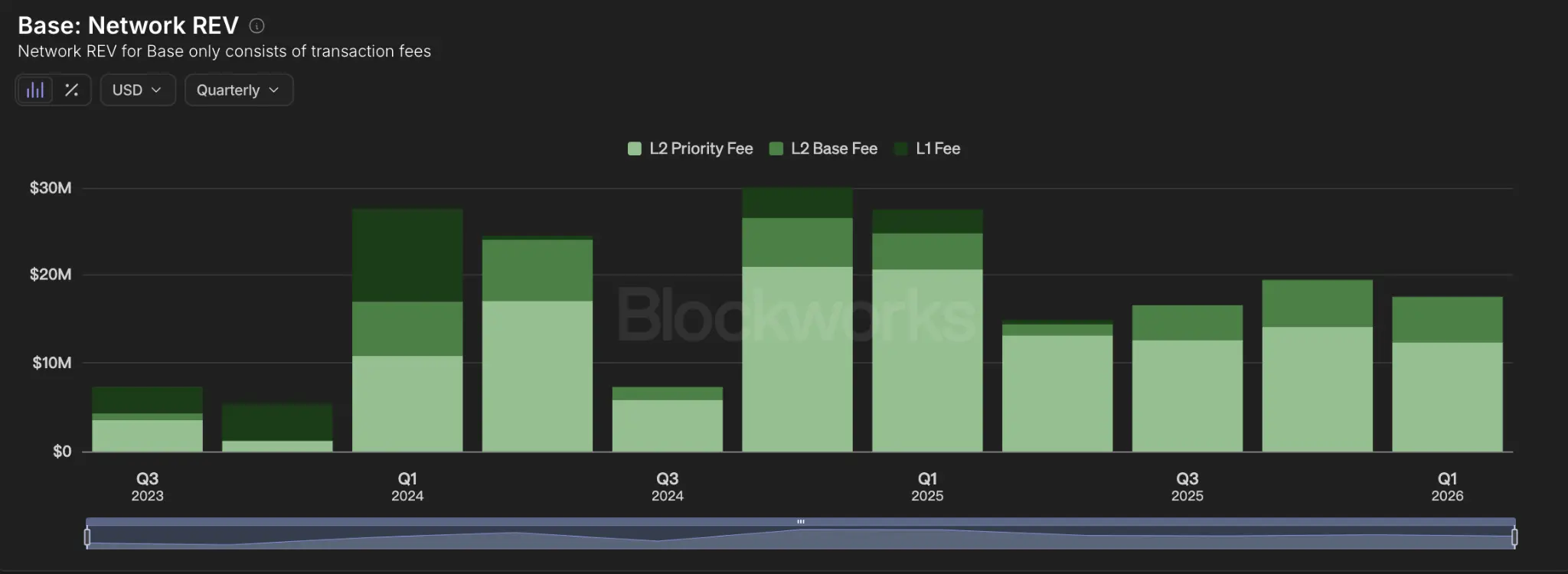
Today, the story of exchange public chains has been told many times. Look at the early examples: Coinbase's Base chain earned over $75 million in sequencer revenue in 2025, capturing nearly 60% of the profits in the entire L2 sequencer market.
Data source: Blockworks
So when we say "the bottom of the ninth," it’s not just a catchy phrase; it’s because this track indeed needs to change the questions being asked. In the earlier rounds, the competition was about who could create a chain and who could attract traffic. Now, simply "creating another chain" is no longer valuable. What truly begins to create a gap is whether a chain can organize assets, transactions, liquidity, and capital efficiency into a market after it is launched.
In other words, the first half of the exchange public chain competition was about building chains, and the second half is about building markets.
Why revisit Ink now?
From this stage, Ink is just starting to become worth revisiting.
On the surface, Ink can easily be categorized as a standard exchange-based L2. Backed by Kraken, it follows the technical narrative of Ethereum Layer 2 and Superchain, featuring points, DeFi, and trading scenarios, and naturally invites comparisons with samples like Base and BSC.
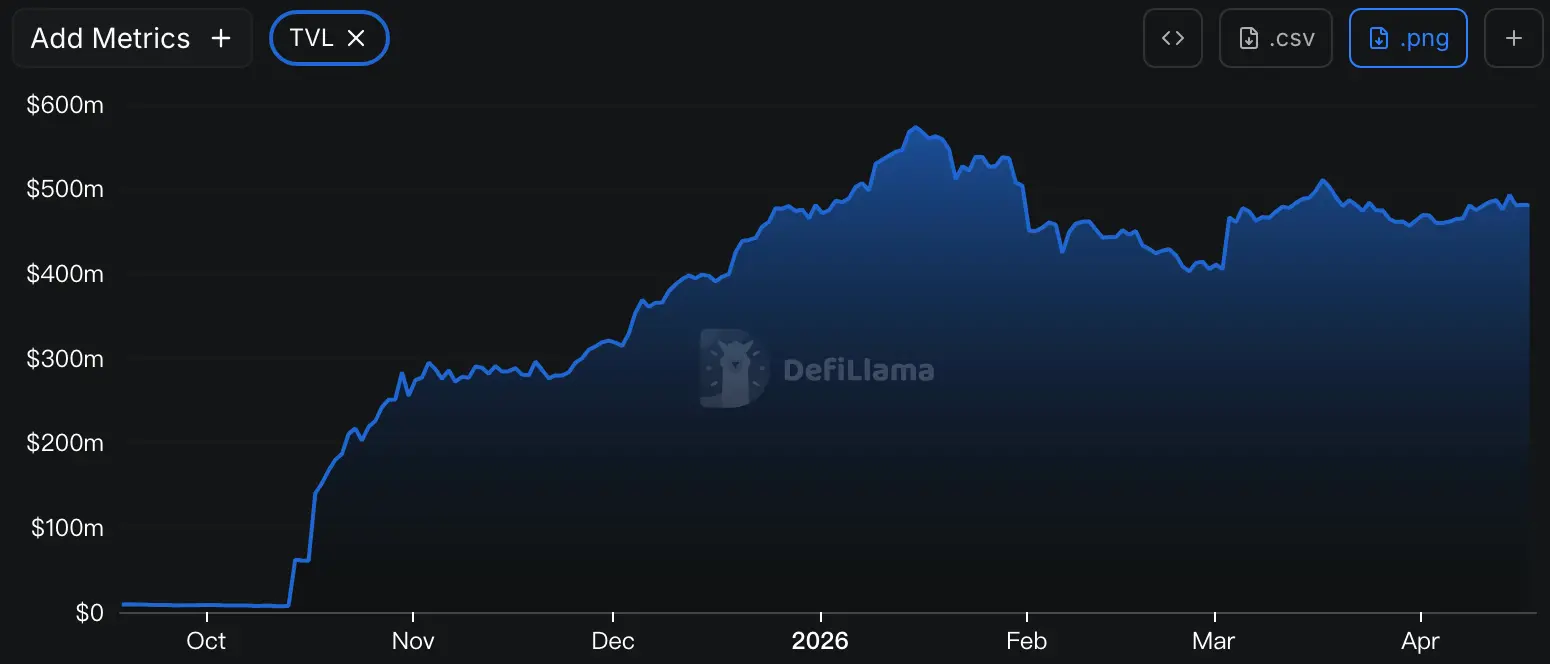
But if it is only understood as "Kraken has also launched a chain," then that’s a fundamental misunderstanding. The data provides the most intuitive feedback: since its low-key launch at the end of 2024, Ink's TVL skyrocketed from $7 million to a peak of $600 million at the beginning of this year, making it one of the fastest-growing networks in the entire Superchain ecosystem.
Data source: DefiLlama
For Kraken, Ink is not merely a brand extension. It is more like Kraken's first attempt to extract its most valuable offline capabilities and reorganize them on-chain: asset entry, trading capabilities, user trust, liquidity organization, and capital efficiency around trading.
The market is not lacking in chains, nor in chains that can issue points. What is truly scarce is a chain that starts with a mature trading platform's asset entry, over 10 million professional users, risk control experience, and brand credit. Many projects have chains first and then add applications. Kraken's approach is reversed. It first asks not "how should the chain be launched," but "which of the most valuable capabilities in the exchange are worth moving to the chain, and can they form a larger market once moved?"
Why is RWA important here?
From this perspective, it becomes easier to understand why RWA appears in Ink's narrative but cannot be the sole protagonist.
In the past two years, the market has told too many stories about "assets on-chain." U.S. Treasury bonds have gone on-chain, fund shares have gone on-chain. But the problem remains unchanged: putting assets on-chain does not equate to forming a market. Many RWA projects address issuance issues, not market issues. Tokenizing assets is just the first step. What truly determines whether they can become on-chain financial assets is whether there are people trading them after they are on-chain and whether there is sufficient liquidity.
If none of this exists, then RWA ultimately becomes just static assets on-chain, not financial assets on-chain. What Kraken is focused on is clearly not just "adding a few more types of assets." It wants to address the most lacking layer after assets go on-chain: the market.
At this point, the underlying logic of layouts like xStocks and Franklin Templeton becomes clear.
Background data shows:
The tokenized stock framework xStocks launched by Kraken's parent company Payward has accumulated a trading volume exceeding $30 billion. Recently, Kraken reached a strategic cooperation with traditional financial giant Franklin Templeton, which manages trillions in assets, planning to deeply integrate the latter's global tokenized money market fund BENJI into the Kraken platform and Ink ecosystem.
This signal means: Kraken wants this chain to carry not just the crypto-native narrative but also to leverage the transfer of tens of billions in traditional assets to capture higher-quality institutional credit.
But having assets alone is not enough.
Nado is not just another DEX
The most valuable aspect of Kraken has never been how many assets it can list, but rather how well it understands how markets are formed. No matter how good the assets are, without real trading and continuous liquidity, it is difficult to turn them into a genuine financial market. This also explains why Nado, the core derivatives protocol in the Ink ecosystem, cannot be simply described as "just another DEX."
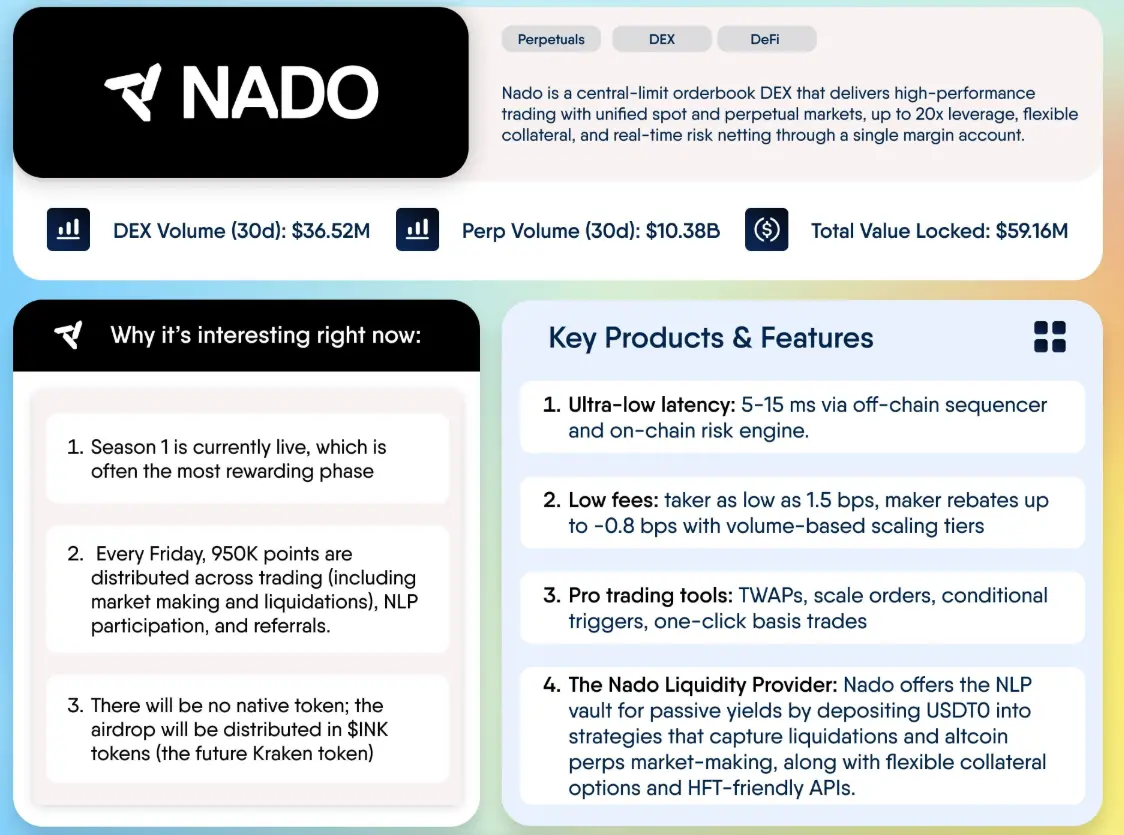
Nado is far from an ordinary AMM Swap; its underlying technology comes from Kraken's targeted cleaning and complete acquisition of the core team and technology of the well-known derivatives protocol Vertex Protocol. As a centralized limit order book (CLOB) DEX deeply incubated by an exchange, Nado perfectly translates the core asset efficiency of CEX:
Relying on a 200ms block time, it achieves extreme execution speeds of 5ms - 15ms at CEX levels;
Introduces a unified margin concept and an on-chain risk control engine.
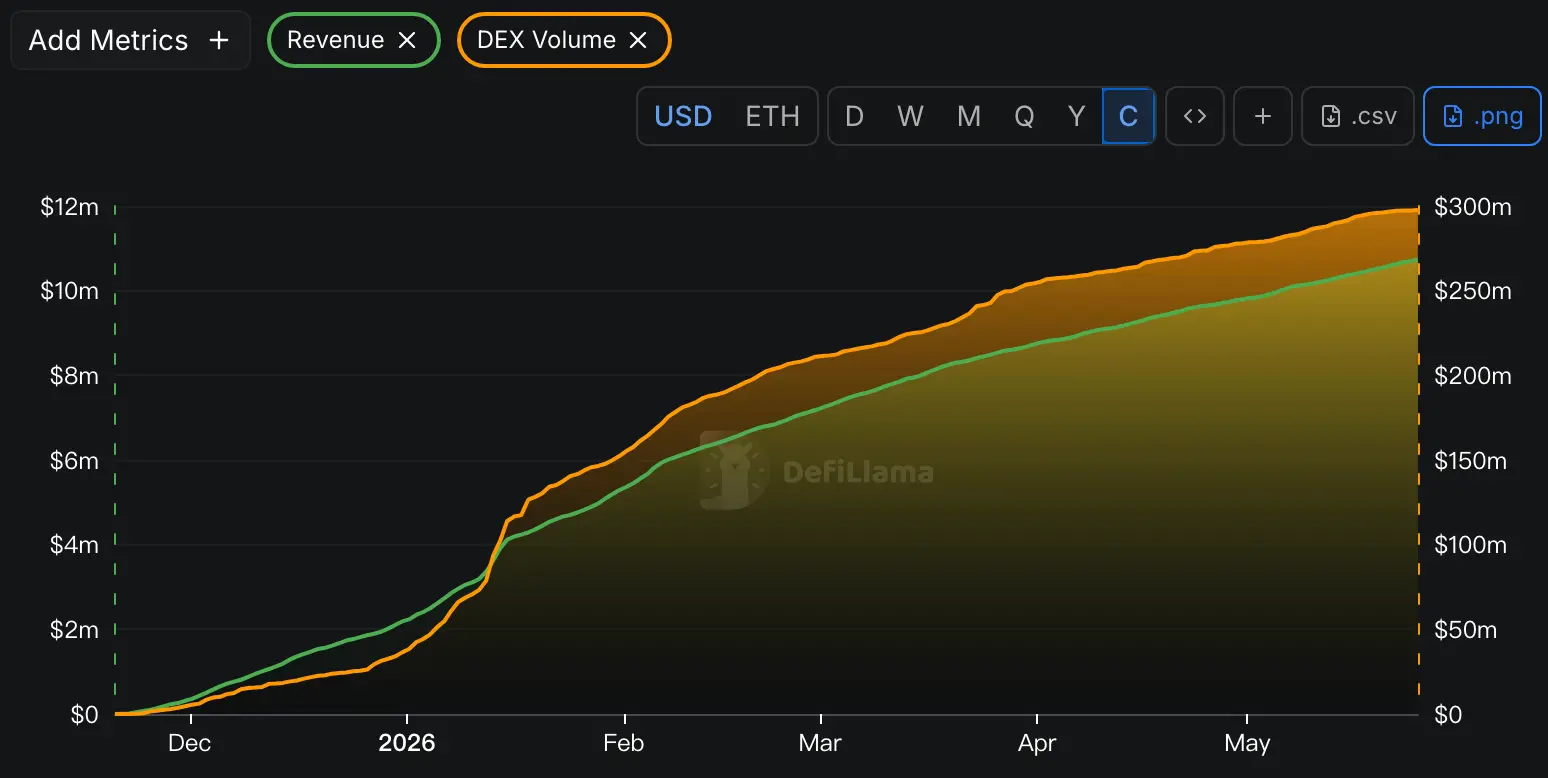
In the recently concluded Private Alpha phase and the first season, Nado achieved over $48 billion in accumulated trading volume in less than half a year, generating over $11 million in protocol fee revenue, with perpetual contract trading volume once exceeding $17 billion in a single month.
Data source: DefiLlama
With Nado officially canceling its invitation system and fully opening the second season on May 21, its points pool size is directly linked to platform trading volume, and it announced that it will gradually support using RWA assets (such as Treasury bonds, tokenized stocks) directly as trading margins.
The recent advancement of xStocks has pushed this clue forward a step. Tokenized U.S. stocks are no longer just holdings on-chain but can now be used as trading margins called by Nado. Users can retain exposure to U.S. stocks like SPYx and QQQx while also participating in other market trades with the same assets.
The improvement in capital efficiency comes from here: the same asset no longer serves just one market but can be reused across multiple trading scenarios.
This is the real value of a 24/7 RWA market: it’s not about assets "staying on-chain" all the time, but about their continuous participation in trading, collateralization, pricing, and risk expression. Once RWA transforms from static assets into callable capital, what Ink wants to convey is not just about assets going on-chain, but about assets, transactions, and capital efficiency beginning to close the loop in the same on-chain environment.
Once RWA can truly be continuously called as trading margins, Ink's positioning will be completely different.
It will no longer just be a chain that allows assets to "stay on it," but an environment where assets can start to flow, be priced, collateralized, and earn returns. Coupled with Tydro, another core lending layer incubated by Aave v3 on the Ink chain, Ink truly connects the capital efficiency closed loop of "trading - lending - re-collateralization."
How should Ink be understood?
Kraken is not starting from scratch to create a story. It already has users, trading venues, understands risks, and has been managing liquidity. The value of Ink is to provide Kraken with an on-chain execution environment, allowing it to gradually spill over what was originally done in the exchange onto the chain.
This is also why points in Ink are not entirely the same as ordinary airdrop projects. If points are merely for short-term TVL boosts, then they are not particularly remarkable. But if the role of points is to gradually embed user behavior, capital retention, and trading habits into the on-chain environment led by Kraken, then it is not just a marketing move but more like Kraken is making an early cold start for this on-chain financial structure.
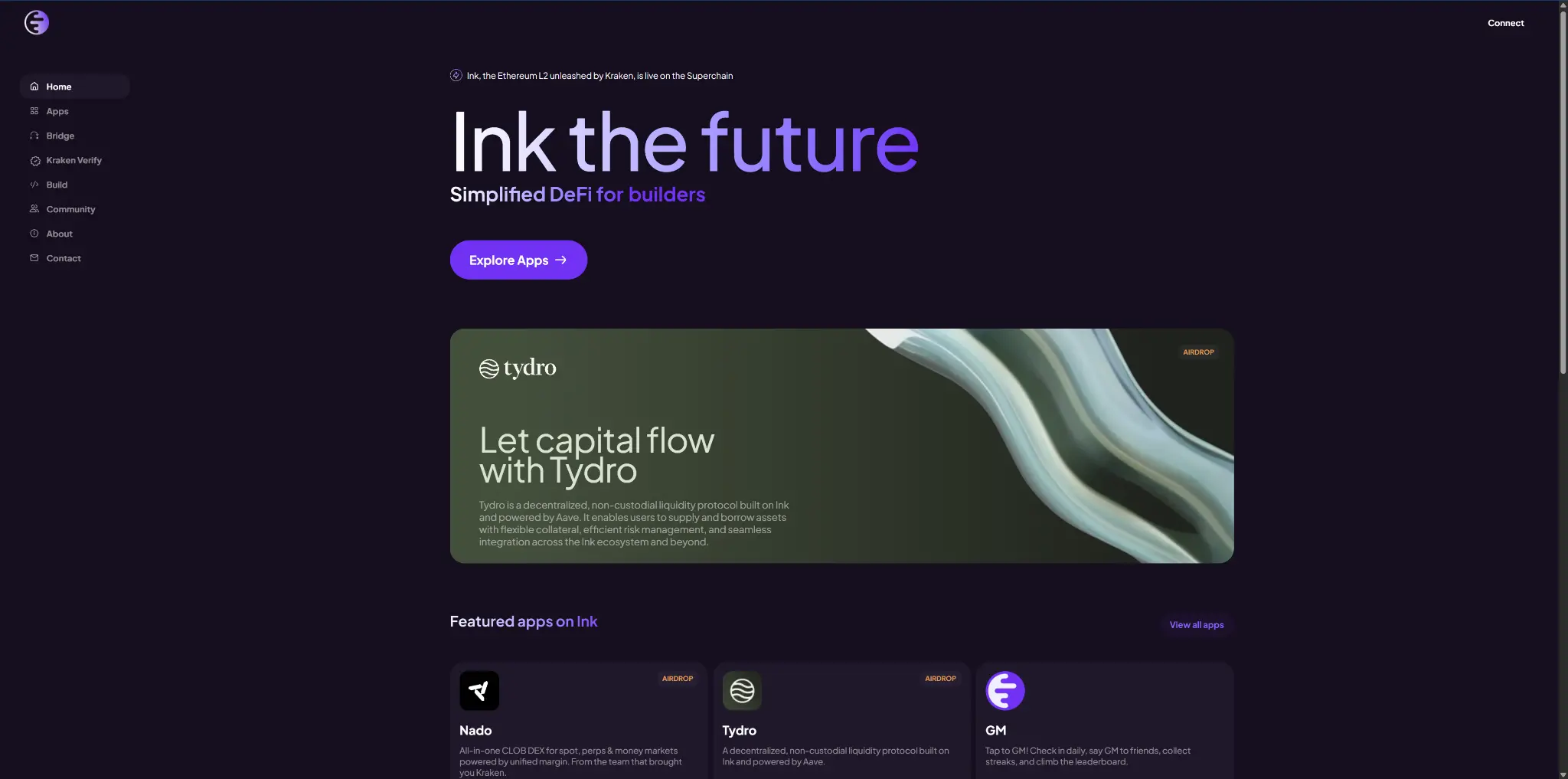
So, how should Ink truly be understood?
It is not "Kraken has also created a chain."
It is not "just another pure RWA concept project."
It is certainly not "the next place to simply chase airdrops."
A more accurate statement is: Kraken is attempting to place its strongest capabilities—asset entry, trading ability, capital efficiency—into the same on-chain environment. Ink is this environment, Nado is the execution layer, Tydro is the liquidity layer, and RWA is the asset direction that can most easily amplify this structure.
xStocks and Franklin Templeton complement the asset side; Nado complements the trading side; Ink handles settlement, retention, and on-chain sequencer revenue; and Kraken itself provides the credit, users, and market organization capabilities behind all of this.
This is why, as we enter the second half of the exchange public chain, Kraken deserves to be looked at separately. Other exchanges also have chains, DeFi, and points; but what Ink's structure truly wants to prove is not "I have it too," but "can I really create a trillion-dollar compliant financial market on-chain?"
For ordinary retail investors and research institutions, the key indicators to watch in the upcoming bottom of the ninth are only a few specific metrics:
Changes in asset structure: Can the RWA assets introduced by Kraken (such as BENJI) truly be converted into underlying margins for protocols like Nado in the second season, achieving secondary liquidity for the assets?
Real retention of trading flow: After Nado opens public testing and launches trading competitions, can its daily active users and trading volume break free from dependence on $INK airdrop expectations and cultivate the stickiness of professional traders?
Capital retention rate: Is the nearly $200 million in funds on Tydro waiting for an airdrop snapshot, or is it beginning to derive more stable collateralization, yield generation, and on-chain secondary utilization?
Because ultimately, whether Ink deserves to be revalued will not be judged by how similar it is to any L2, but whether Kraken can truly use it to stitch together assets, transactions, and capital efficiency into a genuinely liquid financial market.
 Risk warning