BTC $82,792.00 +0.55%
ETH $2,488.13 -1.47%
BNB $738.34 -2.48%
XRP $1.38 -1.49%
SOL $109.71 -2.43%
TRX $0.3320 -0.69%
DOGE $0.0844 -3.12%
ADA $0.2369 -4.51%
BCH $273.16 -7.87%
LINK $12.78 -1.68%
HYPE $85.03 -1.18%
AAVE $167.87 -1.63%
SUI $1.05 -4.27%
XLM $0.1923 -2.90%
ZEC $1,210.51 -0.12%
AAPL $333.33 -1.20%
AMZN $258.68 -0.15%
GOOGL $352.36 +0.13%
MSFT $530.25 -0.28%
META $719.67 -0.30%
NVDA $231.25 -1.93%
TSLA $384.88 +3.27%
SNDK $1,616.15 -1.87%
INTC $105.78 -3.93%
SPCX $163.04 -1.50%
MU $1,036.53 -2.92%
AMD $613.95 -4.01%

dsa

All
Article
Flash

Vitalik Buterin: AI may weaken cryptography within two years and put ECDSA at risk, suggesting a priority on hash cryptography

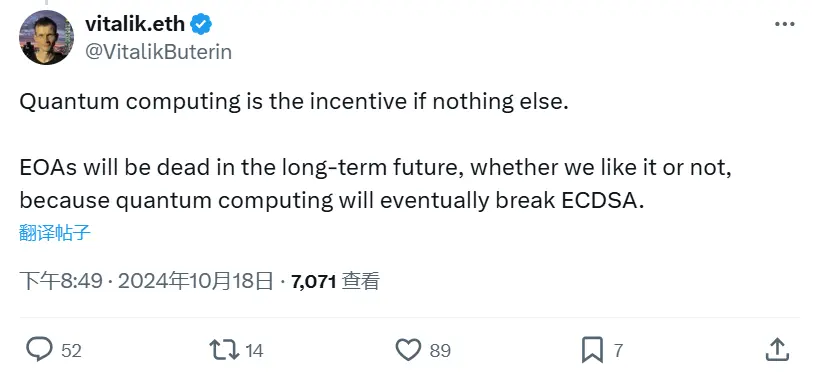
Ethereum co-founder Vitalik Buterin posted on the X platform, stating that AI-accelerated mathematical research may pose new security threats to existing cryptographic systems, especially lattice-based cryptographic schemes, including ML-DSA and fully homomorphic encryption (FHE). He believes that advancements in AI in the field of mathematics over the next two years could significantly undermine the practical security of lattice cryptography, and ECDSA may face the risk of being compromised sooner than expected.Vitalik pointed out that over the past year, the Ethereum Lean roadmap has gradually shifted towards pure hash cryptographic schemes, avoiding the use of lattice-based signatures and related zero-knowledge proof structures. He suggested prioritizing the use of hash cryptography whenever feasible and adopting more conservative security parameters for lattice cryptography; privacy protocols should avoid storing encrypted information directly on-chain, and multi-signature wallets should prioritize off-chain signature confirmations. Additionally, Vitalik advised users, when operationally convenient, to store funds in addresses that have not initiated transactions to reduce potential risks, but he does not recommend users immediately migrate assets on a large scale. He emphasized that the migration process itself also carries risks, and his own losses due to migration errors have even exceeded the losses from past hacking attacks.

BSC releases a report on quantum-resistant cryptography migration: transaction signatures have switched to ML-DSA-44, TPS testing has decreased by about 40%-50%

On May 14, BNB Chain released the "BSC Post-Quantum Cryptography Migration Report," stating that it has completed the migration testing for quantum-resistant cryptography for transaction signatures and the consensus layer, using the NIST standardized post-quantum signature algorithm ML-DSA-44 (Dilithium) and the pqSTARK aggregation scheme.The report shows that BSC has replaced transaction signatures from ECDSA to ML-DSA-44 and switched consensus voting aggregation from BLS12-381 to pqSTARK to address the potential threats posed by future quantum computing to the existing elliptic curve cryptography system. However, post-quantum signatures also significantly increase the on-chain data volume: the size of a single transaction has increased from about 110 bytes to approximately 2.5KB; the block size in a 2000 TPS scenario has increased from about 130KB to around 2MB; and the TPS in the testing environment has decreased by about 40%-50%.BSC stated that the current network bottleneck mainly comes from the larger transaction data propagation, rather than the consensus protocol itself. Meanwhile, the consensus layer aggregation still maintains high efficiency, with pqSTARK achieving a signature compression ratio of about 43:1, and the additional burden on validators remains within a controllable range. The report concludes that existing technology can achieve "quantum-resistant" deployment for blockchain, but future issues related to network bandwidth and data scalability still need to be addressed.
app_icon
ChainCatcher Building the Web3 world with innovations.